Can AI Replace Software Developers? Experts Share Their Predictions
By DAYO ADESULU
Can AI replace software developers? Experts share their predictions. For decades, software development has been regarded as one of the most secure professions in the digital economy.
That assumption is now being tested.
Generative AI can write code, explain unfamiliar programming languages, generate tests, identify bugs, refactor applications and increasingly operate as an autonomous coding agent. In some environments, AI systems can take a high-level instruction and work through multiple steps that previously required a software engineer.
Yet the evidence from developers themselves tells a more complicated story.
The question is no longer simply whether AI can write code. It clearly can.
The more important question is whether AI can take responsibility for everything involved in building reliable software—from understanding what users actually need to designing architecture, making trade-offs, securing systems, testing edge cases, maintaining production applications and accepting accountability when something goes wrong.
Current research suggests the answer is not yet.
According to Stack Overflow’s 2025 Developer Survey, 84% of developers were using or planning to use AI tools in their development process, while 51% of professional developers were using them daily. Yet 46% said they actively distrusted AI output accuracy, compared with only 33% who trusted it.
So, can AI replace software developers?
The emerging answer is more nuanced: AI is likely to replace some software-development tasks, transform the developer’s job and reduce demand for certain types of coding work—but completely replacing software engineers remains a much harder problem. How Generative AI Is Transforming Journalism and Digital
AI Has Already Changed How Software Is Built
Software development has never been purely about typing code.
Developers spend time understanding requirements, searching documentation, designing systems, reviewing code, testing applications, debugging problems, communicating with colleagues and maintaining software after deployment.
AI is now entering almost every part of that workflow.
A developer can ask an AI coding assistant to:
- Generate functions
- Write unit tests
- Explain legacy code
- Convert code between languages
- Find potential bugs
- Generate documentation
- Build application components
- Suggest database structures
- Review pull requests
- Debug errors
- Create prototypes
- Refactor existing code
This is why the debate has moved beyond the old idea of an AI “autocomplete” tool.
The industry is moving toward AI coding agents capable of performing sequences of tasks with considerably less human intervention.
Stack Overflow’s 2025 survey found that 31% of respondents were already using AI agents, 17% planned to use them, while 38% had no plans to adopt them. Among those using agents, 69% agreed they had experienced increased productivity.
That adoption curve could accelerate as coding agents become more capable.
Why AI Could Replace Some Developer Tasks
There is a strong economic argument for automation.
Companies do not necessarily need humans to perform repetitive programming tasks if AI can accomplish them faster and cheaply enough.
Routine coding is particularly vulnerable
Tasks such as writing simple database queries, creating basic API endpoints, generating boilerplate code or converting repetitive code patterns are increasingly easy for AI systems.
A developer who previously spent hours writing routine code can now generate a first version in minutes.
That does not mean the developer disappears.
However, the number of people required to perform the same amount of routine coding could decline.
Testing is increasingly automated
AI can also generate test cases, analyze failures and suggest fixes.
As these systems improve, testing could become increasingly automated, although human review remains important for high-risk software.
Documentation can be automated
AI is particularly effective at explaining existing code and generating technical documentation.
That could reduce the amount of time developers spend performing documentation-related work.
Prototyping is becoming dramatically faster
A product manager or entrepreneur with limited programming experience can now describe an application in natural language and receive working code.
This is helping create what is often called vibe coding—building software through natural-language instructions rather than manually writing every line.
But professional software engineering requires much more than producing a functioning prototype.
The Biggest Problem: AI-Generated Code Still Needs Verification
This is where the replacement argument becomes complicated.
AI can produce code that looks convincing while containing subtle errors.
A program may compile successfully and still be insecure, inefficient or fundamentally wrong.
Stack Overflow’s 2025 research found that 66% of developers’ biggest frustration was receiving AI solutions that were “almost right, but not quite,” while 45% said debugging AI-generated code could be more time-consuming.
That distinction is crucial.
Generating code is not the same as engineering software.
A professional developer must ask:
Does the code actually solve the problem?
Is it secure?
Will it scale?
What happens when the user does something unexpected?
Does it comply with regulatory requirements?
Can another engineer maintain it five years from now?
What happens when the AI-generated component interacts with the rest of the system?
Those questions require context and judgment.
Research Shows a Productivity Paradox
The evidence on AI productivity is also more complicated than the marketing claims sometimes suggest.
Google’s DORA research, based on nearly 5,000 technology professionals and more than 100 hours of qualitative research, describes AI as an amplifier rather than an automatic solution to software-development problems.
In March 2026, DORA researchers reported that 90% of technology professionals surveyed were using AI at work and more than 80% believed it had increased their productivity.
However, they also found that AI can accelerate initial code creation while shifting more time toward auditing and verification. Higher AI adoption was associated with increased delivery throughput but also increased delivery instability.
In other words:
AI can make developers faster at producing code without necessarily making the entire software-development process proportionally faster.
That is a critical distinction for technology executives.
When AI Made Experienced Developers Slower
One of the most revealing findings came from METR, which conducted a randomized controlled trial involving experienced open-source developers.
In its early-2025 study, METR found that developers using the AI tools tested took 19% longer to complete the selected tasks than developers working without those tools.
The result surprised many observers because developers themselves often expected AI to make them faster.
METR emphasized that the study was a snapshot of early-2025 tools and that AI capabilities were evolving rapidly.
The finding nevertheless demonstrates why simplistic claims about AI replacing developers can be misleading.
AI capability on benchmarks does not automatically translate into productivity in complex real-world software repositories.
A developer working on a large production system has to understand existing architecture, dependencies, undocumented behavior and historical decisions.
That context can be difficult for an AI system to reconstruct.
But AI Is Becoming Much Better at Software Engineering
The argument should not swing too far in the opposite direction.
AI capabilities are advancing rapidly.
Anthropic’s 2026 Economic Index found that software development remains one of the most prominent uses of Claude. In its March 2026 analysis, computer and mathematical tasks accounted for 35% of conversations on Claude.ai, while coding activity was also increasingly moving into Claude Code and API-based workflows.
Anthropic’s June 2026 research also found that people expect AI capabilities to expand significantly over the next year.
More than one-third of respondents expected AI to be capable of doing most or nearly all of their work tasks within 12 months.
That does not prove software developers will disappear.
But it does demonstrate how quickly the boundary between human and machine work is moving.
The Software Developer May Become an AI Supervisor
One possible future is not developer versus AI.
It is developer plus AI agents.
Instead of writing every function manually, a software engineer could increasingly become responsible for directing a collection of AI systems.
The workflow might look like this:
Human defines objective → AI designs solution → AI writes code → AI runs tests → AI reviews code → Human validates → AI deploys → AI monitors
In this model, the human developer becomes an architect, reviewer and decision-maker.
This is already influencing how technology leaders think about engineering teams.
A recent World Economic Forum analysis argued that software developers are becoming an early example of an AI-native workforce, with developers increasingly reshaping their roles around AI rather than simply being displaced by it.
That transition could be one of the most important changes in the profession.
The Skills That Could Become More Valuable
If AI becomes better at writing code, some traditional programming skills may become less differentiating.
But other skills could become more valuable.
System Architecture
Someone still needs to determine how different components should interact.
AI can suggest architectures, but organizations need humans who understand the business, technical and operational consequences of those decisions.
Product Thinking
The hardest question is often not:
“How do we build it?”
It is:
“Should we build it at all?”
Understanding customers and identifying the right problem may become more valuable as AI makes implementation cheaper.
Security
AI-generated code can introduce vulnerabilities.
Security expertise will therefore remain essential, particularly in banking, healthcare, government, defence and critical infrastructure.
Code Review and Verification
As AI produces more code, organizations will need more effective systems for checking that code.
Interestingly, the growing AI-generated code market is creating demand for companies specializing in AI-assisted code review. Reuters reported in August 2026 that CodeRabbit reached a $1.5 billion valuation after raising $143 million, highlighting demand for systems that monitor and review AI-generated software.
That is an important market signal.
If AI replaces some coding, it may simultaneously create a larger market for AI verification.
Junior Developers Could Face the Biggest Disruption
One of the most difficult consequences could involve entry-level software engineers.
Historically, junior developers learned by performing relatively simple tasks.
They fixed small bugs.
They wrote straightforward features.
They updated documentation.
They created tests.
They gradually progressed toward complex responsibilities.
AI can now perform many of those beginner-level tasks.
That creates a potential career-development problem.
If companies need fewer junior developers, where will tomorrow’s senior engineers come from?
This issue deserves serious attention from universities, technology companies and governments.
At the same time, the World Economic Forum continues to list software and applications developers among the fastest-growing job categories through 2030. Its 2025 report projects 170 million new jobs globally against 92 million displaced jobs across all sectors, producing a net increase of 78 million. Poverty and Artificial Intelligence in Developing Nations: Yabatech Don Calls for Urgent Action – The Cheer News
So the evidence does not currently support the conclusion that software development as a profession is simply disappearing.
Instead, the profession is changing.
AI May Expand the Number of People Who Can Build Software
There is another side to the disruption.
AI lowers the technical barrier to software creation.
A small business owner can describe an internal application.
A researcher can build a data-analysis tool.
A journalist can create a database interface.
A teacher can develop an educational application.
An entrepreneur can prototype a product without hiring a large engineering team immediately.
This could expand the software economy.
The number of people capable of creating software may increase dramatically, even if the traditional definition of “software developer” changes.
That is similar to what happened with desktop publishing, website builders and cloud computing.
Technology did not eliminate publishing, websites or software.
It changed who could create them.
What Happens to Software Companies?
The corporate implications are enormous.
If AI enables one engineer to accomplish what previously required several people, companies could reduce engineering costs.
But there is another possibility.
Companies may use the productivity gains to build more software.
Instead of employing fewer developers, they could maintain similar teams while dramatically increasing the number of products, features and experiments they can deliver.
This is known as the productivity expansion effect.
The final outcome will depend on demand.
If software demand grows faster than AI reduces the need for human labor, developer employment could continue growing.
If AI capability expands faster than software demand, employment pressure could become much stronger.
Experts Are Pointing Toward a Hybrid Future
The emerging consensus is not that humans will remain responsible for every line of code forever.
Nor is it that AI will simply eliminate software engineering.
The more plausible scenario is a gradual transition.
Short term: AI assistants
Developers use AI for coding, testing, documentation and debugging.
Medium term: AI agents
Developers delegate complete tasks to autonomous coding systems.
Long term: AI-native engineering
Humans define objectives and constraints while AI systems perform much of the implementation, testing and maintenance.
At every stage, human oversight remains important where the cost of failure is high.
What Could Make Full Developer Replacement Possible?
For AI to truly replace most software developers, several difficult problems would need to be solved.
1. Reliable long-horizon reasoning
AI would need to manage complex projects over weeks or months without losing context.
2. Deep understanding of business requirements
Software is built for people and organizations, not simply programming languages.
3. Autonomous debugging
AI would need to diagnose failures across complicated production environments.
4. Security assurance
It would need to reliably identify vulnerabilities in its own work.
5. Architectural judgment
AI would need to make long-term technical decisions involving cost, scalability and maintainability.
6. Accountability
Someone must ultimately be responsible when software causes financial, legal or physical harm.
These challenges explain why complete replacement remains much harder than automated code generation.
What Developers Should Do Now
The safest strategy for software engineers is not to compete with AI at the tasks AI performs best.
Instead, developers should learn to work with it.
Learn AI-assisted development
Become comfortable with coding agents, AI-powered IDEs and model-assisted debugging.
Strengthen fundamentals
Programming fundamentals, algorithms, databases, networking and systems architecture remain valuable because developers need to understand what AI is producing.
Develop verification skills
Learn testing, security analysis, code review and observability.
Understand your industry
A developer who understands healthcare, finance, cybersecurity, manufacturing or another sector can provide value beyond raw coding ability.
Develop communication skills
As implementation becomes cheaper, communicating requirements and making technical decisions become increasingly important.
What This Means for Africa and Nigeria
The AI transformation could be particularly significant for Africa.
African countries have large populations of young people entering the digital economy.
AI-assisted development could allow smaller teams to build products for local and international markets with fewer resources.
A Nigerian developer, for example, could use AI to accelerate development of fintech, education, healthcare, agricultural or logistics applications.
However, there is a danger if AI tools reduce opportunities for junior developers before local technology ecosystems have developed enough experienced engineers.
That makes AI education and workforce reskilling especially important.
Africa should not simply train people to write code.
It should train people to design, verify, secure, manage and deploy AI-assisted software systems.
That distinction could determine whether AI becomes a job creator or a barrier to entry.
Why This Matters
The question “Can AI replace software developers?” is ultimately the wrong question if it is treated as a simple yes-or-no debate.
The more important question is:
Which parts of software development will AI replace, which will it augment, and which will become more valuable because of AI?
The evidence is already pointing toward a major transformation.
Developers are using AI at unprecedented levels.
AI agents are taking on increasingly complex coding tasks.
Companies are investing heavily in automated software engineering.
Yet developers continue to distrust AI output and rely on human judgment.
The World Economic Forum still identifies software and applications developers among the fastest-growing job categories through 2030, while DORA describes AI as an amplifier of organizational strengths and weaknesses rather than a magic productivity button.
The future therefore looks less like “AI eliminates programmers” and more like “AI changes what being a programmer means.”
The developers who thrive may be those who can combine technical fundamentals with AI orchestration, product thinking, security, architecture and human judgment.
Frequently Asked Questions
Will AI completely replace software developers?
Probably not in the immediate future. AI is rapidly automating coding tasks, but software engineering involves requirements analysis, architecture, security, testing, maintenance and accountability.
Will AI reduce the number of software developers companies need?
It could reduce demand for some routine development tasks and potentially change team structures. However, cheaper software creation could also increase demand for new applications and digital products.
Are AI coding tools reliable?
They can be highly useful, but reliability varies. Stack Overflow’s 2025 survey found that 46% of developers distrusted AI output accuracy, compared with 33% who trusted it.
Will junior developers be affected more than senior developers?
Potentially. Entry-level tasks are often easier to automate, which could make traditional pathways into software engineering more difficult. However, companies will still need experienced people capable of architecture, verification and AI supervision.
Should developers learn AI?
Yes. AI-assisted software development is becoming a core professional skill. Developers should learn how to use AI tools while strengthening programming fundamentals, security, testing and system-design skills.
What will software developers do if AI writes most of the code?
They could increasingly focus on architecture, product requirements, system integration, security, verification, AI-agent orchestration, performance and strategic technical decisions.
Conclusion
AI is already replacing pieces of software development.
It writes code.
It generates tests.
It explains documentation.
It finds bugs.
It creates prototypes.
And increasingly, AI agents can execute multi-step development tasks.
But replacing the entire software developer is a much bigger challenge.
Software engineering is not simply the production of code. It is the process of turning human requirements into reliable systems that operate safely in the real world.
That requires judgment.
It requires context.
It requires responsibility.
And it requires people who can decide when the machine is wrong.
The most likely future is therefore not a world without software developers.
It is a world where fewer people may manually write more code, while highly skilled engineers use AI to build significantly more sophisticated systems.
The developer of the future may spend less time typing code and more time thinking, designing, directing, testing and verifying machines that write it.
That is not the end of software engineering.
It may be the beginning of software engineering’s most significant transformation yet.
SEO Information
SEO Title:
Can AI Replace Software Developers? Experts Share Their Predictions
Focus Keyphrase:
Can AI replace software developers
Meta Description:
Can AI replace software developers? Explore expert predictions, developer research, AI coding agents, productivity gains, risks and the future of software engineering.
URL Slug:can-ai-replace-software-developers
Relevant Keywords:
AI software developers, can AI replace software developers, AI coding, AI coding agents, future of software development, artificial intelligence programmers, AI developer jobs, generative AI coding, software engineering AI, AI programming tools, coding agents, future of developers, AI and employment, software developers 2030, AI productivity
Suggested Feature Image
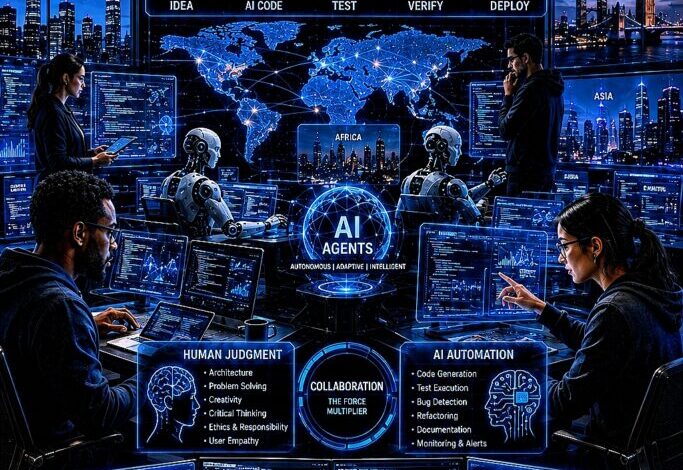
A premium cinematic 4:5 technology-news scene showing professional software engineers collaborating with sophisticated autonomous AI coding agents inside a futuristic development laboratory. Show human developers reviewing holographic code, system architecture and security dashboards while AI agents independently generate code, run tests, debug applications, monitor production systems and deploy software. Include a large central holographic workflow reading “IDEA → AI CODE → TEST → VERIFY → DEPLOY,” with a subtle visual contrast between “HUMAN JUDGMENT” and “AI AUTOMATION.” Add global digital elements representing software development hubs across North America, Europe, Asia and Africa. Use a sophisticated blue-and-black technology-news aesthetic with controlled red highlights. Emphasize human-AI collaboration rather than portraying AI as simply replacing programmers. Include the TCNEWS logo in bold red at the bottom-right corner.
Suggested Infographic
Title: “CAN AI REPLACE SOFTWARE DEVELOPERS?”
Create a professional infographic showing the evolution:
CODING ASSISTANT → AI COPILOT → AI CODING AGENT → AUTONOMOUS SOFTWARE ENGINEERING
Include three evidence panels:
84% — developers using or planning to use AI tools
51% — professional developers using AI tools daily
46% — developers who distrust AI output accuracy
Use the 2025 Stack Overflow Developer Survey as the source.
Add a second section:
WHAT AI DOES WELL
- Code generation
- Testing
- Documentation
- Debugging assistance
- Refactoring
- Prototyping
WHAT HUMANS STILL PROVIDE
- Product judgment
- Architecture
- Accountability
- Context
- Security decisions
- Ethical judgment
- Long-term maintenance
End with:
THE FUTURE: DEVELOPERS + AI AGENTS
Use a sophisticated blue-and-black global technology-news aesthetic with controlled red highlights and TCNEWS in bold red at the bottom-right corner.
Social Media Captions
🚨🤖 CAN AI REALLY REPLACE SOFTWARE DEVELOPERS?
AI can now write code, generate tests, find bugs, explain complex programs and increasingly operate as an autonomous coding agent.
But here’s the surprising part:
Many developers still don’t trust AI enough to let it work completely alone.
Stack Overflow’s global 2025 Developer Survey found that 84% of developers use or plan to use AI tools, yet 46% actively distrust the accuracy of AI-generated output.
Meanwhile, the World Economic Forum still lists software and applications developers among the fastest-growing job categories through 2030.
So what is really happening?
👉 AI may not eliminate developers.
👉 It may eliminate parts of the developer’s job.
👉 And the developer who knows how to direct, test and verify AI could become far more valuable.
🔥 Will AI eventually replace programmers—or create a new generation of AI-powered software engineers?
Read the full analysis.
What do YOU think?
X
🤖💻 Can AI replace software developers?
AI can already write, test, debug and explain code.
But developers still distrust much of its output.
The future may not be:
Humans OR AI
It may be:
Developers + AI agents
The biggest skill could become knowing what the machine gets wrong.
#AI #SoftwareDevelopment #Coding #ArtificialIntelligence #Tech2026
The future of software engineering is changing rapidly.
AI coding tools are already being used across development workflows, while autonomous coding agents are beginning to perform multi-step tasks.
Yet research shows an important paradox: AI adoption is rising while trust in AI-generated code remains limited.
That suggests the developer’s value may increasingly shift from manually writing every line of code toward:
Architecture + product thinking + security + verification + AI orchestration.
The question is no longer simply whether AI can code.
The real question is whether AI can be trusted to engineer software independently.
💻🤖 AI VS SOFTWARE DEVELOPERS?
AI can now:
⚡ Write code
🐛 Find bugs
🧪 Generate tests
📚 Explain programs
🔄 Refactor software
🚀 Build prototypes
🤖 Operate coding agents
But developers still have something AI struggles with:
JUDGMENT.
The future of software engineering may be less about typing every line of code—and more about knowing what should be built, how it should work, whether it is safe and whether the AI got it right.
#AI, #SoftwareDevelopers, #Coding, #ArtificialIntelligence, #AICoding, #FutureOfWork, #TechNews, #SoftwareEngineering, #TCNEWS, #TheCheerNews,