

Dangote Refinery Crude Supply 2025: Nigeria Set to End Crude Imports as Refinery Goes Fully Local

By DAYO ADESULU
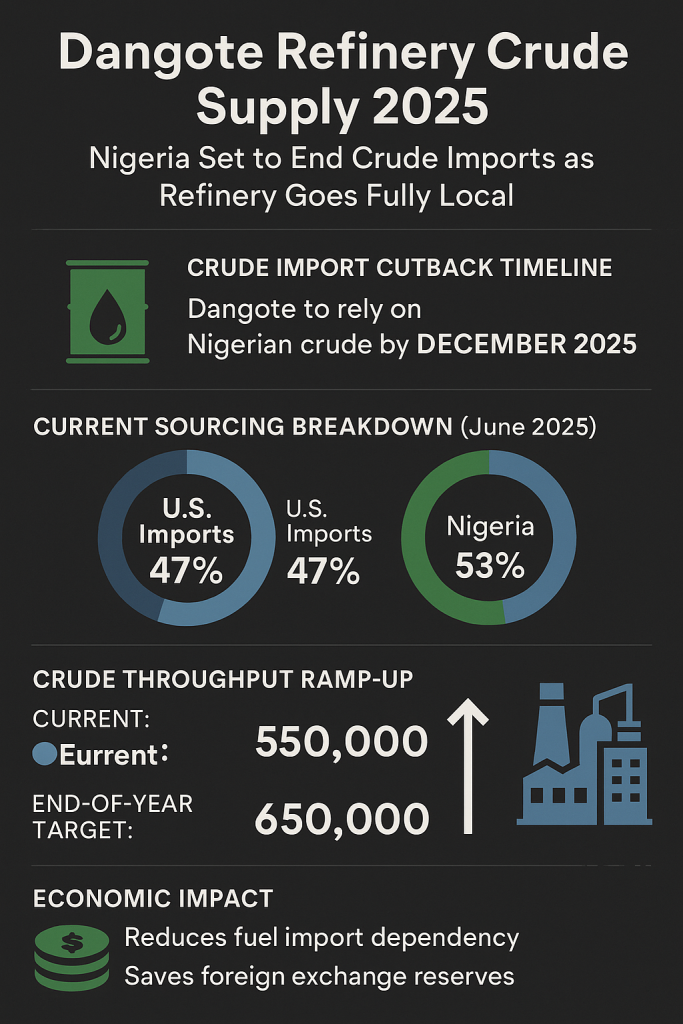
As part of its localization strategy, Dangote Refinery plans to rely fully on Nigerian crude by December 2025. Explore how this shift could transform Dangote refinery crude supply 2025 and reduce fuel import dependence.
Dangote to Rely on Nigerian Crude by December 2025
Nigeria’s $20 billion Dangote Refinery Crude is preparing to cut all foreign crude importation by the end of 2025. The refinery, which has been gradually increasing its processing capacity since its soft launch, will shift to sourcing 100% of its crude feedstock from Nigerian oil producers.
According to Devakumar Edwin, Vice President at Dangote Industries, several long-term contracts with international suppliers are set to expire, making room for domestic suppliers to fill the gap.
- Dangote Refinery Has Enough Petrol to Meet Nigeria’s Needs, Says Aliko Dangote
- https://www.thecheernews.com/again-dangote-refinery-reduces-fuel-price-ex-depot-price-now-n820-per-litre/
“We expect some of the long-term contracts will expire. Personally, and as a company, we expect that before the end of the year, we can transition 100 per cent to local crude,” Edwin said in an interview with Bloomberg.
Current Sourcing: U.S. and African Imports Still in Play
June 2025 Breakdown of Crude Origins
Despite its long-term goal of complete localization, Dangote refinery crude currently source from both international and domestic channels. In June 2025:
- 53% of crude came from Nigerian producers
- 47% came from the United States
Relationship With Global Suppliers
Beyond the U.S., the refinery has also imported crude from Brazil, Ghana, Angola, and Equatorial Guinea. These relationships were vital in the early phase, when local supply chains failed to meet demand due to pipeline vandalism and limited contractual readiness.
Domestic Supply Gains Momentum Amid Regulatory Push
Compliance With Domestic Crude Supply Obligations
The Nigerian Upstream Petroleum Regulatory Commission (NUPRC) has emphasized the Domestic Crude Supply Obligations (DCSO) that require local producers to supply a portion of their output to Nigerian refineries.
Although oil producers initially pushed back, compliance has improved, and the Dangote refinery crude plant now receives more domestic crude than imported barrels.
NNPC July–August Cargo Allocations
According to a cargo list obtained by Bloomberg, Dangote refinery crude is scheduled to receive five crude cargoes each in July and August 2025 from NNPC Limited. Each shipment contains nearly 1 million barrels, boosting the refinery’s local stockpile.
Challenges Hindering Local Crude Supply
Crude Theft and Pipeline Attacks
Recurring incidents of pipeline sabotage and crude oil theft, particularly in the Niger Delta, continue to disrupt supply chains. These risks have made some producers cautious about prioritizing local distribution.
Oil Producers’ Resistance to Local Contracts
Initially, several producers protested NUPRC’s DCSO directive. Concerns centered around pricing, logistics, and contractual bottlenecks. The government has since worked to streamline policy and improve trade transparency.
Plant Operations Update: Ramp-Up to 650,000 bpd
Current Daily Throughput at 550,000 bpd
As of July 2025, the refinery is processing 550,000 barrels per day (bpd)—a near-peak performance. This places it among the largest operating refineries in the world.
Full Capacity Projections by Year-End
The Dangote facility has a nameplate capacity of 650,000 bpd, which it aims to hit by the end of 2025. Achieving this milestone will further reduce Nigeria’s reliance on refined fuel imports.
Economic Implications for Nigeria’s Oil Sector
Reducing Fuel Import Dependency
Dangote’s vision is rooted in cutting the wasteful practice of exporting crude only to re-import refined petroleum at a premium. As the refinery becomes self-sufficient in crude supply, Nigeria will begin saving billions in foreign exchange.
Foreign Exchange Savings and Trade Impact
If fully implemented, local sourcing could free up significant forex currently used for fuel imports. This would strengthen the naira, reduce fuel scarcity, and stabilize domestic fuel pricing.
Stakeholder Engagement and Government Role
Strengthening Relations With Local Traders
Improved communication and contracts between the refinery, local oil traders, and the federal government have created optimism. The ramp-up in local sourcing has been largely enabled by better trade terms and improved trust.
Regulatory Support and Policy Clarity
Support from NUPRC and NNPC has been key to enabling the shift. Clearer policies, reliable cargo scheduling, and pipeline security investments are making local supply more attractive.
Aliko Dangote’s Vision: Ending the Refined Fuel Loop
A $20B Strategy to Transform Nigeria’s Energy Future
Aliko Dangote refinery crude, situated in Lagos, was built with the goal of ending Nigeria’s fuel dependency on Europe and the U.S. By processing locally sourced crude, the project aims to:
- Achieve national energy self-sufficiency
- Reduce environmental and transport costs
- Create local jobs and industrial growth
Conclusion: Dangote Refinery Crude Supply 2025 Could Reshape Nigeria’s Oil Economics
The decision to go 100% local by December 2025 marks a historic shift. It signals the maturity of Nigeria’s downstream sector and provides a roadmap toward sustainable energy independence.
With improved regulation, enhanced local supply, and robust refining capacity, the Dangote refinery crude supply 2025 strategy could reshape Nigeria’s economic and energy landscape for decades.
❓ FAQs on Dangote Refinery and Crude Supply Strategy
1. What is Dangote refinery crude full capacity?
650,000 barrels per day (bpd).
2. When will the refinery stop importing crude?
By December 2025, according to Dangote Industries.
3. Why were oil producers reluctant to supply locally?
Concerns over pricing, contract clarity, and pipeline security.
4. What are the benefits of using Nigerian crude?
Reduces import costs, saves forex, strengthens local industry.
5. How much is Dangote refinery crude currently processing?
About 550,000 bpd as of mid-2025.
6. What is the role of NNPC in crude allocations?
NNPC provides scheduled cargo deliveries and supports domestic refining under DCSO mandates.
#DangoteRefinery, #NigeriaOil, #CrudeSupply2025, #RefineryUpdate, #LocalCrude #NNPC, #OilAndGasNigeria, #EnergySecurity, #DownstreamDevelopment, #MadeInNigeriaFuel,


