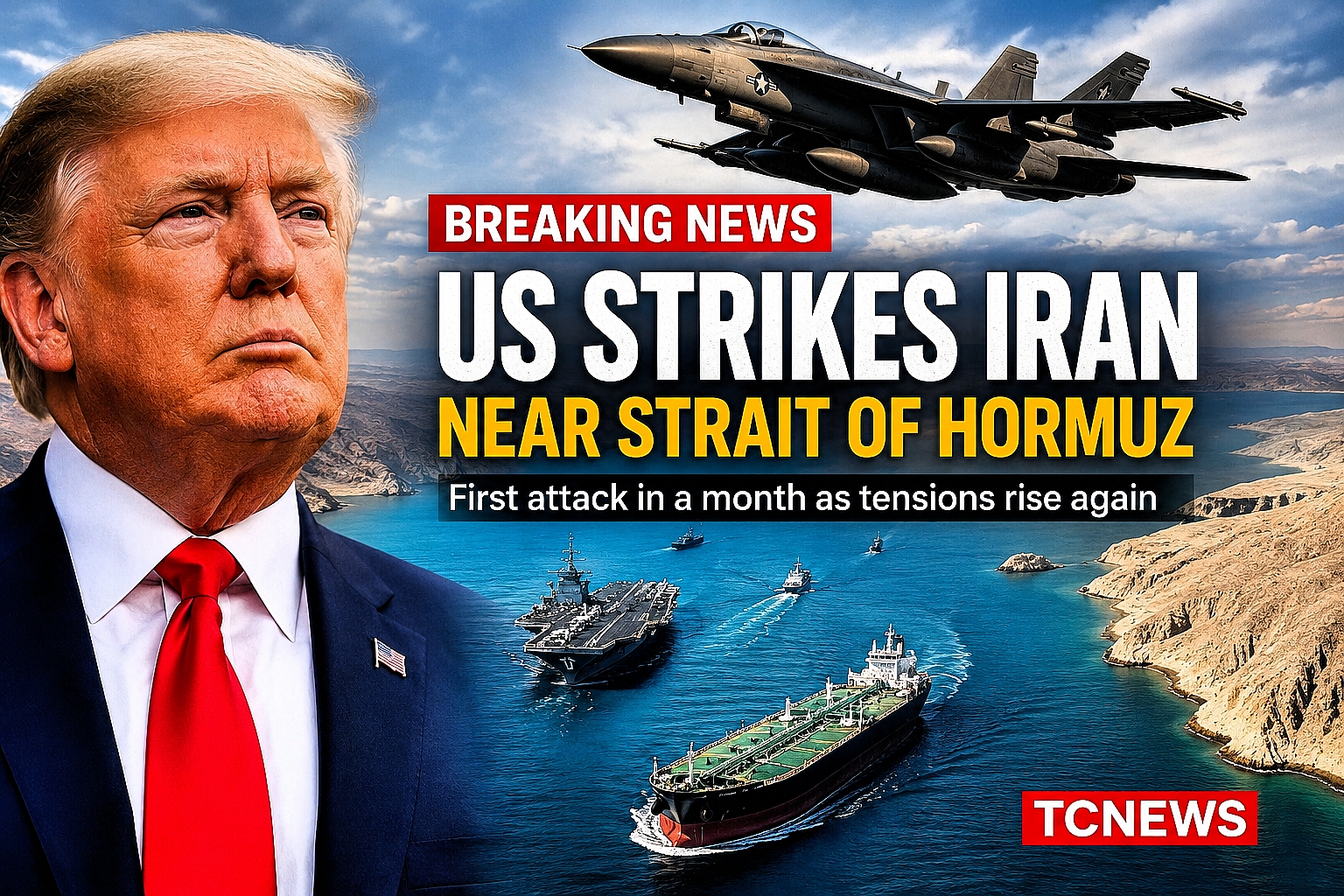
The United States has carried out fresh strikes against Iranian military targets near the strategically important Strait of Hormuz, marking the first reported US attack on Iran since late July and raising fresh concerns over the fragile calm surrounding the six-month-old conflict.
The US Central Command (CENTCOM) said on Sunday that American forces struck two Iranian rocket launchers on Larak Island, located in the Strait of Hormuz.
According to CENTCOM spokesman Captain Tim Hawkins, the Iranian Revolutionary Guards had been observed preparing to launch rockets equipped with sea mines into the strategic waterway.
The development comes at a sensitive moment in the conflict. Although the intensity of fighting has fallen significantly since an April ceasefire, tensions remain high around the Strait of Hormuz, one of the world’s most important energy routes.
US Confirms Strikes on Iranian Launchers
CENTCOM said the strikes targeted two Iranian launchers on Larak Island after US forces detected preparations for an attack involving rockets and sea mines.
“Earlier today, US forces struck two Iranian launchers on Larak Island,” a CENTCOM spokesman said.
The military action represents the first publicly reported US strike on Iranian territory since late July.
The renewed attack also signals that Washington remains prepared to use military force despite its recent emphasis on economic pressure against Tehran.
For several weeks, the administration of President Donald Trump has reportedly focused more heavily on what it describes as “economic warfare” against Iran, including measures aimed at restricting Iranian fuel supplies and putting pressure on the country’s economy.
However, the alleged preparations to deploy sea mines appear to have prompted an immediate military response.
Strait of Hormuz Remains at the Centre of the Conflict
The Strait of Hormuz has become one of the most sensitive flashpoints in the US-Iran confrontation.
The narrow waterway connects the Persian Gulf with the Gulf of Oman and is a critical route for global energy supplies. Before the latest hostilities, roughly one-fifth of the world’s oil supply passed through the strait.
Iran has effectively restricted shipping through the waterway during the conflict, creating concerns about energy supplies, international trade and global oil prices.
The United States has consequently maintained a strong naval presence in the area while attempting to keep international shipping routes open.
Captain Hawkins said US forces recently completed operations to clear sea mines from international shipping routes in the strait.
“Last week, CENTCOM completed clearing sea mines from the strait’s international shipping routes,” Hawkins said.
He added that American forces were continuing to closely monitor the area and remained prepared to protect commercial shipping.
US-Iran Conflict Enters Sixth Month
The latest US strikes came shortly after the conflict reached the six-month mark.
The war began with US and Israeli airstrikes against Iran on February 28. The fighting subsequently expanded into a broader confrontation involving missile attacks, military operations and disruptions around the Strait of Hormuz.
A ceasefire reached in April helped bring an end to the most intense phase of the fighting.
In June, the two sides also signed a memorandum of understanding intended to provide a framework for a final peace agreement.
However, months later, a comprehensive settlement has yet to emerge.
Instead, sporadic attacks have continued, particularly around the strategic maritime corridor.
Diplomatic Efforts Face Fresh Challenges
Several countries have attempted to mediate between Washington and Tehran.
Pakistan and Qatar have played prominent roles in diplomatic efforts aimed at securing a permanent end to the conflict.
Despite those initiatives, negotiations have failed to produce a final peace agreement.
The latest US military action could further complicate those diplomatic efforts, particularly if Iran responds with attacks against American forces or attempts to further restrict shipping through the Strait of Hormuz.
At the same time, Washington has intensified economic pressure on Tehran.
US Naval Blockade Puts Pressure on Iran
The Trump administration has also pursued a naval counterblockade targeting Iranian ports.
The pressure campaign is reportedly affecting petrol supplies in Iran at a time when domestic production is insufficient to meet demand.
Washington’s strategy appears designed to increase economic pressure on Tehran while limiting the need for sustained large-scale military operations.
Nevertheless, the latest strikes demonstrate that the United States is willing to return to direct military action when it believes American forces or international shipping face an immediate threat.
Senator Reed Criticises Trump’s Iran Policy
The renewed military action has also intensified political criticism inside the United States.
US Senator Jack Reed, the top Democrat on the Senate Armed Services Committee, criticised President Trump over the handling of the conflict.
Writing on Friday, Reed argued that the administration had failed to achieve its stated objectives after six months of war.
“Six months later, not a single objective has been achieved,” Reed said.
He further argued that the conflict had weakened America’s position in both the Middle East and internationally.
The criticism highlights the growing debate within Washington over the costs and strategic consequences of the prolonged confrontation with Iran.
Why This Matters
The latest US strikes matter beyond the immediate military confrontation because of the strategic importance of the Strait of Hormuz.
Any prolonged disruption to the waterway could affect global oil supplies, shipping costs and energy prices. It could also increase pressure on economies that depend heavily on Middle Eastern energy exports.
More importantly, the strikes could test the fragile ceasefire framework established earlier in the year.
If Iran retaliates, the confrontation could quickly escalate again, potentially drawing US naval forces, Iranian military units and other regional actors into renewed hostilities.
For international markets, the key question will be whether the latest strikes remain a limited operation or become the beginning of another sustained round of US-Iran military exchanges.
What Happens Next?
The immediate focus will be on Tehran’s response.
Iran could choose diplomatic protests, retaliatory military action or additional measures targeting shipping in the Strait of Hormuz.
Washington, meanwhile, is likely to maintain heightened surveillance around the waterway while continuing its economic pressure campaign.
The outcome could determine whether the fragile calm established after the April ceasefire survives or gives way to another escalation.
For now, the US strikes on Larak Island have served as a reminder that, despite months of diplomatic efforts and reduced fighting, the US-Iran conflict remains far from resolved.
Frequently Asked Questions
Why did the US strike Iran?
The US said its forces targeted two Iranian rocket launchers on Larak Island after observing Iran’s Revolutionary Guards preparing to launch rockets carrying sea mines into the Strait of Hormuz.
Why is the Strait of Hormuz important?
It is one of the world’s most strategically important oil-shipping routes, linking the Persian Gulf with the Gulf of Oman.
Is there a ceasefire between the US and Iran?
A ceasefire reached in April significantly reduced the intensity of fighting, but sporadic attacks have continued and a final peace agreement has not been reached.
Could the latest strikes trigger another escalation?
Yes. A military response from Iran could increase tensions and potentially lead to renewed attacks around the Strait of Hormuz.
What is the US currently doing against Iran?
Alongside limited military operations, Washington has emphasised economic pressure and a naval counterblockade aimed at restricting Iran’s ability to sustain its economy and fuel supplies.
Conclusion
The US strikes against Iranian rocket launchers on Larak Island mark a significant return to direct American military action against Iran after weeks of relative restraint.
While Washington says the operation was aimed at preventing an imminent threat to the Strait of Hormuz, the development could further complicate diplomatic efforts to end the six-month conflict.
With global energy markets watching closely and the strategic waterway remaining under intense military scrutiny, the next steps by Washington and Tehran could determine whether the region moves closer to peace—or back toward a wider confrontation.
SEO Title: US Strikes Iranian Rocket Launchers Near Strait of Hormuz
Focus Keyphrase: US strikes Iran
Meta Description: The US strikes Iran for the first time in a month, targeting two Iranian rocket launchers on Larak Island near the Strait of Hormuz.
URL Slug: us-strikes-iran-rocket-launchers-strait-hormuz
Relevant Keywords: US strikes Iran, Donald Trump, Iran war, Strait of Hormuz, Iranian rocket launchers, Larak Island, US Central Command, Iran ceasefire, US-Iran conflict, Middle East tensions
Image Suggestions:
- Donald Trump alongside a US military aircraft and the Strait of Hormuz.
- A professional editorial composite showing Larak Island, US naval vessels and Iranian military launchers.
- A satellite-style representation of the Strait of Hormuz with oil tankers and military vessels.
Facebook Caption:
🚨 BREAKING: US BOMBS IRAN AGAIN!
The United States has launched its first reported strikes against Iran in a month, hitting two Iranian rocket launchers on Larak Island in the strategic Strait of Hormuz.
🇺🇸 Washington says Iranian forces were preparing to launch rockets carrying sea mines into the vital shipping route.
But here’s the big question 👇
Will Iran retaliate—and could this trigger a fresh escalation in the six-month-old war?
What do you think happens next? 🇺🇸🇮🇷
#USIran #IranWar #StraitOfHormuz #DonaldTrump #MiddleEast #BreakingNews #TCNEWS
-

-

-

-