The AI Economy: How Artificial Intelligence Is Creating Trillion-Dollar Industries and New Careers
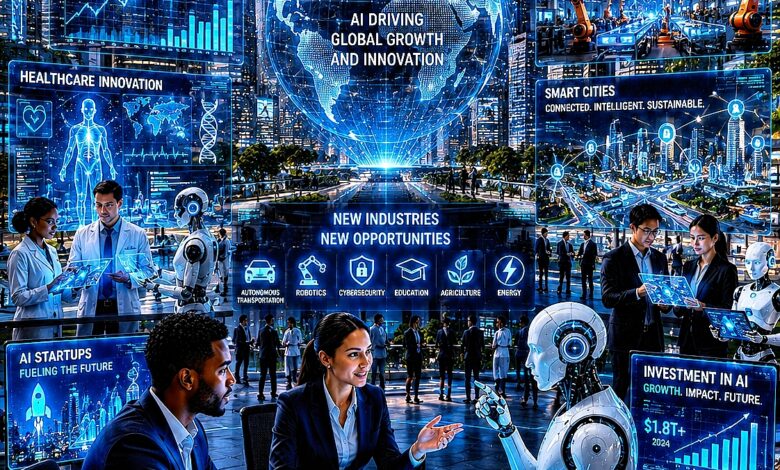
Artificial intelligence is no longer just a technological innovation—it is becoming the engine of a new global economy. From Silicon Valley to Shenzhen, London to Lagos, AI is reshaping industries, creating entirely new business models, and redefining the future of work. Governments, multinational corporations, startups, and investors are pouring billions of dollars into AI, betting that it will become one of the most valuable technologies of the 21st century.
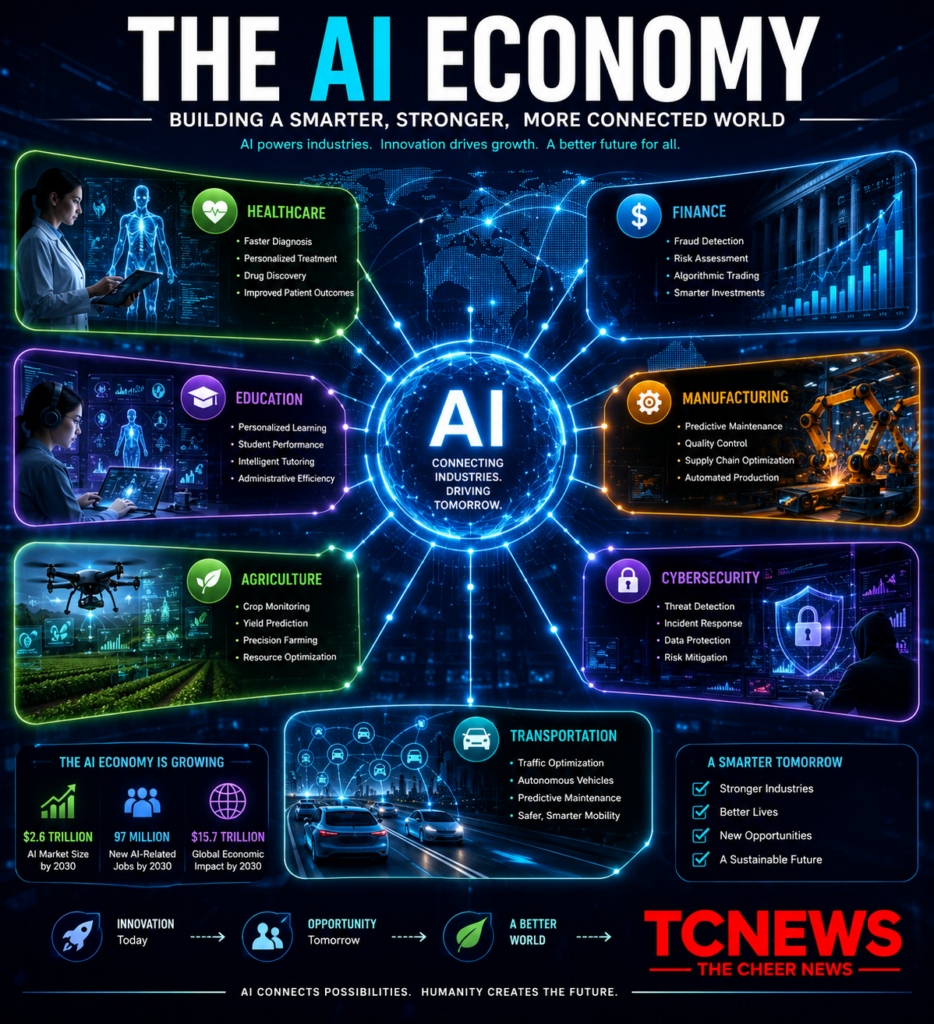
What began as a tool for automating repetitive tasks has evolved into a transformative force driving innovation across healthcare, finance, manufacturing, education, agriculture, transportation, entertainment, and scientific research. AI-powered companies are attracting record-breaking investments, while organizations that successfully integrate AI are gaining significant competitive advantages.
The emergence of the AI economy is not simply about replacing human labor. It is about creating new opportunities, increasing productivity, accelerating innovatiion, and opening doors to industries that did not exist a decade ago. For businesses, governments, and individuals, understanding the AI economy is becoming essential for long-term success.
What Is the AI Economy?
The AI economy refers to the growing ecosystem of businesses, technologies, investments, products, services, and jobs powered by artificial intelligence.
It includes:
- AI software development
- AI hardware and semiconductor manufacturing
- Cloud computing
- Robotics
- Autonomous systems
- AI-powered healthcare
- Financial technology
- Cybersecurity
- Smart manufacturing
- Digital assistants
- AI education platforms
- Data infrastructure
Together, these sectors are generating enormous economic value while transforming traditional industries.
Why the AI Economy Is Growing Rapidly
Several factors are driving the rapid expansion of the AI economy.
Explosion of Data
Every day, billions of people generate massive amounts of digital information through smartphones, online transactions, connected devices, social media, healthcare systems, and industrial equipment.
AI converts this data into actionable insights that help organizations make better decisions.
Improved Computing Power
Modern graphics processing units (GPUs), specialized AI chips, and cloud computing platforms have dramatically increased the computing power available for training advanced AI models.
This has accelerated AI innovation across industries.
Falling Costs
As AI technology becomes more accessible, businesses of all sizes can adopt intelligent automation without massive infrastructure investments.
Cloud-based AI services have significantly reduced barriers to entry.
Industries Being Transformed
Healthcare
AI is improving:
- Disease diagnosis
- Drug discovery
- Medical imaging
- Personalized medicine
- Hospital operations
Healthcare providers increasingly use AI to improve patient outcomes while reducing costs.
Financial Services
Banks and financial institutions use AI for:
- Fraud detection
- Risk assessment
- Credit scoring
- Customer support
- Investment analysis
AI enables faster, more accurate financial decision-making.
Manufacturing
Manufacturers deploy AI to:
- Predict equipment failures
- Improve quality control
- Optimize supply chains
- Automate production
- Reduce waste
Smart factories are becoming more efficient through AI-powered automation.
Agriculture
Farmers use AI to:
- Monitor crops
- Detect diseases
- Optimize irrigation
- Predict yields
- Improve food production
These innovations support greater agricultural productivity and sustainability.
Education
Educational institutions increasingly use AI for:
- Personalized learning
- Intelligent tutoring
- Automated grading
- Student performance analysis
- Administrative support
AI helps educators deliver more individualized learning experiences.
Transportation
AI powers innovations such as:
- Autonomous vehicles
- Smart traffic management
- Logistics optimization
- Fleet management
- Predictive maintenance
These technologies improve efficiency and reduce operational costs.
The Rise of New AI Careers
One of the biggest misconceptions about AI is that it only eliminates jobs.
In reality, AI is creating entirely new career opportunities.
Emerging roles include:
- AI Engineer
- Machine Learning Engineer
- Prompt Engineer
- AI Product Manager
- AI Ethics Specialist
- AI Security Analyst
- Data Scientist
- AI Research Scientist
- Robotics Engineer
- AI Solutions Architect
- AI Policy Advisor
- AI Trainer
Many traditional professions are also evolving to incorporate AI skills.
AI Entrepreneurship
The AI economy has sparked a global startup boom.
Entrepreneurs are building AI-powered companies that offer:
- Business automation
- Customer service solutions
- Healthcare platforms
- Educational technology
- Legal services
- Financial software
- Marketing automation
- Cybersecurity tools
Access to cloud computing and open-source AI technologies has lowered the barriers for startups entering the market.
AI Investment Trends
Global investment in AI continues to grow as venture capital firms, governments, and large technology companies compete to develop advanced AI capabilities.
Funding is flowing into:
- Foundation models
- AI infrastructure
- Robotics
- Enterprise AI
- Autonomous systems
- Semiconductor manufacturing
- AI cybersecurity
- Scientific research
Investors increasingly view AI as a long-term driver of economic growth and innovation.
Opportunities for Developing Economies
Countries across Africa, Asia, and Latin America have an opportunity to participate in the AI economy by investing in:
- Digital infrastructure
- STEM education
- AI research
- Startup ecosystems
- Broadband connectivity
- Digital skills training
Young entrepreneurs can use AI to build globally competitive businesses without requiring enormous physical infrastructure.
Recent Developments
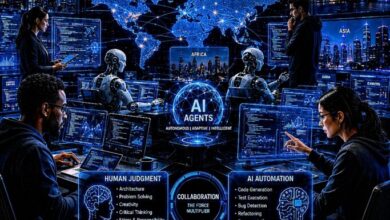
Artificial intelligence continues to expand across sectors as businesses integrate AI into customer service, software development, finance, manufacturing, healthcare, and scientific research. Organizations are increasingly deploying AI agents, multimodal models, and automation platforms to improve productivity and reduce costs.
Governments are also introducing national AI strategies focused on innovation, workforce development, ethical governance, and digital competitiveness, recognizing AI as a critical driver of future economic growth.
AI Agents: The Rise of Autonomous Digital Workers and the Fu
Benefits of the AI Economy
Increased Productivity
AI automates repetitive work, allowing employees to focus on higher-value tasks.
Faster Innovation
Researchers and businesses can develop products more quickly using AI-powered tools.
Economic Growth
AI creates new industries, attracts investment, and supports entrepreneurship.
Better Decision-Making
Organizations gain valuable insights from large datasets.
Improved Public Services
Governments can use AI to improve healthcare, education, transportation, and public administration.
Risks and Challenges
Workforce Disruption
Some routine jobs may change significantly, requiring workers to develop new skills.
Skills Gap
Demand for AI professionals currently exceeds supply in many regions.
Ethical Concerns
Responsible AI development requires transparency, fairness, and accountability.
Data Privacy
Organizations must protect personal and sensitive information when deploying AI.
Digital Inequality
Countries with limited digital infrastructure may struggle to benefit fully from AI-driven economic growth.
Expert Perspectives
Economists and technology experts generally agree that AI will become one of the most significant drivers of global economic transformation over the coming decades. Rather than replacing entire workforces, AI is expected to reshape jobs, create new industries, and increase demand for workers who can collaborate effectively with intelligent technologies.
Experts also emphasize that education, digital infrastructure, and responsible governance will determine which countries and businesses benefit most from the AI economy.
Future Outlook
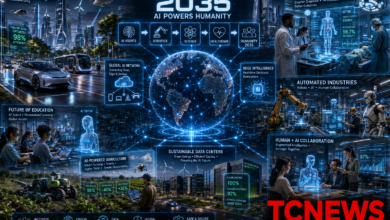
The AI economy is expected to expand rapidly as organizations adopt autonomous AI agents, intelligent robotics, advanced automation, and next-generation computing technologies.
Future innovations may include AI-managed factories, personalized education systems, precision healthcare, autonomous logistics networks, and AI-powered scientific discovery.
Businesses that invest in AI capabilities today are likely to be better positioned to compete in tomorrow’s digital economy.
Why This Matters
Artificial intelligence is becoming a cornerstone of global economic development. It is creating new industries, transforming traditional businesses, and opening career opportunities that did not exist a few years ago. Countries, companies, and individuals that embrace AI responsibly will be better equipped to innovate, compete, and prosper in an increasingly technology-driven world.
Frequently Asked Questions (FAQs)
What is the AI economy?
The AI economy refers to economic activity generated by artificial intelligence technologies, businesses, investments, products, services, and jobs.
Will AI create more jobs than it replaces?
Many experts believe AI will transform existing jobs while creating new careers in technology, business, healthcare, education, cybersecurity, and research.
Which industries benefit most from AI?
Healthcare, finance, manufacturing, agriculture, education, transportation, cybersecurity, and scientific research are among the sectors experiencing significant AI-driven transformation.
Can small businesses benefit from AI?
Yes. Cloud-based AI services make advanced technologies increasingly accessible to startups and small businesses.
How can individuals prepare for the AI economy?
Learning digital skills, understanding AI tools, developing critical thinking, and continuously updating professional knowledge can help individuals thrive in the evolving workforce.
Conclusion
The AI economy represents one of the most significant technological and economic shifts of our time. By accelerating innovation, improving productivity, and creating new industries, artificial intelligence is reshaping how businesses operate and how people work.
While challenges related to workforce transformation, ethics, and digital inequality remain, the opportunities created by AI are immense. The organizations and individuals that invest in AI skills, responsible innovation, and lifelong learning will be best positioned to succeed in this rapidly evolving landscape.
The AI economy is not a distant future—it is already here, and its influence will continue to grow for decades to come.
Hashtags
#AIEconomy #ArtificialIntelligence #FutureOfWork #AIJobs #Innovation #DigitalEconomy #Technology #Business #MachineLearning #Entrepreneurship #TheCheerNews