How Small Businesses Can Use AI to Increase Productivity and Profits in 2026
By DAYO ADESULU
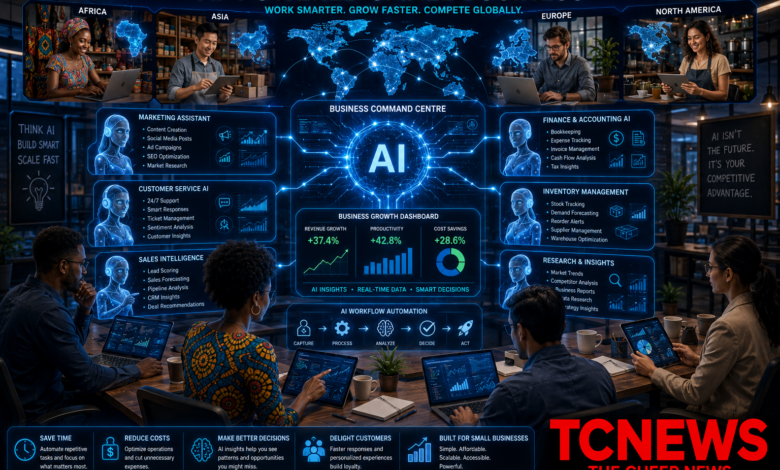
In 2026, a small business can use AI to write marketing material, respond to customers, analyze sales data, automate repetitive administration, improve decision-making, and support employees—all without building an AI system from scratch.
That shift could become one of the most important economic consequences of the AI revolution.
According to a March 2026 survey by Goldman Sachs 10,000 Small Businesses Voices, 76% of surveyed small businesses were already using AI. Among those users, 93% reported a positive business impact, while 84% identified increased efficiency and productivity as the main benefit. Yet only 14% said AI was fully integrated into their core operations.
That gap is significant.
Many business owners have experimented with AI. Far fewer have redesigned their businesses around it.
The opportunity, therefore, is no longer simply learning how to use a chatbot.
It is learning where AI can remove wasted time, improve decisions, increase customer value and ultimately strengthen the bottom line.
For entrepreneurs in Nigeria, Africa and other emerging markets, that opportunity may be particularly important because AI can give smaller teams access to capabilities that previously required larger workforces or expensive specialist services.
AI Chips: The Semiconductor Race Powering the Future of Art
What Does AI Mean for a Small Business?
AI for small businesses does not necessarily mean buying expensive robots or developing a proprietary artificial intelligence model.
For most small companies, it begins with using existing AI-powered software to improve everyday work.
A business could use AI to help with:
- Marketing
- Customer service
- Research
- Sales
- Accounting support
- Data analysis
- Content creation
- Scheduling
- Inventory management
- Documentation
- Business planning
- Software development
- Recruitment support
- Internal knowledge management
The important question is not:
“How can I use AI?”
A better question is:
“Which part of my business consumes too much time or produces too little value?”
That is where AI should begin.
Why Small Businesses Are Paying Attention
Large corporations can employ teams of analysts, marketers, developers, accountants and customer-service specialists.
A small business may have only a handful of employees.
That creates a fundamental advantage for AI.
AI can provide additional capacity without requiring a business to immediately expand its headcount.
Goldman Sachs found that 87% of surveyed small businesses using AI viewed it as augmenting rather than replacing their employees. Furthermore, 67% expected AI to increase revenue.
This suggests that many entrepreneurs see AI primarily as a productivity multiplier.
Instead of asking an employee to work faster, the business can redesign the workflow so that AI handles appropriate repetitive tasks while the employee focuses on judgment, relationships, and higher-value activities.
1. Use AI to Automate Repetitive Administration
Administrative work can quietly consume enormous amounts of time.
Employees may spend hours:
- Drafting routine emails
- Summarizing meetings
- Preparing documents
- Organizing information
- Creating reports
- Updating records
- Extracting information from documents
- Preparing standard responses
AI can assist with many of these activities.
For example, a business could create a workflow where meeting notes are converted into an action list, routine customer inquiries are categorized and recurring reports are summarized.
The objective is not to remove human review.
Instead, AI handles the first layer of work while employees verify important outputs.
That can free people to concentrate on customers, sales, strategy and problem-solving.
2. Transform Marketing With AI
Marketing is another area where small businesses can gain significant leverage.
A small company may not have enough money to maintain a large marketing department.
AI can help generate initial drafts for:
- Blog articles
- Social media posts
- Product descriptions
- Email campaigns
- Advertising concepts
- Video scripts
- Customer surveys
- Promotional ideas
However, generic AI-generated content is unlikely to create a strong competitive advantage by itself.
The real advantage comes from combining AI with the company’s own knowledge.
A local restaurant, for example, understands its customers, neighbourhood and products better than a generic AI model.
AI can help transform that knowledge into campaigns, content and customer communications.
Human expertise remains the differentiator.
3. Improve Customer Service
Customer service can become a major productivity challenge as a business grows.
AI can help organize incoming questions and provide draft responses to common inquiries.
A business might use AI to help answer questions about:
- Opening hours
- Products
- Services
- Pricing
- Delivery
- Appointments
- Returns
- Frequently asked questions
More advanced systems can categorize requests and direct complex cases to human staff.
The principle should be straightforward:
AI handles routine interactions; humans handle situations requiring judgment, empathy or authority.
This is especially important when customers are dealing with financial, legal, medical or otherwise sensitive matters.
4. Use AI for Sales
Sales teams often spend significant time researching prospects and preparing communications.
AI can help organize customer information, summarize previous interactions and prepare personalized drafts.
It can also help businesses identify patterns in customer inquiries.
For example, if many customers repeatedly ask about the same product feature, the company may have discovered an opportunity to improve its marketing or product documentation.
AI therefore becomes more than a writing assistant.
It can become a tool for discovering what customers actually want.
5. Turn Business Data Into Decisions
Many small businesses possess valuable data but rarely analyze it deeply.
Sales records, customer inquiries, website traffic, inventory information and expenses can reveal important patterns.
AI-assisted analytics can help business owners ask questions such as:
- Which products sell most frequently?
- Which months generate the highest revenue?
- Which customers return most often?
- Which expenses are increasing?
- Which marketing channels generate the strongest response?
- Where are customers abandoning the buying process?
The technology does not replace sound financial judgment.
Instead, it can make business information easier to understand.
This could be particularly useful for entrepreneurs who do not have dedicated data analysts.
6. Improve Inventory and Operations
For businesses selling physical products, inventory management can directly affect profitability.
Too much inventory ties up capital.
Too little inventory can lead to missed sales.
AI-assisted forecasting can analyze historical sales and other available information to help identify patterns.
Small retailers, manufacturers and distributors could use AI to support:
- Demand forecasting
- Inventory monitoring
- Purchasing decisions
- Supplier analysis
- Delivery planning
- Stock alerts
The quality of the output, however, depends heavily on the quality of the underlying data.
Bad records can produce bad recommendations.
7. Give Small Teams Access to Specialized Skills
Perhaps the most significant advantage of AI is its ability to provide small teams with assistance across multiple knowledge areas.
A business owner could use AI to help understand:
- Market research
- Basic financial information
- Competitor positioning
- Product strategy
- Customer feedback
- Technology requirements
- Business documentation
This does not mean AI should replace qualified professionals.
A business should still consult appropriate experts when decisions require specialized professional judgment.
However, AI can help entrepreneurs prepare better questions and understand complex information before speaking with those professionals.
8. Build AI Into the Workflow—Not Just the Browser
This is where many businesses struggle.
Using AI occasionally is not the same as integrating AI.
The OECD has highlighted that SME AI adoption remains behind that of larger firms and identified factors such as connectivity, data, computing resources, skills and finance as important conditions for successful adoption.
A business should therefore examine its workflow.
Suppose a company receives 100 customer inquiries every week.
Simply giving employees access to an AI chatbot may not change much.
A better approach is to redesign the process:
Customer inquiry → classification → AI-assisted response → human review when necessary → customer follow-up → record updated.
That is workflow integration.
And workflow integration is where productivity gains become more measurable.
9. Measure Productivity Before Declaring Success
AI adoption should not be based on excitement.
It should be measured.
Before implementing an AI workflow, a business should identify a baseline.
For example:
Before AI
Customer response takes an average of four hours.
After AI
Average response falls to one hour.
Or:
Before AI
Employees spend 15 hours weekly preparing reports.
After AI
The process takes six hours.
These measurements make the value of AI easier to understand.
Useful metrics can include:
- Time saved
- Cost reduction
- Revenue generated
- Conversion rate
- Customer response time
- Error rate
- Employee productivity
- Customer satisfaction
AI should ultimately contribute to business outcomes.
10. Protect Customer and Company Data
One of the biggest mistakes a small business can make is treating AI as risk-free.
Sensitive company information should not automatically be copied into an AI system.
Businesses should establish clear rules covering:
- Customer information
- Financial records
- Passwords
- Confidential contracts
- Intellectual property
- Employee information
- Business strategy
- Proprietary data
Goldman Sachs’ 2026 survey found that data privacy and security concerns were among the major barriers to deeper AI adoption among small businesses.
That concern is justified.
The more AI becomes embedded in business operations, the more important data governance becomes.
11. Train Employees to Work With AI
AI adoption is not simply a technology project.
It is a people project.
Employees need to understand:
- What AI can do
- What AI cannot do
- How to check AI outputs
- What information should remain confidential
- When human approval is required
- How to identify AI-generated errors
Goldman Sachs reported that 73% of surveyed small businesses believed additional training and resources would help them implement AI successfully.
That finding highlights an important point.
Buying AI software without developing employee skills is unlikely to deliver its full value.
12. Start Small Instead of Trying to Automate Everything
A small business does not need an enormous AI transformation programme.
A better starting point is often one painful process.
For example:
Problem: Employees spend too much time preparing weekly reports.
AI project: Automate the first draft and data summary.
Measurement: Compare preparation time before and after implementation.
Review: Check accuracy.
Expansion: If successful, apply the same approach to another process.
This creates a controlled learning cycle.
The business can gradually move from experimentation to integration.
AI Agents Change the Equation
The next stage goes beyond individual AI prompts.
AI agents can potentially perform multiple connected steps within a workflow.
Microsoft’s 2026 Work Trend Index describes organizations increasingly using AI and agents to take on execution while humans focus more on directing work, making decisions and owning outcomes.
For a small company, this could eventually mean an AI system helping coordinate a workflow from beginning to end.
For example:
New customer inquiry → identify request → retrieve relevant information → prepare response → update customer record → schedule follow-up.
That is significantly different from asking an AI system to write a single email.
However, agentic systems require stronger controls because they can potentially perform actions rather than simply generate information.
What AI Cannot Fix
AI is powerful, but it cannot automatically solve a badly designed business.
If a company has:
- Poor customer service
- Weak products
- Inaccurate financial records
- Confusing processes
- Poor leadership
- Unclear pricing
AI may simply make some processes faster without fixing the underlying problems.
There is a crucial distinction:
AI can accelerate a good process.
It can also accelerate a bad process.
Therefore, businesses should improve the workflow before automating it.
AI and Profit: The Real Connection
Productivity does not automatically equal profit.
A company can save employees several hours and still fail to increase its earnings.
The connection becomes stronger when saved time is redirected toward revenue-producing activities.
For example:
AI saves 10 hours per week → employees spend those hours following up with customers → more sales opportunities → higher revenue.
Or:
AI reduces administrative costs → savings are reinvested into marketing → customer acquisition increases.
This is where AI becomes a business strategy rather than simply a productivity tool.
Nigeria and Africa: Why This Matters
For African entrepreneurs, AI could help smaller businesses compete with companies that have larger workforces and greater access to specialized expertise.
A Nigerian small business could potentially use AI for:
- Customer communications
- Social media marketing
- Bookkeeping support
- Market research
- Product development
- Business analysis
- E-commerce
- Translation
- Training
- Administrative work
The opportunity is significant because Africa’s entrepreneurial ecosystem contains millions of small and growing businesses.
However, infrastructure remains important.
Internet access, electricity, digital skills, data availability and affordable technology will influence how widely businesses can adopt AI.
The OECD similarly identifies connectivity, skills, finance, data and computing resources as important enablers of SME AI adoption.
For African economies, therefore, AI policy should not focus only on building advanced models.
It should also focus on making useful AI accessible to ordinary businesses.
The Risks Small Businesses Should Watch
AI Errors
AI can generate inaccurate information.
Data Leakage
Sensitive business information may be exposed through poor data practices.
Over-Automation
Removing humans from important decisions can create serious problems.
Vendor Dependence
Businesses can become dependent on a particular AI provider.
Cybersecurity
AI-connected systems create additional attack surfaces.
Employee Resistance
Workers may resist technology if implementation is poorly communicated.
Hidden Costs
Subscription fees, integration, training and maintenance can add up.
Poor Return on Investment
Not every AI project will generate enough value to justify its cost.
A Practical AI Adoption Framework for Small Businesses
Small businesses can think about AI adoption through five stages.
Stage One: Identify
Find repetitive, time-consuming or error-prone tasks.
Stage Two: Test
Choose one process and run a limited AI experiment.
Stage Three: Measure
Track time, cost, quality and business outcomes.
Stage Four: Integrate
Connect the successful AI workflow to everyday business operations.
Stage Five: Scale
Expand AI to other areas only after the initial system demonstrates value.
This approach reduces unnecessary spending and helps employees learn gradually.
What the Future Holds
The small business of the future may look very different from today’s typical company.
A five-person company could potentially operate with a much larger digital capacity.
Employees may work alongside AI systems that assist with:
- Marketing
- Research
- Customer service
- Finance
- Software
- Operations
- Sales
This does not necessarily mean companies will stop hiring.
Instead, the economic advantage may shift toward businesses that know how to combine small human teams with increasingly capable digital systems.
Microsoft’s research points toward this emerging model of human-agent collaboration, where AI takes on more execution while humans retain direction and accountability.
The competitive advantage will therefore not simply belong to companies that buy the most AI tools.
It will belong to companies that redesign their operations intelligently.
Why This Matters
The AI revolution could fundamentally change the economics of entrepreneurship.
In previous technology waves, sophisticated software and specialist capabilities were often accessible first to large corporations.
AI is changing that equation.
A small company can now access powerful capabilities through increasingly affordable software.
The challenge is no longer simply access.
It is implementation.
The Goldman Sachs 2026 survey provides a revealing picture: AI adoption among surveyed small businesses is high, but deep integration remains limited.
That means the next competitive advantage may come from businesses that move beyond experimentation.
The winners will ask:
What can we automate?
What can we improve?
What can we measure?
Where must humans remain in control?
For Nigeria and Africa, the opportunity is particularly significant.
AI could help entrepreneurs operate leaner businesses, reach wider markets and compete internationally.
But technology alone will not create successful businesses.
The combination of AI, human judgment, strong processes, customer understanding and disciplined execution will.
Frequently Asked Questions
What is the best way for a small business to start using AI?
Start with one repetitive or time-consuming process where success can be measured. Test AI, evaluate the result and expand gradually.
Can AI really increase small-business profits?
It can contribute to profitability by reducing costs, saving time, improving customer service, supporting sales and helping businesses make better decisions. However, results depend on how AI is implemented.
Will AI replace small-business employees?
AI can automate certain tasks, but many businesses are using it to augment employees. Goldman Sachs found that 87% of surveyed small businesses using AI said it augments rather than replaces their workforce.
What tasks should small businesses automate first?
Repetitive, predictable and measurable tasks are generally good candidates, such as routine administration, document processing, basic customer inquiries and reporting.
What are the biggest AI risks for small businesses?
Important risks include inaccurate outputs, data privacy problems, cybersecurity vulnerabilities, excessive automation, vendor dependence and poor return on investment.
Does a business need AI experts to get started?
Not necessarily. Many existing AI services are designed for general users. However, businesses may need specialist support when integrating AI into sensitive systems or complex workflows.
How should a business measure AI success?
Measure specific outcomes such as time saved, cost reduction, sales conversion, response time, error rates and customer satisfaction.
What is the future of AI for small businesses?
AI agents and increasingly integrated systems could eventually allow small teams to manage much larger digital workflows, with humans directing operations while AI handles selected execution tasks.
Conclusion
AI is becoming one of the most accessible productivity technologies in modern business.
For small companies, its greatest value may not come from spectacular demonstrations.
It may come from hundreds of small improvements.
A faster customer response.
A better marketing campaign.
A clearer sales report.
A simpler administrative process.
A more informed decision.
A more efficient employee.
Over time, those improvements can compound.
The evidence already shows strong interest. Yet the most important phase is only beginning: moving from experimentation to genuine business integration.
For entrepreneurs, the question should therefore not be whether AI is powerful.
It clearly is.
The more important question is:
Where can AI create measurable value in my business?
Businesses that answer that question carefully—and combine AI with human expertise—could gain a significant advantage in the increasingly competitive global economy.
The future may not belong to the biggest companies.
It may increasingly belong to the most intelligently augmented companies.
Hashtags
#AIForSmallBusiness #SmallBusiness #ArtificialIntelligence #AI #Entrepreneurship #BusinessAutomation #AIProductivity #BusinessGrowth #AI2026 #SMEs #AIInnovation #DigitalTransformation #Nigeria #Africa #FutureOfBusiness #TheCheerNews