ChatGPT Explained: How OpenAI’s AI Platform Is Transforming Work, Business and Everyday Life
By DAYO ADESULU
Key Takeaways
- ChatGPT has evolved from a conversational chatbot into a powerful AI productivity platform.
- Businesses are increasingly using ChatGPT for customer support, software development, marketing, research, and workflow automation.
- Competition among OpenAI, Google, Anthropic, Meta, Microsoft, xAI, and DeepSeek is accelerating AI innovation.
- Governments worldwide are developing regulations to address AI safety, privacy, transparency, and accountability.
- Nigeria is beginning to embrace ChatGPT across education, media, startups, and digital entrepreneurship.
Introduction
When OpenAI introduced ChatGPT in November 2022, few anticipated how quickly it would become one of the most transformative technologies of the decade. Within months, millions of people were using the chatbot to draft emails, write software, summarize reports, generate creative content, and answer complex questions. Today, ChatGPT has evolved far beyond a simple conversational assistant into a sophisticated artificial intelligence platform capable of supporting businesses, researchers, educators, healthcare professionals, software developers, and governments.
In 2026, ChatGPT sits at the center of a rapidly expanding AI ecosystem. Organizations are integrating it into enterprise software, customer service, research, and decision-making processes, while individuals rely on it for learning, productivity, and creative work. As adoption grows, so do debates around ethics, regulation, privacy, and the future of employment. Understanding ChatGPT is no longer just a matter of technological curiosity—it has become essential for anyone seeking to thrive in an increasingly AI-driven world.
What Is ChatGPT?
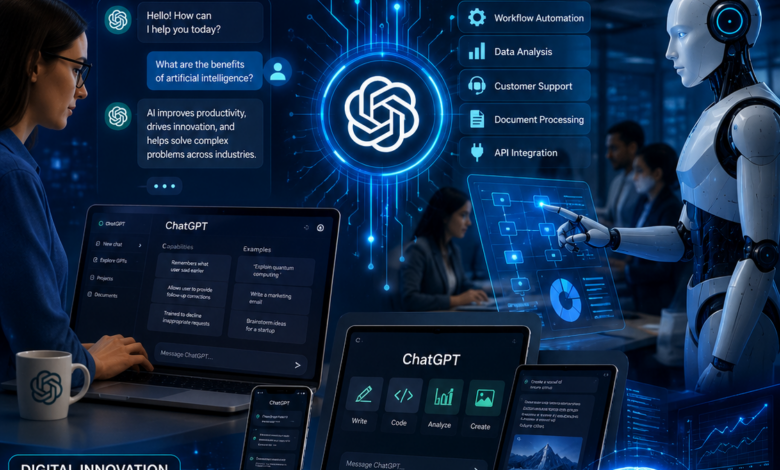
ChatGPT is a conversational artificial intelligence platform developed by OpenAI. It is built on a family of advanced large language models (LLMs) that can understand natural language, recognize context, and generate responses that closely resemble human communication.
Unlike traditional search engines that retrieve links to existing web pages, ChatGPT generates original responses by predicting the most appropriate sequence of words based on patterns learned during training. This enables it to perform a wide variety of tasks, including:
- Answering questions
- Drafting articles and reports
- Writing computer code
- Translating languages
- Summarizing lengthy documents
- Brainstorming ideas
- Analyzing data
- Creating presentations
- Generating images
- Assisting with business workflows
Its versatility has made ChatGPT one of the fastest-adopted consumer technologies in history, with applications spanning virtually every industry.
How ChatGPT Works
At its core, ChatGPT relies on a machine learning technique known as deep learning. Specifically, it uses Transformer-based neural networks that analyze relationships between words, sentences, and concepts.
The model undergoes extensive training on a broad range of publicly available and licensed text. Rather than memorizing information, it learns statistical patterns that allow it to generate coherent and contextually relevant responses to user prompts.
Modern versions of ChatGPT are multimodal, meaning they can work with:
Text
Draft articles, emails, reports, and creative writing.
Images
Interpret images, generate new visuals, and assist with design concepts.
Voice
Support spoken conversations through advanced voice capabilities.
Documents
Analyze PDFs, spreadsheets, presentations, and business reports.
Code
Write, debug, and explain programming languages including Python, JavaScript, SQL, and more.
Increasingly, ChatGPT also supports agentic capabilities, allowing it to complete multi-step tasks, organize information, and interact with connected applications on behalf of users.
The Evolution of ChatGPT
The journey from a conversational chatbot to a comprehensive AI platform has been remarkably rapid.
ChatGPT (2022)
Initially launched as a text-based chatbot designed primarily for conversation and writing assistance.
GPT-4 Era
Expanded reasoning abilities, improved accuracy, multimodal capabilities, and stronger enterprise features.
Enterprise Adoption
Businesses began integrating ChatGPT into customer support, software development, legal research, healthcare administration, financial analysis, and education.
AI Agents
The latest evolution focuses on AI systems capable of independently completing complex workflows, accessing multiple information sources, and collaborating across software environments.
This shift represents a broader transformation from AI as an assistant to AI as a digital co-worker.
Major Companies Shaping the ChatGPT Ecosystem
Although OpenAI remains the creator of ChatGPT, a much larger ecosystem supports its continued growth.
OpenAI
OpenAI leads the development of ChatGPT and continues expanding the platform into enterprise productivity, research, education, healthcare, and AI agents. The company’s focus has broadened from developing advanced language models to creating AI systems capable of supporting complex organizational workflows.
Microsoft
Microsoft is OpenAI’s largest strategic partner and has integrated ChatGPT-powered capabilities across Microsoft 365, Azure, GitHub, Windows, and enterprise software. Its cloud infrastructure provides the computing power needed to train and deploy many AI models.
NVIDIA
Behind every advanced AI model lies enormous computing power. NVIDIA’s graphics processing units (GPUs) have become the industry standard for training and running large AI systems, making the company a critical supplier in the global AI ecosystem.
Google has responded with its Gemini family of AI models, integrating generative AI into Search, Workspace, Android, and Google Cloud. Its competition with OpenAI has accelerated innovation across the industry.
Anthropic
Anthropic has positioned its Claude AI models as enterprise-focused alternatives, emphasizing AI safety, reliability, and responsible deployment.
Meta
Meta continues investing in open-source AI through its Llama family of models while embedding AI capabilities into social media platforms and developer tools.
Emerging Competitors
Other significant players include xAI, Amazon, DeepSeek, Alibaba, Tencent, Mistral AI, and Cohere. Each is contributing to a highly competitive global AI landscape, where innovation is driven by advances in models, infrastructure, and real-world applications.
Latest Developments
The current direction of ChatGPT reflects a broader industry shift toward practical deployment rather than experimentation.
Recent developments include:
- AI agents capable of completing multi-step tasks with minimal supervision.
- Enhanced multimodal capabilities that combine text, voice, images, and documents.
- Improved enterprise integrations with productivity software and cloud platforms.
- Greater emphasis on privacy, security, and governance for business users.
- Continued investment in AI infrastructure to support growing demand.
These developments signal that ChatGPT is becoming an essential digital productivity platform rather than simply a chatbot.
Expert Insights
Technology analysts increasingly describe ChatGPT as one of the defining innovations of the modern digital economy. Its significance extends beyond conversational AI, representing a new interface through which people interact with computers, software, and information.
Experts also emphasize that long-term success will depend not only on building more powerful AI models but also on improving reliability, transparency, security, and responsible deployment. Organizations that invest in AI governance alongside technological adoption are expected to gain the greatest competitive advantage.
Furthermore, the rapid evolution of ChatGPT is encouraging businesses to rethink workflows, customer engagement, and knowledge management. Instead of replacing human expertise, many analysts see AI augmenting professional capabilities, enabling employees to focus on strategic thinking, creativity, and complex decision-making.
Global Context: How ChatGPT Is Shaping the World
ChatGPT is no longer simply a consumer application. It has become part of a broader transformation in how governments, businesses, educational institutions, and technology companies operate.
In the United States, organizations are integrating AI into software development, healthcare, legal research, customer service, and enterprise productivity. Technology companies continue investing billions of dollars in AI infrastructure, including advanced semiconductor chips and cloud data centers.
Across Europe, policymakers are working to balance innovation with public trust through comprehensive AI governance. Businesses are increasingly adopting AI while complying with stricter transparency, privacy, and accountability requirements.
China has accelerated domestic AI development through companies such as DeepSeek, Alibaba, Tencent, and Baidu. These firms are competing aggressively with Western AI developers while supporting the country’s broader strategy of technological self-reliance.
Meanwhile, countries across the Middle East, India, Singapore, and South Korea are investing heavily in AI research, startup ecosystems, and digital transformation initiatives. The result is a truly global AI race in which innovation is viewed as both an economic opportunity and a strategic national priority.
Nigerian Context: ChatGPT’s Growing Influence
Nigeria is emerging as one of Africa’s most dynamic digital economies, and ChatGPT is beginning to influence multiple sectors.
Education
Students increasingly use ChatGPT to understand difficult concepts, prepare assignments, improve writing skills, and support exam preparation. Universities, however, continue to debate appropriate guidelines to encourage learning while discouraging academic misconduct.
Journalism
News organizations are experimenting with AI to assist with research, headline generation, transcription, translation, and SEO optimization. Importantly, editorial judgment and fact-checking remain essential to maintaining credibility.
Small Businesses
Entrepreneurs are leveraging ChatGPT to write marketing copy, respond to customer inquiries, create business proposals, prepare presentations, and develop business plans at a fraction of traditional costs.
Software Development
Nigeria’s growing technology community is using ChatGPT to accelerate coding, debug applications, learn programming languages, and improve software documentation.
Public Sector
Although adoption remains at an early stage, AI has the potential to improve public service delivery, automate administrative processes, enhance digital governance, and strengthen data analysis for policymaking.
For Nigeria, the challenge is not simply adopting AI but investing in reliable electricity, broadband connectivity, digital skills, and responsible governance to maximize its benefits.
Benefits of ChatGPT
For Businesses
Organizations are using ChatGPT to:
- Improve customer support through AI-powered assistants.
- Generate reports, proposals, and documentation more efficiently.
- Accelerate software development and testing.
- Analyze large volumes of business data.
- Enhance internal knowledge management.
- Reduce repetitive administrative work.
- Support marketing, sales, and communication.
These capabilities allow employees to focus more on strategic thinking and less on routine tasks.
For Consumers
Individuals benefit from ChatGPT in numerous ways:
- Personalized learning support.
- Language translation.
- Writing assistance.
- Career guidance.
- Coding support.
- Travel planning.
- Financial education.
- Everyday problem-solving.
- Creative brainstorming.
- Improved accessibility for users with disabilities.
Risks and Challenges
Despite its remarkable capabilities, ChatGPT is not without limitations.
Accuracy
AI systems can sometimes generate incorrect or misleading information with confidence. Users should verify important facts, especially in legal, financial, or medical contexts.
Privacy
Sharing sensitive personal or corporate information with AI systems may raise privacy and confidentiality concerns, particularly when organizational policies are unclear.
Cybersecurity
Threat actors may misuse AI to produce phishing emails, fraudulent messages, malicious code, or large volumes of misleading content. Strong cybersecurity practices remain essential.
Workforce Disruption
Some repetitive tasks are becoming increasingly automated. While AI creates new opportunities, it also requires workers to continuously update their skills to remain competitive.
Ethical Concerns
The rapid growth of AI has intensified discussions about responsible innovation.
Key ethical issues include:
Bias
AI models may reflect biases present in training data, potentially affecting hiring, lending, healthcare, and other decision-making processes.
Transparency
Users should understand when they are interacting with AI rather than a human and how AI-generated outputs are produced.
Copyright
Questions continue regarding the use of copyrighted material in AI training and the ownership of AI-generated content.
Misinformation
Generative AI can create convincing but false information, making media literacy and independent verification increasingly important.
Human Oversight
Many experts believe AI should support—not replace—human judgment, particularly in high-stakes areas such as healthcare, law, education, and public administration.
Government Regulations
Governments worldwide are responding to AI’s rapid growth with new policies and regulatory frameworks.
The European Union has established one of the world’s most comprehensive AI regulatory systems, introducing rules based on the level of risk posed by different AI applications.
In the United States, federal agencies and state governments continue developing policies focused on innovation, consumer protection, cybersecurity, and responsible AI deployment.
China has introduced regulations governing generative AI services while continuing to invest heavily in domestic AI capabilities.
Across Africa, governments are beginning to develop national AI strategies. Nigeria has shown increasing interest in expanding digital innovation while exploring policies that encourage responsible AI adoption, investment, and skills development.
Investment Opportunities
Artificial intelligence has become one of the fastest-growing investment themes in global technology.
Key sectors attracting attention include:
AI Software
Companies developing enterprise AI platforms, productivity tools, and specialized AI applications continue expanding rapidly.
Semiconductors
Demand for high-performance AI chips remains strong as organizations build increasingly sophisticated AI systems.
Cloud Computing
Cloud providers supplying the infrastructure needed to train and deploy AI models continue benefiting from growing enterprise demand.
Cybersecurity
As AI adoption expands, organizations require stronger cybersecurity solutions to protect digital assets and AI systems.
Robotics
AI-powered robotics is expected to transform manufacturing, logistics, healthcare, agriculture, and warehouse automation over the coming decade.
While AI presents significant commercial opportunities, investment decisions should be based on independent research, individual financial circumstances, and professional advice where appropriate.
Practical Implications
For Businesses
Organizations considering ChatGPT should:
- Establish AI governance policies.
- Train employees on responsible AI use.
- Protect confidential information.
- Verify AI-generated outputs.
- Measure productivity improvements.
- Integrate AI gradually into business operations.
For Consumers
Individuals can maximize ChatGPT by:
- Using it as a learning companion.
- Improving workplace productivity.
- Developing new digital skills.
- Supporting creative projects.
- Fact-checking important information.
- Protecting sensitive personal data.
Future Trends
ChatGPT is expected to evolve in several important ways over the next few years:
- More advanced AI agents capable of completing complex tasks independently.
- Improved reasoning and decision-support capabilities.
- Greater personalization tailored to individual users.
- Expanded voice-first experiences.
- Deeper integration with enterprise software.
- Enhanced collaboration between humans and AI.
- Better safeguards for privacy, security, and transparency.
- Increased adoption across healthcare, education, manufacturing, and government services.
Rather than replacing human intelligence, future AI systems are expected to function as collaborative partners that enhance productivity and decision-making.
Why This Matters
ChatGPT represents far more than another software application. It is reshaping how people learn, work, communicate, innovate, and solve problems.
For businesses, it offers opportunities to improve efficiency, reduce costs, and develop new products and services. For individuals, it provides access to powerful digital tools that can enhance education, creativity, and professional development.
For Nigeria, ChatGPT presents an opportunity to accelerate digital transformation, strengthen entrepreneurship, improve education, and increase participation in the global knowledge economy. Realizing these benefits, however, will require investment in digital infrastructure, AI literacy, and responsible governance.
As artificial intelligence becomes embedded in everyday life, understanding ChatGPT is no longer optional—it is becoming an essential digital skill for the future.
Frequently Asked Questions
1. What is ChatGPT?
ChatGPT is an AI-powered conversational platform developed by OpenAI that can understand and generate human-like text, assist with problem-solving, write code, summarize documents, and perform many other language-based tasks.
2. Is ChatGPT free to use?
OpenAI offers both free and paid subscription plans. Paid plans generally provide access to more advanced models, additional features, and higher usage limits.
3. Can ChatGPT replace human workers?
ChatGPT can automate certain tasks and improve productivity, but it is best viewed as a tool that augments human capabilities rather than replacing professional expertise.
4. Is ChatGPT safe?
When used responsibly, ChatGPT can be a valuable productivity tool. Users should avoid sharing confidential information and should independently verify important outputs.
5. How can Nigerian businesses benefit from ChatGPT?
Nigerian businesses can use ChatGPT for customer support, marketing, proposal writing, software development, business planning, content creation, and employee training, helping them improve efficiency and compete more effectively in the digital economy.
Conclusion
ChatGPT has become one of the defining technologies of the artificial intelligence era. Its ability to support communication, creativity, software development, research, and enterprise productivity has transformed expectations of what AI can achieve. As the technology continues to evolve, organizations and individuals that embrace responsible adoption, continuous learning, and sound governance will be best positioned to benefit from the opportunities it creates.
For Nigeria and the wider African continent, ChatGPT is more than a technological innovation—it is a catalyst for digital transformation, entrepreneurship, and global competitiveness. The challenge now is to harness its potential while addressing the ethical, regulatory, and educational issues that accompany rapid technological change.
Hashtags
#ChatGPT #OpenAI #ArtificialIntelligence #GenerativeAI #AITechnology #EnterpriseAI #DigitalTransformation #Innovation #TechNews #NigeriaTech #FutureOfWork #MachineLearning #TheCheerNews