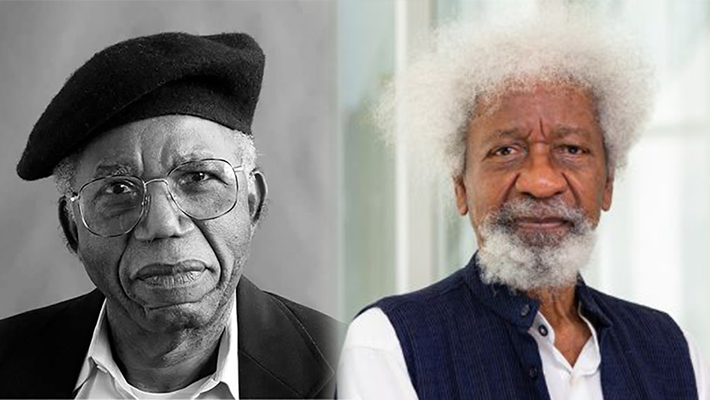
Chinua Achebe and Wole Soyinka, Intellectual Giants Without Academics PhDs
By DAYO ADESULU
When discussions arise about Africa’s greatest literary figures, two names stand tall: Professor Chinua Achebe and Professor Wole Soyinka. Both men are celebrated worldwide for their groundbreaking works and intellectual contributions. Yet, an interesting fact often surprises many admirers—neither Achebe nor Soyinka held a PhD.
Instead, their influence and global recognition came through intellectual brilliance, creative depth, and an unshakable commitment to truth and humanity. Their lives remain proof that personal achievement and impact can transcend academic certifications.
Chinua Achebe: Father of African Literature
Born in 1930, Chinua Achebe graduated from University College, Ibadan in 1953 with a Bachelor of Arts in English, History, and Theology. He did not pursue postgraduate studies. Instead, Achebe turned his attention to storytelling, broadcasting, and cultural critique.
At just 28 years old, he published Things Fall Apart (1958), a novel that redefined African literature and countered colonial narratives. The book has since sold over 20 million copies and has been translated into more than 50 languages.
Despite not having a PhD, Achebe’s intellectual contributions opened doors across the globe. He went on to lecture in leading institutions and later became Professor of Africana Studies at Brown University in the United States.
Over his lifetime, Achebe received more than 30 honorary doctorates, including from Harvard University, Brown University, the University of Kent, the University of Stirling, and the University of Cape Town. Each award recognized his literary genius, moral authority, and commitment to African identity.
Wole Soyinka: Nobel Laureate and Global Voice
Born in 1934, Wole Soyinka began his studies at University College Ibadan before moving to the University of Leeds in the United Kingdom, where he earned his Honours degree in English Literature in 1957. He contemplated further academic research but instead immersed himself in writing and theatre.
Soyinka’s plays, poetry, and essays positioned him as both a literary master and a fearless activist. His works, such as Death and the King’s Horseman and The Man Died, continue to challenge oppression and speak to the struggles of freedom.
In 1986, Soyinka became the first African to win the Nobel Prize in Literature, cementing his legacy as one of the world’s foremost intellectuals.
Like Achebe, Soyinka accumulated more than 30 honorary doctorates from prestigious institutions, including Harvard, Yale, Princeton, Oxford, Cambridge, the University of Leeds, and the University of Ibadan. These honors acknowledge not just his artistry, but his courage in confronting tyranny.
Intellectual Achievements Over Certifications
The stories of Achebe and Soyinka challenge conventional assumptions about academic credentials. In an age where PhDs and formal certifications are often viewed as the pinnacle of intellectual achievement, these two men proved otherwise.
Neither pursued doctoral studies, yet their works transformed global understanding of Africa and literature itself. Their intellectual weight came from original thought, creativity, and moral courage, not from additional letters after their names.
For Achebe, the pen was his doctorate—his novels and essays became timeless classrooms. For Soyinka, the stage and page were his laboratories—his plays and activism redefined what it means to be a public intellectual.
Their lives remind us that while formal education is valuable, true intellectual achievement rests on curiosity, discipline, creativity, and courage to engage with society’s deepest questions.
Global Recognition Beyond Degrees
It is telling that some of the world’s most respected universities chose to honor Achebe and Soyinka with doctorates. These awards were not for academic research in the traditional sense, but for lifetime contributions to knowledge, culture, and humanity.
- Achebe was celebrated as the father of African literature, giving voice to a continent.
- Soyinka was recognized as the Nobel Laureate who spoke truth to power, giving courage to generations.
Their legacies prove that impact outweighs certifications, and that the world ultimately remembers those who create, inspire, and lead.
Chinua Achebe (1930–2013)
Formal Degree:
Bachelor of Arts in English, History & Theology – University College Ibadan (then affiliated with the University of London), 1953.
PhD?
No PhD. Never pursued postgraduate studies.
Career Path:
Focused on writing and broadcasting after university.
Published Things Fall Apart (1958), which became the most widely read African novel.
Later served as Professor of Africana Studies at Brown University, USA.
Honorary Doctorates (selected):
Harvard University – Honorary Doctor of Letters
Brown University – Honorary Doctorate
University of Kent – Honorary Doctorate
University of Stirling (Scotland) – Honorary Doctorate
University of Guelph (Canada) – Honorary Doctorate
University of Cape Town (South Africa) – Honorary Doctorate
Over 30 honorary doctorates in total.
Wole Soyinka (b. 1934)
Formal Degree:
Honours Degree in English Literature – University of Leeds, UK, 1957.
Began studies at University College Ibadan before transferring to Leeds.
PhD?
No PhD. He considered further research but turned fully to writing and theatre.
Career Path:
Playwright, poet, essayist, activist.
In 1986, became the first African Nobel Laureate in Literature.
Honorary Doctorates (selected):
Harvard University – Honorary Doctor of Letters
Yale University – Doctor of Humane Letters
Princeton University – Honorary Doctorate
University of Leeds (alma mater) – Honorary Doctor of Letters
University of Ibadan – Honorary Doctorate
University of Oxford – Honorary Doctorate
University of Cambridge – Honorary Doctorate
University of Cape Town – Honorary Doctorate
Over 30 honorary doctorates worldwide.
Key Takeaway
Neither Achebe nor Soyinka pursued a PhD, yet both became towering intellectuals and global literary icons. Their achievements show that impact and influence in literature and thought often transcend formal academic qualifications.
📌 Achebe is remembered as the father of modern African novel.
📌 Soyinka is celebrated as the first African Nobel Prize winner in Literature.
Conclusion
Chinua Achebe and Wole Soyinka’s stories show that intellectual achievement and personal contribution are more powerful than academic titles. While neither man held a PhD, both received global recognition, not just as Nigerian writers, but as world-class thinkers whose works changed humanity’s understanding of Africa and beyond.
Their journeys should inspire the next generation: pursue education, yes—but do not confuse certificates with wisdom. What the world values most is not just what you studied, but what you create, how you inspire, and the legacy you leave behind.