By DAYO ADESULU
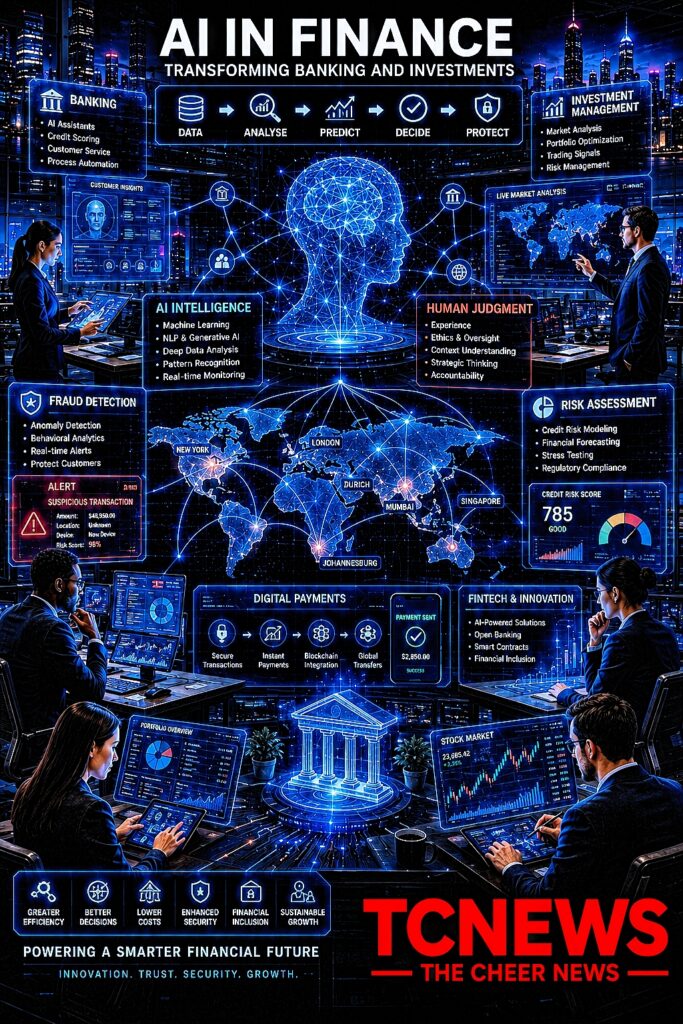
AI in finance is rapidly changing the financial industry, moving from experimental technology to a core part of banking, payments, lending, fraud detection, wealth management, and investment.
Banks once relied heavily on rule-based software and large teams to analyse transactions, assess borrowers and serve customers. Today, AI systems can examine millions of transactions, identify suspicious patterns, summarise financial documents, assist relationship managers, generate research and support investment decisions in seconds.
The transformation is accelerating in 2026.
The European Central Bank says nearly 90% of significant euro-area banks already use AI technologies, with fraud and cybercrime detection among the most common applications, followed by marketing, chatbots and credit scoring.
At the same time, the financial sector is discovering that AI is not simply a productivity tool. It can also introduce new risks. Similar algorithms may react to market events in similar ways, potentially amplifying volatility. AI systems can also create cybersecurity, privacy, operational and regulatory challenges. The Global Race for AI Talent: Which Countries Are Winning? – Credible News
As a result, the future of AI in finance will depend on finding the right balance between automation, innovation and human oversight.
What Is AI in Finance?
AI in finance refers to the use of artificial intelligence, machine learning, natural-language processing, generative AI and increasingly AI agents to perform or support financial activities.
These technologies can process huge volumes of structured and unstructured information and identify patterns that would be difficult for humans to detect manually.
In banking, AI can support:
- Fraud detection
- Credit scoring
- Customer service
- Anti-money-laundering monitoring
- Risk management
- Financial forecasting
- Cybersecurity
- Document processing
- Personalised financial advice
In investment management, AI can help with:
- Market analysis
- Portfolio construction
- Risk assessment
- Financial research
- Trading signals
- Earnings analysis
- Alternative-data analysis
- Portfolio monitoring
The important development in 2026 is that generative AI is expanding these capabilities beyond prediction and classification.
AI systems can increasingly read, summarise, reason over and interact with financial information, while emerging AI agents can perform sequences of tasks with less direct human intervention.
How AI Is Transforming Banking
1. Smarter Fraud Detection
Fraud is one of the most obvious areas where AI can create value.
Traditional fraud systems often depend on predefined rules. For example, a bank might flag a transaction because it exceeds a certain amount or occurs in an unusual location.
AI can go further.
Machine-learning systems can examine behavioural patterns across enormous numbers of transactions and identify unusual combinations of activity.
A customer’s normal spending behaviour, transaction timing, device information and account activity can all contribute to a risk assessment.
This allows banks to detect potentially fraudulent transactions faster while reducing unnecessary alerts.
The European Central Bank says fraud and cybercrime detection are currently the most common AI applications among significant euro-area banks.
However, AI does not eliminate fraud.
Criminals are also using AI to generate convincing phishing messages, impersonate people and discover weaknesses in digital systems.
The financial sector is therefore entering an increasingly sophisticated AI-versus-AI security battle.
2. AI-Powered Customer Service
Banking customers increasingly expect immediate answers.
AI assistants can provide information around the clock without requiring customers to wait for a human representative.
One of the most established examples is Bank of America’s Erica.
The bank says more than 20 million people interacted with Erica nearly 700 million times in 2025, while cumulative interactions since its 2018 launch exceeded 3.2 billion.
The technology is now moving beyond basic question-and-answer services.
In July 2026, Bank of America said its generative-AI-enhanced EricaAssist was being used by more than 18,000 customer-service representatives. The system provides contextual guidance in real time and can reduce average call times by nearly one minute per interaction.
The significance is important.
The most successful banking AI may not replace employees.
Instead, it can give employees better information at the moment they need it.
3. Personalised Banking
Traditional banking products are often designed for broad customer groups.
AI makes it possible to move toward highly personalised financial services.
A bank could analyse a customer’s income patterns, spending behaviour, savings history and financial goals to provide tailored suggestions.
For example, an AI system could identify that a customer is consistently spending more than expected and suggest adjustments.
Another customer could receive automated recommendations for saving toward a particular financial goal.
This creates the possibility of a banking experience that feels less like a product catalogue and more like a continuously available financial assistant.
But personalisation creates a major responsibility.
Banks must protect sensitive financial data and ensure algorithms do not unfairly discriminate against customers.
4. AI Is Changing Credit Decisions
Credit assessment has traditionally depended on financial histories, income records, collateral and other established indicators.
AI can analyse much larger datasets and potentially identify relationships between variables that traditional models overlook.
This can improve risk assessment and potentially help financial institutions serve customers who have limited conventional credit histories.
However, this is also one of the most sensitive applications of AI.
If a model makes an incorrect or discriminatory decision, the customer may be denied access to a loan, mortgage or other financial service.
That is why explainability and human oversight remain important.
A bank cannot simply tell a customer that an algorithm rejected an application without understanding why the system reached that conclusion. Nigeria Fintech Innovation 2025: How Digital Finance Is Reshaping Payments, Banking, and Businesses – The Cheer News
AI and Investment Management
The transformation does not stop at banking.
Investment management is also changing.
Asset managers, hedge funds, investment banks and financial advisers are increasingly using AI to process information and support investment decisions.
AI Can Read Markets at Machine Speed
Financial markets produce enormous amounts of information every day.
There are company filings, earnings calls, economic statistics, central-bank statements, analyst reports, news articles and social-media discussions.
Humans cannot process all of this information simultaneously.
AI can.
Generative AI can rapidly summarise earnings calls and financial reports, while machine-learning models can analyse historical and real-time data to identify patterns.
The IMF says AI is becoming increasingly embedded in trading and investment, with machine-learning models generating trading signals and generative AI analysing earnings calls, regulatory filings and economic news in real time.
That does not mean AI can reliably predict the market.
Financial markets remain influenced by human behaviour, unexpected events, geopolitics, monetary policy and information that may not exist in historical datasets.
AI can improve analysis.
It cannot eliminate uncertainty.
AI-Powered Portfolio Management
AI is also changing how portfolios are constructed and monitored.
Investment platforms can use algorithms to evaluate:
- Risk tolerance
- Asset allocation
- Market conditions
- Historical performance
- Correlations
- Portfolio concentration
- Potential downside scenarios
AI can then help investors and advisers consider different strategies.
For professional asset managers, the technology can continuously monitor thousands of securities and alert teams when conditions change.
This could make portfolio management faster and more data-driven.
Nevertheless, investment decisions remain vulnerable to model errors.
A system trained on historical market behaviour may perform poorly when the market enters an environment that looks different from anything in its training data.
AI Agents Could Take Finance Even Further
The next major development could be AI agents.
Unlike a chatbot that answers a question, an AI agent can potentially perform a series of connected tasks.
Imagine an investment professional asking an AI agent to:
- Review a company’s latest earnings report.
- Compare its performance with competitors.
- Analyse relevant economic indicators.
- Examine valuation metrics.
- Identify major risks.
- Prepare an investment briefing.
- Present the findings to a human portfolio manager.
The technology is not necessarily replacing the investment professional.
Instead, it can compress hours of research into a much shorter period.
The Bank for International Settlements has already identified AI agents as an important emerging development for financial intermediation, insurance, asset management and payments.
The Benefits of AI in Finance
The financial sector has several reasons to accelerate AI adoption.
Faster Decisions
AI can analyse enormous datasets in seconds.
Lower Costs
Automation can reduce the amount of manual work required for repetitive processes.
Better Fraud Detection
Machine learning can identify suspicious behaviour across large transaction networks.
Personalised Services
Customers can receive financial information and recommendations tailored to their circumstances.
Improved Research
Investment professionals can process more financial information faster.
Better Risk Management
AI can continuously monitor portfolios, transactions and operational systems.
24/7 Availability
AI-powered customer-service systems can operate around the clock.
These benefits explain why financial institutions continue investing heavily in AI despite the challenges.
The Risks: When AI Becomes a Financial Threat
The AI revolution in finance also creates serious risks.
Market Volatility
If large numbers of financial institutions use similar AI systems, they could respond to market shocks in similar ways.
That could make markets more correlated.
The BIS warns that AI can accelerate trading and portfolio adjustments, potentially intensifying short-term price movements during periods of stress.
The European Central Bank has also published research showing that different AI architectures can produce very different financial-stability outcomes, including scenarios involving bank-run-like dynamics.
This means the architecture of AI systems may itself become a financial-stability consideration.
Cybersecurity Is Becoming More Dangerous
AI can strengthen cybersecurity.
But it can also make attacks more sophisticated.
Criminals can use AI to discover vulnerabilities, automate attacks and create highly convincing social-engineering campaigns.
The IMF warned in 2026 that AI can accelerate vulnerability discovery and exploitation, while financial institutions’ dependence on shared digital infrastructure can increase systemic exposure.
A successful attack on one major technology provider could therefore affect multiple financial institutions simultaneously.
Privacy and Data Protection
Financial institutions hold some of the most sensitive personal information in the economy.
AI systems may require access to large quantities of data to function effectively.
That creates questions about:
- Who can access customer data?
- Where is it stored?
- How is it used?
- Can it be used to train AI models?
- How long is it retained?
- Can customers challenge automated decisions?
The more powerful financial AI becomes, the more important these questions will become.
AI Could Increase Financial Concentration
Another concern is that advanced AI may favour the largest institutions.
Major banks can spend billions of dollars on computing infrastructure, cybersecurity, data and specialist employees.
Smaller banks may struggle to match those resources.
This could increase concentration in financial markets.
At the same time, cloud-based AI services could democratise access by allowing smaller institutions to use sophisticated models without building everything themselves.
The outcome will depend heavily on regulation, infrastructure and competition.
The Hidden Financial Risk Behind the AI Boom
There is another dimension to AI in finance: finance is increasingly funding the AI revolution itself.
The BIS reported in January 2026 that AI investment is surging and increasingly shifting from company cash flows toward debt financing and private credit.
That creates a potential feedback loop.
Banks, private-credit firms and investors finance AI infrastructure.
AI companies and infrastructure providers expand.
Investors expect strong future returns.
More capital flows into AI.
But if expected returns fail to materialise, highly leveraged projects could become vulnerable.
The BIS has warned that the sustainability of the AI investment boom depends partly on AI firms meeting high earnings expectations.
The issue has become even more important in 2026 as AI infrastructure investment expands.
AI Is Becoming a Financial-Market Infrastructure Issue
This is why regulators are paying increasing attention.
The BIS says AI can affect financial stability through three major channels: market functioning and liquidity, operational dependencies and resilience, and the amplification and propagation of stress.
The IMF has similarly called for stronger oversight of AI-driven trading and lending, greater visibility into AI dependencies and better international cooperation on operational resilience and cyber defence.
The regulatory challenge is therefore becoming more complex.
Authorities must encourage innovation without allowing AI systems to create hidden systemic risks.
What This Means for African Banking
Africa could be one of the biggest beneficiaries of AI in finance.
Many African markets have large populations with limited access to traditional financial services.
AI could help banks and fintech companies reduce costs and expand access.
Potential applications include:
- Digital lending
- Fraud detection
- Mobile banking
- Credit scoring
- Customer support
- Financial education
- Personalised savings
- Insurance
- Cross-border payments
Nigeria is particularly well positioned because of its large fintech ecosystem and high demand for digital financial services.
However, AI adoption must be accompanied by strong data protection, cybersecurity and consumer-protection standards.
The technology should expand financial inclusion without creating new forms of exclusion.
The Future: Human Finance Meets Machine Intelligence
The most likely future is not a financial system operated entirely by machines.
Instead, finance will become increasingly human-AI collaborative.
AI will process information.
AI will identify patterns.
AI will automate routine decisions.
AI will monitor markets.
AI will support employees.
Humans will remain responsible for judgement, accountability, ethics, relationships and major strategic decisions.
This distinction matters.
Bank of America itself describes its newer AI systems as supporting employees while keeping humans at the centre of client interactions.
That model could become the dominant approach across financial services.
Why This Matters
The transformation of AI in finance is bigger than chatbots and automated banking.
Artificial intelligence is changing how money is borrowed, invested, transferred, protected and managed.
It can make financial services faster and potentially cheaper. It can improve fraud detection, expand access to financial products and give investment professionals powerful analytical capabilities.
But the same technology can accelerate market movements, amplify cyberattacks, create privacy problems and introduce new systemic risks.
The financial industry therefore faces a crucial question:
How do we make AI powerful enough to transform finance without making the financial system dangerously dependent on machines that humans do not fully understand?
The answer will shape banking and investment for decades.
Frequently Asked Questions
What is AI in finance?
AI in finance refers to the use of artificial intelligence and machine learning in banking, payments, lending, investment management, fraud detection, risk management and other financial activities.
How is AI changing banking?
AI is helping banks detect fraud, automate customer service, assess credit risk, personalise services, monitor cybersecurity threats and analyse financial information.
Can AI replace financial advisers?
AI can automate parts of financial research and portfolio analysis, but human advisers remain important for judgement, client relationships, complex financial decisions and accountability.
Is AI safe for investing?
AI can improve investment analysis, but it cannot eliminate investment risk. Models can make errors, react unexpectedly to unusual market conditions or contribute to correlated trading behaviour.
What is the biggest AI risk in finance?
One of the biggest concerns is systemic risk. If many institutions depend on similar models, cloud providers, data or algorithms, a failure or common reaction could spread rapidly across financial markets.
How will AI affect African banking?
AI could lower the cost of financial services, strengthen fraud detection, improve credit assessment and expand digital financial inclusion across Africa. However, strong cybersecurity, privacy and consumer-protection safeguards will be essential.
Conclusion
Artificial intelligence is becoming one of the most consequential technologies in modern finance.
From fraud detection and digital banking assistants to algorithmic trading, credit assessment, portfolio management and AI agents, the technology is moving deeper into the financial system.
The evidence already shows that this is not merely a future trend. Nearly 90% of significant euro-area banks are already using AI technologies, while major global financial institutions are expanding generative AI and agentic systems.
However, the financial industry cannot measure AI’s success only by efficiency.
Trust will matter.
Security will matter.
Transparency will matter.
Human accountability will matter.
And financial stability will matter.
The banks and investment firms that succeed will not necessarily be those that automate the most.
They will be those that learn how to combine machine intelligence with human judgement.
The future of finance may therefore belong neither to humans alone nor to machines alone.
It will belong to the institutions that know how to make both work together.
👇 What do you think?
#AI, #AIinFinance, #ArtificialIntelligence, #Banking, #Fintech, #Investment, #Finance, #FutureOfBanking, #Technology, #FintechAfrica, #Nigeria, #TCNEWS, #TheCheerNews,