By DAYO ADESULU
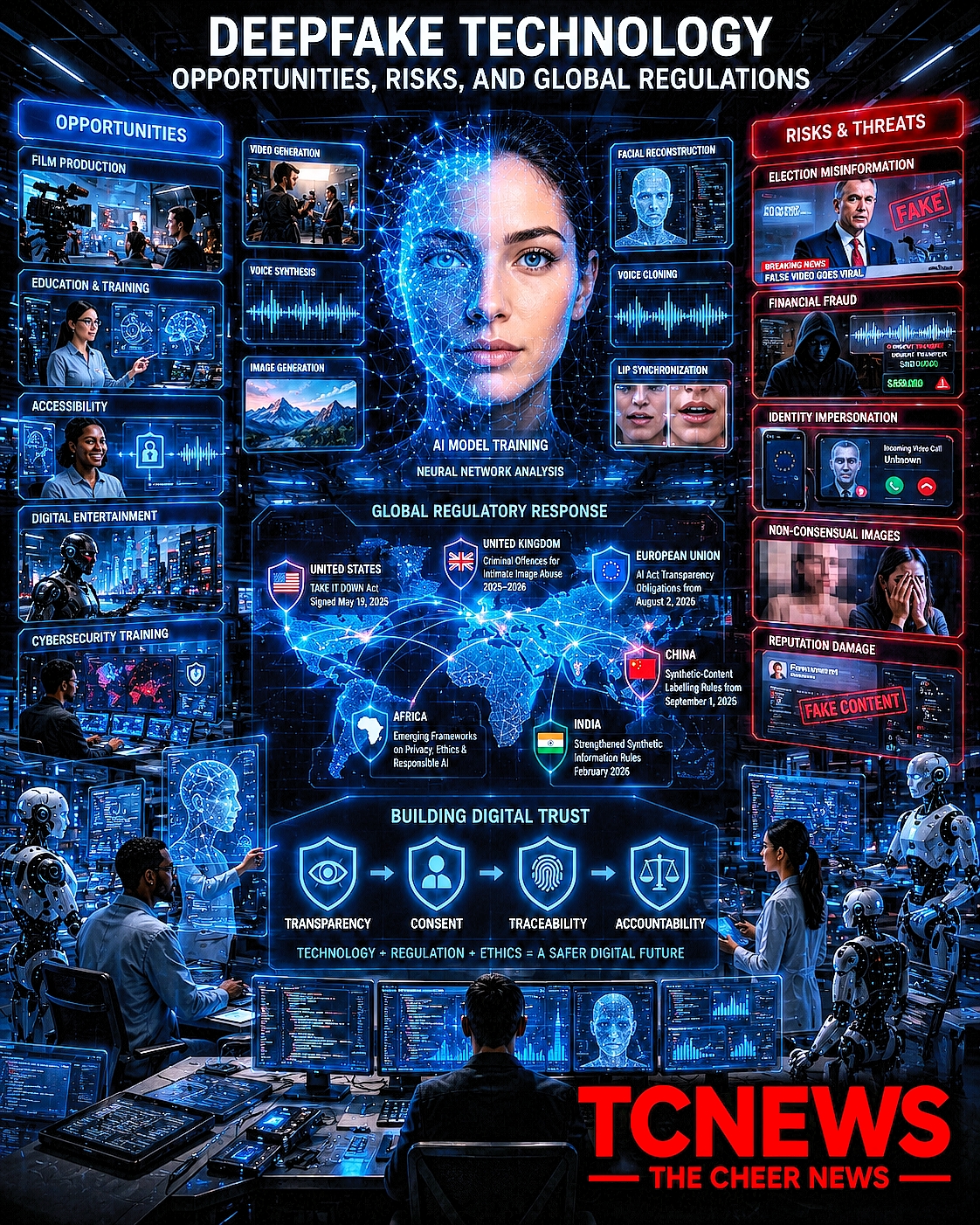
Deepfake technology is moving from a novelty of artificial intelligence to a major force shaping media, entertainment, politics, cybersecurity, and digital trust. As synthetic video, cloned voices, and AI-generated images become increasingly convincing, governments around the world are racing to determine where innovation should end and manipulation should begin.
A few years ago, creating a convincing fake video required specialist software, technical expertise, and significant computing resources. Today, increasingly sophisticated AI systems can reproduce a person’s face, imitate a voice, or generate realistic scenes with relatively little technical knowledge.
That transformation creates enormous opportunities.
Film studios can recreate historical scenes. Companies can produce multilingual training videos. Educators can create interactive learning experiences. People with speech impairments may benefit from synthetic voices. Journalists can use synthetic media for clearly identified illustrations and demonstrations.
However, the same technology can be weaponised.
A criminal can clone an executive’s voice and instruct an employee to transfer money. A political actor can fabricate a candidate appearing to make a damaging statement. A fraudster can create a convincing video call. A person’s face can be inserted into sexually explicit material without consent.
The challenge has become so significant that regulators are increasingly focusing on labelling, traceability, consent, platform responsibility and rapid removal of harmful synthetic content.
The OECD reported in 2026 that media-reported AI incidents and hazards involving synthetic media increased 2.5 times between 2022 and 2025, accounting for more than 14% of recorded incidents and hazards in the third quarter of 2025.
Meanwhile, the European Union’s AI Act transparency rules for deepfakes began applying on 2 August 2026, making this a particularly important moment for the global regulation of synthetic media. The Global Race for AI Talent: Which Countries Are Winning
What Is Deepfake Technology?
A deepfake is AI-generated or AI-manipulated content that makes a person, object, place or event appear to be authentic when it is not.
Deepfakes can involve:
- Video
- Images
- Audio
- Voice cloning
- Facial manipulation
- Lip synchronisation
- Digital avatars
- Synthetic photographs
- AI-generated performances
The technology commonly relies on machine-learning models trained to recognise patterns in faces, voices, movements and other forms of data.
For example, an AI system can analyse recordings of someone’s voice and generate new speech that sounds remarkably similar to the original speaker.
Similarly, facial-generation technology can manipulate expressions, movements and lip patterns or place one person’s likeness into another video.
This means the old question—“Does this video look real?”—is becoming increasingly unreliable.
The new question must be:
“Can the origin and authenticity of this content be verified?”
Why Deepfakes Are Becoming So Powerful
Three developments are accelerating the technology.
Better Generative AI Models
Modern generative AI can create increasingly realistic images, video and audio.
Cheaper Computing
Cloud computing and specialised AI chips have reduced the technical barriers to producing synthetic media.
Easier Consumer Tools
Users no longer need advanced programming knowledge to experiment with face-swapping, voice cloning or AI video generation.
That combination has democratised synthetic media.
It has also democratised abuse.
The Opportunities Created by Deepfake Technology
It would be a mistake to treat every synthetic image or video as harmful.
The underlying technology has legitimate and potentially transformative applications.
1. Entertainment and Film
Hollywood and global film industries have long used digital effects.
Deepfake technology can extend those capabilities by allowing filmmakers to create younger versions of actors, reconstruct historical figures or produce multilingual performances.
Used responsibly, synthetic media can reduce production costs and expand creative possibilities.
However, consent and contractual rights are becoming increasingly important.
Actors and performers will need clearer agreements covering how their likeness, voice and digital identity can be used.
2. Education and Training
Imagine a history lesson in which students interact with an AI-generated representation of a historical figure.
Or consider a medical training programme in which a synthetic patient demonstrates symptoms in different scenarios.
Deepfake technology can make educational material more immersive.
Businesses can also create training videos featuring digital presenters without requiring a full production crew.
The key requirement is transparency.
Students and employees should know when a person or scene is synthetic.
3. Accessibility
Synthetic voice technology could provide important benefits to people who have lost their ability to speak.
A person’s previous recordings could potentially be used to construct a personalised synthetic voice.
Digital avatars may also help people communicate through visual or interactive systems.
This is an example of how technology that can be abused can also provide genuine social value.
4. Multilingual Communication
AI-generated voices and avatars could help organisations produce content in multiple languages.
A presenter could deliver an educational message in English and then create versions in French, Spanish, Arabic or other languages.
For global businesses and African organisations operating across multiple linguistic markets, this could dramatically reduce the cost of localisation.
Again, however, the audience should not be deceived about whether the presenter actually recorded each version.
5. Advertising and Marketing
Brands are experimenting with digital presenters, synthetic actors and personalised advertising.
Instead of recording hundreds of versions of a campaign, AI could generate variations tailored to different markets.
That could make advertising more efficient.
Yet companies must obtain appropriate permissions when using someone’s likeness or voice.
The Dark Side: Deepfakes as a Weapon
The greatest concern is not the technology itself.
It is misuse at scale.
Political Manipulation
Deepfakes can create fake speeches, interviews or campaign messages.
A fabricated video appearing to show a politician making an inflammatory statement could spread across social media before fact-checkers have time to respond.
UNESCO and UNDP have warned that AI-generated misinformation, privacy threats, hate speech and deepfakes targeting political figures can undermine democratic processes and freedom of expression.
The danger becomes particularly acute during elections.
A false video released hours before voting could influence public opinion even if it is later debunked.
Financial Fraud and Voice-Cloning Scams
Deepfake technology is also transforming fraud.
A criminal can potentially clone the voice of a company executive and instruct an employee to make an urgent payment.
Alternatively, fraudsters can impersonate relatives, lawyers, government officials or financial advisers.
The U.S. Federal Trade Commission has warned that AI-generated deepfakes and voice cloning can significantly increase impersonation fraud.
The scale of the wider impersonation problem is already substantial: the FTC reported that consumers lost $2.95 billion to government and business impersonation scams in 2024.
Deepfake technology gives criminals another tool for making those scams more convincing.
Non-Consensual Sexual Deepfakes
One of the most damaging uses of deepfake technology is the creation of fake intimate images.
Victims can have their faces inserted into explicit material without their consent.
Women and girls have been disproportionately targeted, while the technology has also been used to harass, extort and humiliate victims.
This has become one of the areas where governments are moving fastest.
The United Kingdom’s 2026 Crime and Policing Act created offences involving the creation, adaptation, supply or offering of tools designed to generate purported intimate images, including so-called “nudification” tools.
The UK has also introduced measures requiring regulated platforms to take down reported non-consensual intimate images as soon as reasonably practicable and no later than 48 hours in specified circumstances.
Deepfakes and the Crisis of Trust
Perhaps the most profound danger is the damage deepfakes can do even when people know they exist.
This is sometimes described as the “liar’s dividend.”
If society becomes accustomed to seeing convincing fake videos, a real recording can also be dismissed as fake.
A politician accused of corruption could claim that genuine evidence was AI-generated.
A criminal caught on camera could insist that the footage was fabricated.
That means deepfakes do not simply create false evidence.
They can also weaken confidence in genuine evidence.
For journalism, courts, elections and public institutions, that is a serious problem.
The Global Regulatory Race
Governments are approaching deepfake regulation differently.
Some are creating specific laws.
Others are adapting existing privacy, criminal, election, consumer-protection and platform regulations.
The result is a fragmented global landscape.
European Union: Mandatory Transparency
The European Union has taken one of the world’s most comprehensive approaches through the AI Act.
From 2 August 2026, relevant Article 50 transparency obligations require AI-generated or manipulated content to be appropriately marked, while deployers of systems generating deepfakes must disclose that the material has been artificially generated or manipulated.
The European Commission says providers must also apply machine-readable markings to synthetic content to enable detection, subject to the applicable rules and exceptions.
The EU’s approach therefore combines:
Transparency + Labelling + Machine-readable identification + Accountability
The Commission’s 2026 Code of Practice provides practical measures to help providers and deployers comply with these obligations.
United States: Targeted Federal Protection
The United States has taken a more targeted approach rather than adopting one comprehensive federal deepfake law covering every form of synthetic media.
One major development is the TAKE IT DOWN Act, signed into law on May 19, 2025.
The law criminalises intentional disclosure of non-consensual intimate visual depictions and requires covered platforms to establish processes for removing such material.
The U.S. Federal Trade Commission has also pursued stronger tools against impersonation fraud, including action addressing government and business impersonation and proposals concerning AI-enabled impersonation of individuals.
The American model therefore places significant emphasis on:
Fraud + Impersonation + Consumer protection + Non-consensual intimate imagery
China: Mandatory Labelling and Traceability
China has developed a detailed synthetic-content identification regime.
Its Measures for the Labelling of AI-Generated Synthetic Content took effect on 1 September 2025.
The rules distinguish between visible and hidden labels.
Service providers must apply explicit labels to relevant AI-generated text, audio, images, video and virtual scenes, while metadata must contain implicit identification information. Platforms distributing content must also take steps to identify and label synthetic material.
China’s approach is therefore heavily focused on:
Identification + Traceability + Platform responsibility
It also prohibits malicious deletion, alteration, forgery or concealment of required synthetic-content labels.
United Kingdom: Criminalising Harmful Deepfake Abuse
The UK has increasingly focused on harmful intimate deepfakes.
The Data (Use and Access) Act 2025 introduced offences relating to creating or requesting the creation of purported intimate images of adults without consent.
The 2026 Crime and Policing Act went further by criminalising the making or supply of certain tools designed to generate purported intimate images.
The UK approach illustrates an important regulatory trend:
Governments are beginning to regulate not only the harmful content but also the tools specifically designed to facilitate abuse.
India: Stronger Rules for Synthetic Content
India has also strengthened its framework.
In February 2026, amendments to the Information Technology Rules introduced measures specifically addressing synthetically generated information, including deepfakes and AI-generated content.
According to India’s Ministry of Electronics and Information Technology, platforms must deploy reasonable technical measures against unlawful synthetic content, while permissible AI-generated content must carry clear labelling and traceable metadata.
The framework covers areas including:
- Impersonation
- Non-consensual intimate imagery
- Child sexual exploitation material
- Misleading synthetic content
- Obscene material
- Privacy violations
India has also required action against unlawful AI-generated or manipulated content in election contexts, with the Election Commission saying campaign material using synthetic or AI-altered content should be clearly labelled.
Nigeria: Privacy and Responsible AI Become Central
Nigeria does not yet have a single comprehensive deepfake statute equivalent to the EU’s AI Act.
Instead, deepfake-related harms can intersect with existing privacy, cybercrime, criminal, communications and consumer-protection frameworks.
The Nigeria Data Protection Commission has, however, increasingly highlighted the privacy implications of AI-generated imagery.
In February 2026, the NDPC joined international data protection authorities in a joint statement warning about realistic AI-generated images and videos depicting identifiable people without their knowledge or consent.
The statement specifically highlighted defamatory content, non-consensual intimate imagery, cyberbullying and exploitation risks, while calling for stronger safeguards, transparency and rapid removal mechanisms.
Nigeria’s emerging AI governance ecosystem also emphasises accountability, transparency, ethical AI and human-centred governance.
For Nigeria, the challenge will be developing rules that protect citizens without unnecessarily restricting legitimate AI innovation.
Why Labelling Alone May Not Be Enough
Labelling is important.
But it does not solve every deepfake problem.
A malicious actor can potentially remove a visible label.
A screenshot can eliminate metadata.
A video can be re-recorded from another screen.
A manipulated clip can be uploaded to a platform that lacks sophisticated detection systems.
That is why experts increasingly discuss content provenance.
Instead of simply asking whether something “looks fake,” provenance systems attempt to establish information about where content originated, how it was modified and which tools were involved.
Machine-readable credentials, metadata and digital signatures could therefore become increasingly important.
The Technology Arms Race: Generation vs Detection
Every improvement in deepfake generation creates pressure for better detection.
AI companies and cybersecurity firms are developing systems that analyse:
- Facial inconsistencies
- Lip movements
- Audio patterns
- Lighting
- Compression artefacts
- Metadata
- Biological signals
- Image provenance
- Synthetic fingerprints
But detection is becoming a moving target.
As generation improves, some detection methods become less reliable.
This creates a technological arms race:
AI GENERATION → AI DETECTION → BETTER GENERATION → BETTER DETECTION
The long-term solution may therefore depend less on detection alone and more on authentication and provenance.
What Journalists Should Do About Deepfakes
The rise of synthetic media creates a new responsibility for journalists.
Newsrooms should never publish a suspicious video simply because it is going viral.
Instead, reporters should:
Verify the original source
Find the earliest available version.
Examine metadata
Where available, check file information and provenance.
Compare multiple sources
Look for independent confirmation.
Contact the person involved
Where practical, ask the alleged speaker or organisation for confirmation.
Analyse the context
Determine when and where the supposed event occurred.
Use forensic tools cautiously
AI detection tools can provide evidence but should not automatically be treated as definitive proof.
Explain uncertainty
If authenticity cannot be established, tell readers.
In the deepfake era, “we cannot independently verify this video” is often better journalism than pretending to know.
How Businesses Can Protect Themselves
Businesses also need new security procedures.
A company should not approve a major financial transaction solely because an executive appears to have ordered it through a video call.
Instead, organisations should establish independent verification protocols.
For example:
Voice instruction → secondary verification
Video call → callback through a trusted number
Urgent payment request → multi-person approval
Password reset → identity verification
AI has changed the threat environment.
Companies must therefore change their verification procedures.
Deepfakes Could Transform Cybersecurity
The same technology used to create deepfakes can also help cybersecurity teams.
Synthetic media can be used in controlled environments to train employees against sophisticated social-engineering attacks.
Security teams could simulate realistic phishing calls, fake executive requests and manipulated videos without exposing real people to harm.
That creates an unusual paradox:
Deepfake technology can become both a cyber threat and a cybersecurity training tool.
The Future of Deepfake Technology
The technology is likely to become:
Cheaper.
Faster.
More realistic.
More accessible.
And increasingly integrated into mainstream creative software.
At the same time, regulation will become more sophisticated.
Governments are likely to focus increasingly on:
- Consent
- Identity rights
- Provenance
- Watermarking
- Platform accountability
- Election integrity
- Consumer fraud
- Child protection
- Non-consensual intimate imagery
- Cross-border enforcement
The biggest challenge will be maintaining a balance.
Overregulation could discourage legitimate creative and technological applications.
Underregulation could allow synthetic media to undermine privacy, democracy and public trust.
Why This Matters
Deepfake technology is not simply another AI trend.
It is changing the meaning of evidence.
For decades, society largely treated photographs, recordings and videos as strong forms of proof.
That assumption is weakening.
A convincing video can now be fabricated.
A person’s voice can be cloned.
A photograph can be generated without a camera.
A public figure can be made to appear to say something they never said.
That means digital literacy will become increasingly important.
Citizens, journalists, businesses, courts and governments will need better ways to establish authenticity.
The regulatory developments of 2025 and 2026 show that governments are beginning to recognise the urgency. The EU has moved into mandatory transparency requirements; China has established detailed labelling and traceability rules; the United States has enacted federal protections against non-consensual intimate deepfakes; the UK has criminalised additional forms of intimate-image abuse; and India has strengthened platform duties around synthetic information.
For Nigeria and other African countries, the opportunity is to build strong safeguards before deepfake abuse becomes even more widespread.
Frequently Asked Questions
What exactly is a deepfake?
A deepfake is AI-generated or AI-manipulated audio, image or video that can make a person, place, object or event appear authentic when it is not.
Are all deepfakes illegal?
No. Synthetic media can have legitimate uses in entertainment, education, accessibility, advertising and research. Laws generally focus on harmful uses such as fraud, impersonation, non-consensual intimate imagery, misinformation and other unlawful conduct.
Can deepfakes be detected?
Sometimes, but detection is becoming increasingly difficult as generative AI improves. Provenance, metadata and authentication technologies are therefore becoming increasingly important alongside detection.
Which countries have deepfake regulations?
The European Union, China, United States, United Kingdom and India have all introduced or strengthened measures addressing different forms of synthetic media. Their approaches differ significantly.
Is deepfake technology dangerous for elections?
Yes. Fake political videos or cloned voices can spread false claims about candidates and potentially influence voters. UNESCO and UNDP have highlighted deepfakes and AI-driven disinformation as emerging threats to democratic processes.
Can deepfake technology be useful?
Absolutely. It can support film production, education, accessibility, multilingual communication, advertising, training and cybersecurity simulations.
What should I do if I receive a suspicious video?
Do not immediately share it. Check the original source, look for independent confirmation, examine the context and seek credible reporting before treating the material as authentic. https://www.thecheernews.com/dangote-group-leverages-advanced-technology-to-drive-efficiency-across-industries/
Conclusion
Deepfake technology represents one of artificial intelligence’s greatest contradictions.
It can democratise creativity while enabling sophisticated fraud.
It can make education more immersive while making misinformation more convincing.
It can help people communicate while allowing criminals to impersonate them.
And it can make entertainment more powerful while challenging society’s ability to distinguish reality from fabrication.
The technology itself is not inherently good or evil.
Its impact depends on how it is developed, deployed, labelled, regulated and used.
The regulatory race is already underway.
The European Union is demanding greater transparency. China is requiring identification and traceability. The United States has enacted federal protections against non-consensual intimate deepfakes. Britain is criminalising increasingly sophisticated forms of synthetic-image abuse. India is strengthening platform responsibilities, while Nigeria is placing greater emphasis on privacy, responsible AI and protection from harmful AI-generated imagery.
But laws alone will not solve the problem.
Technology companies must build safer systems.
Platforms must respond quickly to abuse.
Journalists must verify before publishing.
Businesses must strengthen identity verification.
And ordinary users must learn to question digital evidence.
The future may not be a world where we stop believing videos.
It may be a world where authenticity itself becomes a technology—verified through provenance, trusted sources, digital credentials, and responsible human judgment.
That is the real challenge of the deepfake era.
#DeepfakeTechnology, #DeepfakeAI, #ArtificialIntelligence, #AI, #Cybersecurity, #DigitalTrust, #FutureOfTechnology, #TechNews, #TCNEWS, #TheCheerNews,