By DAYO ADESULU
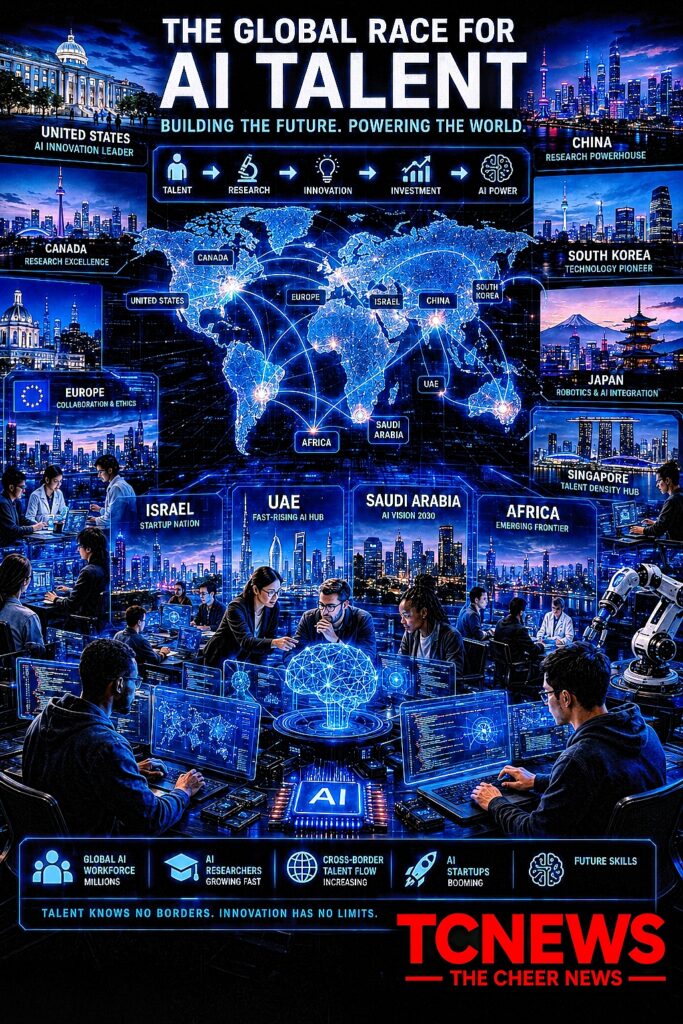
The global race for AI talent now wants the world to know which countries are winning as artificial intelligence is becoming a contest not only over computing power, chips, and investment, but also over something much harder to manufacture: human talent.
Behind every frontier AI model, autonomous agent, robotics system and scientific breakthrough is a network of researchers, engineers, data scientists, mathematicians, entrepreneurs and technical leaders. Countries that attract and retain these people gain a powerful advantage in building AI companies, developing domestic models and translating research into economic growth.
That is why the global race for AI talent has intensified in 2026.
The United States remains the world’s largest AI talent hub, backed by deep capital markets, leading technology companies, universities and research laboratories. China, meanwhile, has built enormous research capacity and is rapidly closing the technological gap with America. India combines a huge technology workforce with rapidly expanding AI expertise. Singapore, Switzerland, Israel, the United Kingdom, Canada and South Korea remain important specialist hubs.
At the same time, the United Arab Emirates and Saudi Arabia are emerging as aggressive new competitors, while countries such as South Africa are becoming increasingly important in Africa’s AI ecosystem.
However, the race is changing.
The latest evidence suggests that having AI talent is no longer enough. Countries must attract it, retain it, educate more of it and create an environment where researchers can actually build companies and technologies.
According to Stanford University’s 2026 AI Index, the number of AI researchers and developers moving to the United States has fallen 89% since 2017, including an 80% decline in the most recent year measured. Yet America remains home to more AI talent than any other country. AI in Finance: How Artificial Intelligence Is Transforming
That creates a fascinating question:
Who is actually winning the global race for AI talent?
The United States: Still the World’s Biggest AI Talent Magnet
For now, the United States remains the strongest overall AI ecosystem.
Its advantage comes from more than the number of researchers.
The country combines:
- World-class universities
- Major AI research laboratories
- Silicon Valley and other technology hubs
- Enormous venture-capital markets
- Leading cloud companies
- Advanced semiconductor ecosystems
- High salaries for AI specialists
- A large market for deploying AI
- A deep network of technology entrepreneurs
Stanford’s 2026 AI Index reports that the United States produced 59 notable AI models in 2025, compared with 35 from China. It also remains the leading country for higher-impact AI patents and private AI investment.
U.S. private AI investment reached $285.9 billion in 2025, more than 23 times China’s reported $12.4 billion in private investment, although Stanford cautions that private investment figures do not capture China’s full state-supported AI spending.
However, America’s biggest advantage is facing a challenge.
Its ability to attract additional international AI researchers is weakening.
Stanford’s finding that AI researchers and developers moving to the U.S. have fallen 89% since 2017 is particularly significant because international recruitment has historically been one of America’s greatest strengths.
That does not mean the U.S. is losing its talent base.
Rather, it means the rest of the world is becoming much better at competing for it.
China: The Most Powerful Challenger
China has built perhaps the strongest alternative to America’s AI ecosystem.
Its advantage lies in scale.
China has enormous numbers of engineering graduates, a large domestic market, extensive industrial capacity and strong government support for artificial intelligence.
Stanford’s 2026 AI Index says China leads the world in AI publication volume, citations and patent grants, while the U.S. continues to lead in notable model production and higher-impact patents.
The gap between American and Chinese frontier models has also narrowed dramatically.
Stanford reports that U.S. and Chinese models have traded the lead several times since early 2025, with the performance gap between the leading systems becoming extremely small by early 2026.
That matters for the talent race.
Researchers are more likely to remain in or move to an ecosystem where they can access:
Data + Compute + Funding + Research Institutions + Industrial Applications.
China increasingly offers all five.
The emergence of companies such as DeepSeek has further demonstrated that Chinese researchers can produce globally competitive AI systems despite restrictions on access to some advanced computing hardware.
China therefore isn’t merely producing AI talent.
It is increasingly creating an environment capable of absorbing and deploying that talent at national scale.
India: A Giant Talent Reservoir
India occupies a unique position in the global AI race.
It has one of the world’s largest technology workforces, a huge population of engineering graduates and a mature software-services industry.
The country is now trying to move beyond its traditional role as a global technology outsourcing centre and become a major AI development hub.
Stanford’s 2026 AI Index found that India’s AI talent concentration increased by 120% between 2019 and 2025, one of the fastest increases recorded.
BCG’s 2026 Global Talent Tracker also places India among the top three destinations for STEM and AI talent. However, the consultancy notes that much of the inflow appears connected to Indians returning home from countries such as the United States, United Kingdom, UAE and Canada rather than a broad influx of foreign AI professionals.
India therefore has an enormous opportunity.
But it faces a major challenge.
The country’s traditional IT-services model is being disrupted by generative AI.
The Financial Times reported in August 2026 that India’s technology industry is already experiencing layoffs and reduced hiring as companies adapt to AI automation.
India’s future advantage will therefore depend on whether it can transform its enormous software workforce into a globally competitive AI engineering and product-development workforce.
Singapore: Small Country, Extraordinary AI Density
Singapore demonstrates that population size does not determine AI influence.
The city-state has developed one of the world’s highest concentrations of AI expertise.
Stanford’s 2026 AI Index places Singapore second globally in AI talent concentration, behind Israel.
Singapore benefits from:
- Strong universities
- Excellent digital infrastructure
- High-quality research institutions
- International connectivity
- Business-friendly policies
- Major multinational technology operations
- Strong government investment
It is also one of the countries where generative AI adoption is particularly high.
Stanford reports that generative AI reached 61% population adoption in Singapore, compared with 28.3% in the United States.
That combination of talent, infrastructure and adoption makes Singapore an important AI hub far beyond its geographical size.
Israel: The Talent-Density Powerhouse
Israel occupies another unusual position.
It does not have the population of the United States, China or India.
Yet it has an exceptionally high concentration of AI talent.
According to LinkedIn data reported in Stanford’s 2026 AI Index, Israel had the world’s highest AI talent concentration in 2025 at 2.1% of LinkedIn members, followed by Singapore at 1.82% and Luxembourg at 1.60%.
Israel’s strengths include:
- Artificial intelligence
- Cybersecurity
- Defence technology
- Computer science
- Entrepreneurship
- Advanced research
Its close relationship between military technology, universities and startups has helped create an unusually dense technology ecosystem.
Israel’s challenge, like Singapore’s, is scale.
The country can produce highly sophisticated AI expertise, but it cannot match the workforce size of China, India or the United States.
The United Kingdom and Europe: Strong Research, Fierce Competition
Europe remains a major player in the AI talent race.
The United Kingdom has strong universities, research institutions, startups and technology companies.
Germany, France, Switzerland and other European countries also have deep technical talent pools.
Switzerland is particularly notable for talent density.
Stanford reports that Switzerland and Singapore lead the world in AI researchers and developers per capita.
Germany is also gaining ground as a research destination.
BCG’s 2026 research places Germany third globally as a destination for research talent, while France and Spain recorded gains across multiple talent categories.
However, Europe faces a structural problem.
Its AI ecosystem is fragmented across multiple countries.
A researcher may have access to excellent universities in one country, strong industrial research in another and venture capital somewhere else.
The European challenge is therefore not simply producing talent.
It is keeping that talent inside a competitive innovation ecosystem.
Canada: A Former Leader Facing Pressure
Canada has traditionally been one of the world’s most important AI research hubs.
Toronto, Montreal and Edmonton have produced influential AI research communities.
The country has also benefited from international researchers and major university programmes.
However, the global talent race is becoming more competitive.
BCG’s June 2026 research found that Canada fell from third to seventh place among destinations for highly skilled talent, recording the largest single-year market-share loss among major destinations.
That does not mean Canada’s AI ecosystem is collapsing.
Rather, it demonstrates how quickly the competitive landscape is changing.
Researchers now have more alternatives.
UAE: The Fast-Rising AI Talent Hub
Perhaps the most interesting new entrant is the United Arab Emirates.
The UAE has aggressively positioned itself as an international AI hub.
It has invested heavily in infrastructure, research, education, and technology partnerships.
Stanford’s 2026 AI Index found that UAE AI talent concentration increased by 121% between 2019 and 2025, the fastest growth among the countries measured.
BCG’s latest research also shows the UAE attracting nearly 194,000 highly skilled workers, gaining 0.8 percentage points of global talent share. It is rapidly approaching the United Kingdom in several talent categories.
This is significant because the UAE is not merely trying to train local talent.
It is trying to import global talent.
Its strategy combines:
High salaries + infrastructure + international lifestyle + government investment + AI ambition.
That could make the UAE one of the world’s most important AI talent destinations over the next decade.
Saudi Arabia Wants a Place at the AI Table
Saudi Arabia is also emerging as a serious competitor.
Stanford reports that Saudi Arabia’s AI talent concentration increased by 113% between 2019 and 2025.
BCG also found that Saudi Arabia recorded the highest talent-retention ratio among major destinations, at 2.6 times.
The significance goes beyond recruitment.
Saudi Arabia wants to build a domestic technology ecosystem capable of supporting its economic diversification strategy.
AI fits naturally into that ambition.
The country can use large-scale investment to attract researchers, entrepreneurs and technical specialists while developing its own universities, technology companies and infrastructure.
South Korea: Innovation Density Matters
South Korea has another advantage: technological manufacturing.
The country is a global leader in semiconductors, electronics and industrial technology.
Stanford’s AI Index identifies South Korea as the global leader in AI patents per capita, demonstrating its unusually high innovation density.
This gives South Korea an important strategic position.
AI is not only software.
It increasingly depends on:
Chips + Robotics + Manufacturing + AI Software + Research
South Korea operates at the intersection of these sectors.
Africa: The Continent Nobody Can Ignore
Africa does not yet compete with the United States or China in frontier AI model production.
But that does not mean the continent is irrelevant to the AI talent race.
Quite the opposite.
Africa has a young population, expanding digital economies and enormous demand for AI applications in:
- Agriculture
- Healthcare
- Financial services
- Education
- Logistics
- Telecommunications
- Government services
Stanford’s 2026 AI Index identifies South Africa as one of the countries where AI engineering skills have been growing particularly quickly since 2022, alongside the UAE and Chile.
The continent also has growing AI communities in countries including Nigeria, Kenya, Egypt, Ghana and Rwanda.
For Africa, the strategic question is different.
It is not necessarily about creating the next frontier model immediately.
It is about developing enough skilled people to build African AI companies, adapt global models to local needs and prevent the continent from becoming merely a consumer of foreign AI systems.
Nigeria: A Huge Opportunity and a Serious Challenge
Nigeria deserves particular attention.
The country has one of Africa’s largest technology communities and a huge population of young people.
Its fintech sector has already demonstrated that Nigerian technology companies can develop solutions with global relevance.
AI could create a similar opportunity.
Nigeria could develop expertise in:
- AI engineering
- Fintech AI
- Agricultural AI
- Healthcare AI
- Language models
- Cybersecurity
- AI-enabled media
- Education technology
However, talent development requires more than enthusiasm.
Nigeria needs:
Better computing infrastructure.
Stronger university-industry partnerships.
Advanced AI research programmes.
Reliable electricity and connectivity.
Competitive compensation.
Funding for AI startups.
Policies that encourage researchers to remain in the country.
Otherwise, talented Nigerians may continue to build their careers elsewhere.
And that brings the global talent race back to its central issue:
Talent follows opportunity.
The New Winners Are Not Necessarily the Biggest Countries
One of the most important lessons from the data is that AI talent concentration and total talent are different measurements.
The United States may have the world’s largest AI talent ecosystem.
China may have enormous research capacity.
India has a massive technology workforce.
But countries such as Israel, Singapore and Switzerland can outperform their population sizes in talent density.
Stanford’s data shows that Israel and Singapore lead AI talent concentration, while Switzerland and Singapore lead AI researchers and developers per capita.
That means smaller countries can compete by becoming specialised AI magnets.
Why AI Talent Is Becoming a National-Security Issue
The AI talent race is no longer simply about jobs.
It is increasingly connected to national security.
Countries that control advanced AI expertise can develop better:
- Cybersecurity systems
- Intelligence tools
- Autonomous systems
- Military technologies
- Surveillance capabilities
- Scientific research
- Critical infrastructure
This explains why governments are increasingly treating AI researchers as strategic assets.
The competition is therefore becoming similar to previous races over nuclear scientists, aerospace engineers and semiconductor specialists.
But there is one major difference.
AI talent is highly mobile.
A researcher can potentially work in New York, London, Toronto, Singapore, Dubai or Zurich without physically moving their entire research infrastructure.
Remote work, international laboratories and global research collaborations are changing the traditional meaning of a national workforce.
The AI Talent Race Is Becoming a Competition for Ecosystems
Money alone cannot win this race.
A country can offer enormous salaries and still struggle if researchers cannot access good universities, computing infrastructure, research partners or entrepreneurial opportunities.
The strongest AI ecosystems combine several factors.
Education
Universities must produce researchers and engineers.
Research
Scientists need laboratories, computing resources and freedom to experiment.
Capital
Startups require venture funding.
Infrastructure
AI requires enormous computing and energy resources.
Industry
Researchers need companies capable of turning ideas into products.
Immigration
Countries need policies that allow international talent to enter and remain.
Quality of Life
Researchers and their families also consider safety, education, healthcare and living conditions.
The winning countries will be those that connect these elements.
The Great Talent Shift
Perhaps the most important development is that AI talent is becoming less geographically concentrated.
Stanford reports that the number of AI researchers and developers moving to the U.S. has dropped dramatically, while countries such as the UAE, India and Saudi Arabia have recorded rapid growth in AI talent concentration.
BCG’s research tells a similar story.
International mobility declined in 2025, with cross-border moves among highly skilled professionals falling from 3.7 million to 3.3 million.
AI talent mobility fell 12%.
Yet competition for the people who do move has intensified.
The world may therefore be entering a new phase:
AI talent is becoming more strategically valuable while becoming less willing or able to move freely.
That makes retention increasingly important.
What Countries Must Do to Win
Governments hoping to compete in AI should focus on five priorities.
1. Build AI Education Early
AI education cannot begin at postgraduate level.
Countries need strong mathematics, computer science and computational thinking programmes from secondary school.
2. Fund Research
Universities need access to advanced computing and research funding.
3. Attract Global Experts
Immigration policies can determine whether a country gains or loses scarce AI specialists.
4. Create Startup Ecosystems
Researchers need pathways from laboratories into companies.
5. Retain Local Talent
Training thousands of AI specialists is pointless if most leave because better opportunities exist elsewhere.
Why This Matters
The global race for AI talent could determine which countries capture the economic benefits of the next technological revolution.
AI models can be downloaded.
Software can be copied.
Computing hardware can be purchased.
But exceptional researchers and engineers are much harder to replicate.
That is why the world’s largest economies are competing aggressively for them.
The United States still has the deepest overall AI ecosystem. China is closing the technological gap. India is rapidly expanding its talent base. Singapore, Israel and Switzerland demonstrate the power of talent density. The UAE and Saudi Arabia are proving that ambitious governments can rapidly reshape talent flows. Europe remains a major research centre, while African countries are beginning to build their own AI capabilities. Dangote Partners CNN to Showcase Africa’s Rising Global Business Influence – The Cheer News
The biggest surprise may be that the race is no longer dominated entirely by traditional technology powers.
New AI hubs are emerging.
And the countries that win may not simply be those with the most people.
They may be the countries that create the best environment for brilliant people to learn, research, build companies and stay.
Frequently Asked Questions
Which country currently has the most AI talent?
The United States remains home to more AI researchers and developers than any other country, according to Stanford’s 2026 AI Index. However, countries such as Israel and Singapore have higher AI talent concentration relative to their populations.
Is China ahead of the United States in AI?
China leads the U.S. in several research indicators, including publication volume, citations and patent grants. The U.S. leads in notable model production and higher-impact patents. Stanford says the performance gap between leading U.S. and Chinese models has effectively closed.
Is India becoming an AI superpower?
India is rapidly increasing its AI talent concentration and ranks among the top destinations for STEM and AI talent. Its large technology workforce gives it enormous potential, although the country must transition from traditional IT services toward higher-value AI development.
Which country is gaining AI talent the fastest?
The UAE recorded the fastest increase in AI talent concentration among the countries highlighted by Stanford, rising 121% between 2019 and 2025. India rose 120%, while Saudi Arabia increased 113%.
Is Africa participating in the AI talent race?
Yes. Although Africa remains behind the leading global AI powers in frontier-model development, AI engineering skills are growing in several countries. Stanford identifies South Africa as one of the countries with particularly rapid growth in AI engineering skills.
Why is AI talent important?
AI researchers and engineers create the models, products, infrastructure and applications that drive the AI economy. Countries that attract and retain this talent are better positioned to gain economic, scientific and strategic advantages.
Conclusion
The global race for AI talent is no longer a distant competition.
It is happening now.
The United States still leads in overall ecosystem strength. China is challenging its technological dominance. India is turning its enormous technology workforce into an increasingly important AI asset. Meanwhile, Singapore, Israel and Switzerland are proving that talent density can matter as much as population size.
At the same time, the UAE and Saudi Arabia are changing the rules by aggressively recruiting global specialists.
Africa is still building its position, but its young population and expanding technology communities give the continent a potentially enormous long-term advantage.
The next phase of the AI revolution will therefore not be decided solely in data centres.
It will be decided in universities, laboratories, startups, technology companies and classrooms around the world.
The countries that understand this early will have an advantage.
Because in the AI economy, the most valuable resource may not be the chip.
It may be the person who knows what to do with it.
AITalent, #AI, #ArtificialIntelligence, #FutureOfTechnology, #AI2026, #TechNews, #GlobalAI, #AfricaTech, #NigeriaTech, #TCNEWS, #TheCheerNews.