🇳🇬 Nigeria’s $1.1 Billion Medical Tourism Problem Signals Deep Healthcare Crisis
By DAYO ADESULU
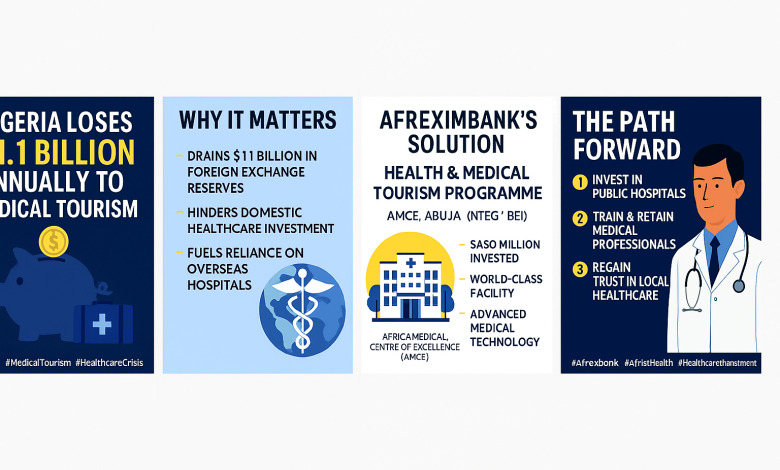
Medical tourism in Nigeria is costing the country an estimated $1.1 billion annually, according to the African Export-Import Bank (Afreximbank). This trend, the bank warns, not only drains Nigeria’s scarce foreign exchange reserves but also cripples growth in the local health sector.
💸 Medical Tourism in Nigeria: A Massive Foreign Exchange Drain
Speaking during the 32nd Afreximbank Annual Meetings in Abuja, Oluranti Doherty, the Bank’s Managing Director for Export Development, described medical tourism as one of the biggest impediments to Nigeria’s economic and healthcare advancement.
- Nigeria Unveils Ambitious Health Sector Overhaul Plan: The National Health Sector Renewal Initiative (NHSRII)
- Testosterone Deficiency In Men Indicates 5 Health Risk Factors
- https://www.thecheernews.com/majority-of-private-health-training-institutions-in-katsina-fail-to-meet-standards/
“Nigeria’s medical tourism costs us $1.1 billion every year. Across Africa, it’s about $7 billion. That’s capital flowing out of our economies and into foreign ones,” Doherty stated.
These funds, she added, are used to build foreign healthcare institutions, while Nigeria’s domestic medical system remains underfunded and underdeveloped.
🏥 Local Healthcare Infrastructure Investment Being Stifled
The loss of capital to overseas medical expenses represents a missed opportunity for healthcare investment within Nigeria. While citizens seek treatment abroad for chronic illnesses, local hospitals and clinics continue to suffer from:
- Poor infrastructure
- Insufficient equipment
- Low funding for research and innovation
- Inadequate public-private partnerships
“This level of capital flight slows down domestic investments and leaves our system dependent and fragile,” Doherty emphasized.
🌍 Africa’s Brain Drain: The Loss of Medical Talent
Another worrying trend is the continued migration of top Nigerian medical professionals to countries like the U.S., India, UK, and UAE. Doherty noted that Africa’s best health workers are being lost to foreign labor markets, creating a talent vacuum locally.
“Our brightest healthcare workers are abroad, driving innovation elsewhere while we’re left behind.”
This talent loss exacerbates the poor quality of care and forces more Nigerians to seek treatment overseas, creating a vicious cycle.
💡 Afreximbank’s Bold Intervention: Health and Medical Tourism Programme
Recognising the growing threat early, Afreximbank launched the Health and Medical Tourism Programme in 2012. The initiative aims to reposition healthcare as a driver of economic growth across Africa.
🌟 Africa Medical Centre of Excellence (AMCE), Abuja
One of the programme’s flagship projects is the Africa Medical Centre of Excellence (AMCE) in Abuja. Highlights include:
- $450 million investment by Afreximbank
- 170-bed facility
- 3-Tesla MRI scanner
- 18 MeV cyclotron
- 20-bed intensive care unit
- State-of-the-art diagnostics and treatment technologies
“This centre isn’t just for Africans—it’s on par with global healthcare standards,” Doherty noted. “It’s a solution from Africa, for Africa.”
🔄 Rebuilding Trust in Nigeria’s Healthcare System
Doherty called on policymakers and the private sector to restore trust in local health services, ensure quality care is accessible, and implement reforms that discourage outbound medical travel.
To reverse the damage caused by medical tourism in Nigeria, she recommended:
- Increased government investment in public hospitals
- Better training and retention strategies for medical professionals
- Incentives for private healthcare investors
- Stronger regulatory oversight and transparency in the health sector
📊 The Cost of Inaction
Without bold reforms, Nigeria risks:
| Impact Area | Effect |
|---|---|
| Foreign Exchange | $1.1 billion loss annually |
| Talent | Ongoing medical brain drain |
| Infrastructure | Neglect of hospitals and clinics |
| Economy | Missed opportunities in healthcare investment |
🔚 Conclusion: From Dependency to Self-Reliance
Afreximbank’s findings are a wake-up call for Nigeria and other African nations. Medical tourism is not just a health issue—it’s an economic liability. Investments like the AMCE in Abuja show that Africa can lead in healthcare innovation—if governments and stakeholders act decisively.