The Future of AI-Powered Search: Is Google Losing Its Dominance?

By DAYO ADESULU
For more than two decades, Google has been the undisputed leader in online search, helping billions of people find information with just a few keywords. Its search engine became so dominant that “Google it” entered everyday language as a synonym for searching the internet.
However, artificial intelligence is changing the rules.
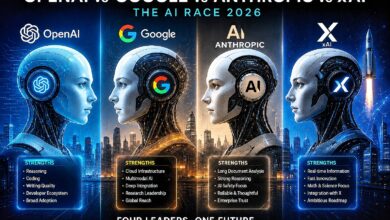
Instead of scrolling through pages of blue links, millions of users are now asking AI assistants complete questions and receiving direct, conversational answers in seconds. Platforms such as ChatGPT, Google’s Gemini, Microsoft’s Copilot, Perplexity AI, and xAI’s Grok are ushering in a new era of AI-powered search that could fundamentally reshape how people access information online.
This technological shift has sparked one of the biggest questions in the digital world:
Is Google losing its dominance, or is it simply evolving into the next generation of search?
What Is AI-Powered Search?
Traditional search engines primarily match keywords with indexed web pages and rank results based on hundreds of factors, including relevance, authority, and user experience.
AI-powered search goes a step further.
Rather than simply displaying links, AI systems:
- Understand natural language.
- Interpret context and intent.
- Summarize information from multiple sources.
- Answer complex questions conversationally.
- Generate comparisons, explanations, and recommendations.
- Support follow-up questions without requiring users to start over.
This conversational approach allows users to interact with search engines almost as if they were speaking with a knowledgeable assistant.
Why Search Is Changing
Several trends are driving the shift toward AI-powered search.
People Want Faster Answers
Modern internet users increasingly prefer direct answers over browsing multiple websites.
Whether researching a medical condition, comparing smartphones, or planning a vacation, many users now expect AI to summarize the information instantly.
More Complex Questions
Traditional search works well for simple queries like:
- Weather today
- Best restaurants nearby
- Latest football scores
However, AI excels when users ask more detailed questions such as:
“Compare electric vehicles under $40,000 with the longest battery life and lowest maintenance costs.”
AI can provide structured responses that would otherwise require visiting numerous websites.
Multimodal Search
Modern AI systems increasingly understand:
- Text
- Images
- Voice
- Documents
- Videos
Users can upload photographs, PDFs, screenshots, or diagrams and ask AI to analyze them.
This represents a significant evolution beyond traditional keyword searches.
Google’s AI Transformation
Google has responded aggressively to the rise of generative AI.
Its search experience increasingly integrates AI-generated summaries that appear before traditional web links, aiming to provide users with faster answers while still connecting them to original sources.
Google also continues expanding AI capabilities across its broader ecosystem, including Android, Chrome, Gmail, Google Workspace, Maps, and Cloud services.
Rather than abandoning search, Google is attempting to reinvent it for the AI era.
The New AI Search Competitors
ChatGPT
OpenAI has transformed how millions of people search for information.
Many users now begin their research with conversational prompts instead of traditional search engines.
ChatGPT is particularly useful for:
- Learning new concepts
- Research summaries
- Writing assistance
- Coding
- Brainstorming
- Business planning
Perplexity AI
Perplexity has emerged as one of the fastest-growing AI-native search platforms.
Unlike many chatbots, it emphasizes cited sources, allowing users to verify information more easily.
This approach has attracted researchers, students, and professionals seeking greater transparency.
Microsoft Copilot
Microsoft has integrated AI into Bing and Microsoft 365.
Its strategy focuses on combining internet search with workplace productivity.
Users can search the web, summarize documents, analyze spreadsheets, and create presentations from one AI assistant.
Grok
Developed by xAI, Grok emphasizes real-time information and conversational responses.
Its close integration with the X platform enables it to respond quickly to emerging events and public discussions.
How AI Search Benefits Users
Faster Research
AI reduces the time needed to gather information from multiple websites.
Better Productivity
Students, journalists, developers, lawyers, marketers, and business leaders increasingly rely on AI to accelerate research.
Personalized Experiences
Future AI search systems may increasingly adapt responses based on user preferences, previous interactions, and context while respecting privacy controls.
Improved Accessibility
Conversational AI makes technology easier to use for people who struggle with traditional keyword searching.
Challenges Facing AI Search
Despite impressive progress, AI-powered search still faces important limitations.
Hallucinations
AI can occasionally generate inaccurate or fabricated information.
Users should verify important facts through reliable sources.
Source Attribution
Publishers are concerned that AI-generated summaries may reduce traffic to original news organizations and websites.
Technology companies continue exploring models that balance user convenience with fair attribution.
Privacy
AI systems process large amounts of user data.
Maintaining transparency and protecting personal information remain essential.
Copyright
Questions continue regarding how AI models use publicly available content during training and answer generation.
These issues are increasingly being addressed through legal frameworks and licensing agreements.
Recent Developments
AI-powered search is advancing rapidly as major technology companies introduce more capable reasoning models, richer multimodal features, and improved citation methods. Search experiences are becoming more conversational, with AI assistants able to synthesize information, analyze uploaded documents, and answer increasingly complex queries.
Competition is also expanding beyond traditional search engines, with AI-native platforms attracting users who value direct answers and interactive conversations over lists of hyperlinks.
Expert Perspectives
Industry analysts generally agree that the future of search will likely combine traditional web indexing with generative AI.
Rather than replacing search engines entirely, AI is expected to become the intelligent interface through which users discover, evaluate, and interact with information online.
Experts also emphasize the importance of transparency, reliable sourcing, and user trust as AI search becomes more widespread.
Future Outlook
The next decade may redefine what it means to “search the internet.”
Future AI search systems could:
- Conduct research autonomously.
- Compare products intelligently.
- Book travel.
- Analyze legal documents.
- Interpret medical reports.
- Create personalized learning plans.
- Assist businesses with strategic decisions.
Search may evolve from finding information to completing tasks on behalf of users.
Why This Matters
AI-powered search represents one of the biggest transformations in internet history. It has the potential to make information more accessible, improve productivity, and change how businesses reach customers. At the same time, it raises important questions about accuracy, publisher sustainability, competition, and digital trust. For users and organizations alike, understanding this shift will be essential as AI becomes the primary gateway to online information.
Frequently Asked Questions (FAQs)
What is AI-powered search?
AI-powered search uses artificial intelligence to understand questions, summarize information, and provide conversational answers instead of simply listing web pages.
Is Google losing its dominance?
Google remains the world’s leading search platform, but AI-powered competitors have introduced new ways of finding information. The search landscape is becoming more competitive rather than being dominated by a single approach.
How is AI search different from traditional search?
Traditional search primarily returns ranked links, while AI search generates direct answers, explanations, and summaries based on user queries.
Can AI search be trusted?
AI search can be highly useful, but users should verify important information using authoritative sources, particularly for medical, legal, financial, or scientific topics.
What is the future of online search?
The future is expected to combine conversational AI, multimodal capabilities, traditional search indexing, and intelligent digital assistants that help users complete tasks as well as find information.
Conclusion
Artificial intelligence is reshaping online search at a pace few could have imagined just a few years ago. While Google continues to play a dominant role, the emergence of AI-driven platforms has fundamentally changed user expectations. People increasingly want direct answers, personalized assistance, and intelligent conversations rather than endless lists of links.
The next chapter of search is unlikely to be a battle with a single winner. Instead, it will be defined by innovation, competition, and the ability to deliver accurate, trustworthy, and useful information. Whether through Google, ChatGPT, Perplexity, Copilot, Grok, or future AI systems, search is evolving into a more intelligent and interactive experience—one that will shape how billions of people learn, work, and make decisions in the years ahead.
#ArtificialIntelligence #AISearch #Google #ChatGPT #Gemini #Perplexity #Copilot #Grok #SearchEngine #Technology#DigitalTransformation #FutureOfSearch #TheCheerNews