By DAYO ADESULU
Artificial intelligence is entering a new phase.
For years, people interacted with AI mainly by asking questions and receiving answers. Today, increasingly capable AI agents are beginning to do something fundamentally different: they can plan tasks, use digital tools, retrieve information, execute actions and work through multi-step problems with less human intervention.
That shift could transform the workplace.
An employee may eventually give an AI agent a business objective rather than a simple instruction. Instead of asking the system to draft an email, for example, a user could ask it to research a prospective client, analyze previous interactions, prepare a proposal, update a customer relationship management system and schedule follow-up activities.
The technology is moving from answering prompts to completing workflows.
OpenAI describes this transition as a move from short chatbot interactions toward delegated, long-horizon tasks in which agents can operate for minutes or hours, orchestrate tools and iterate toward solutions.
Research published in June 2026 also found evidence that agentic AI is changing the scope of knowledge work, with autonomous computer-use systems taking on longer and more complex tasks than conventional search-based workflows.
However, the opportunity comes with a major warning.
The more authority an AI agent receives, the greater the consequences when it makes a mistake.
That makes the rise of AI agents not simply a technology story but also a story about trust, accountability, cybersecurity, employment and the future organization of work.
https://crediblenews.com.ng/physical-ai-intelligent-robots-future/
What Are AI Agents?
An AI agent is a software system capable of pursuing a goal by reasoning about a task, deciding what actions to take and using available tools to accomplish the objective.
A traditional chatbot might answer:
“What are the latest sales figures?”
An AI agent could potentially go further by retrieving the company’s sales data, analyzing trends, creating a report and presenting recommendations.
The important difference is agency.
A chatbot primarily responds.
An agent can potentially plan and act.
Modern AI agents may combine:
- Large language models
- Reasoning systems
- Memory
- Web or database access
- Software tools
- Computer-use capabilities
- APIs
- Workflow automation
- Feedback mechanisms
- Security and permission systems
Together, these components allow AI systems to perform more complex tasks.
From Copilots to AI Agents
The evolution of workplace AI can broadly be understood in several stages.
Stage One: AI Assistants
The system answers questions, summarizes information and generates content.
Stage Two: Copilots
The AI works alongside a human inside applications such as coding, writing, design or productivity software.
Stage Three: AI Agents
The system receives an objective and performs multiple actions to complete it.
Stage Four: Multi-Agent Workforces
Multiple specialized agents coordinate with one another, with humans providing oversight.
This final stage is still developing, but it represents one of the most consequential possibilities for enterprise AI.
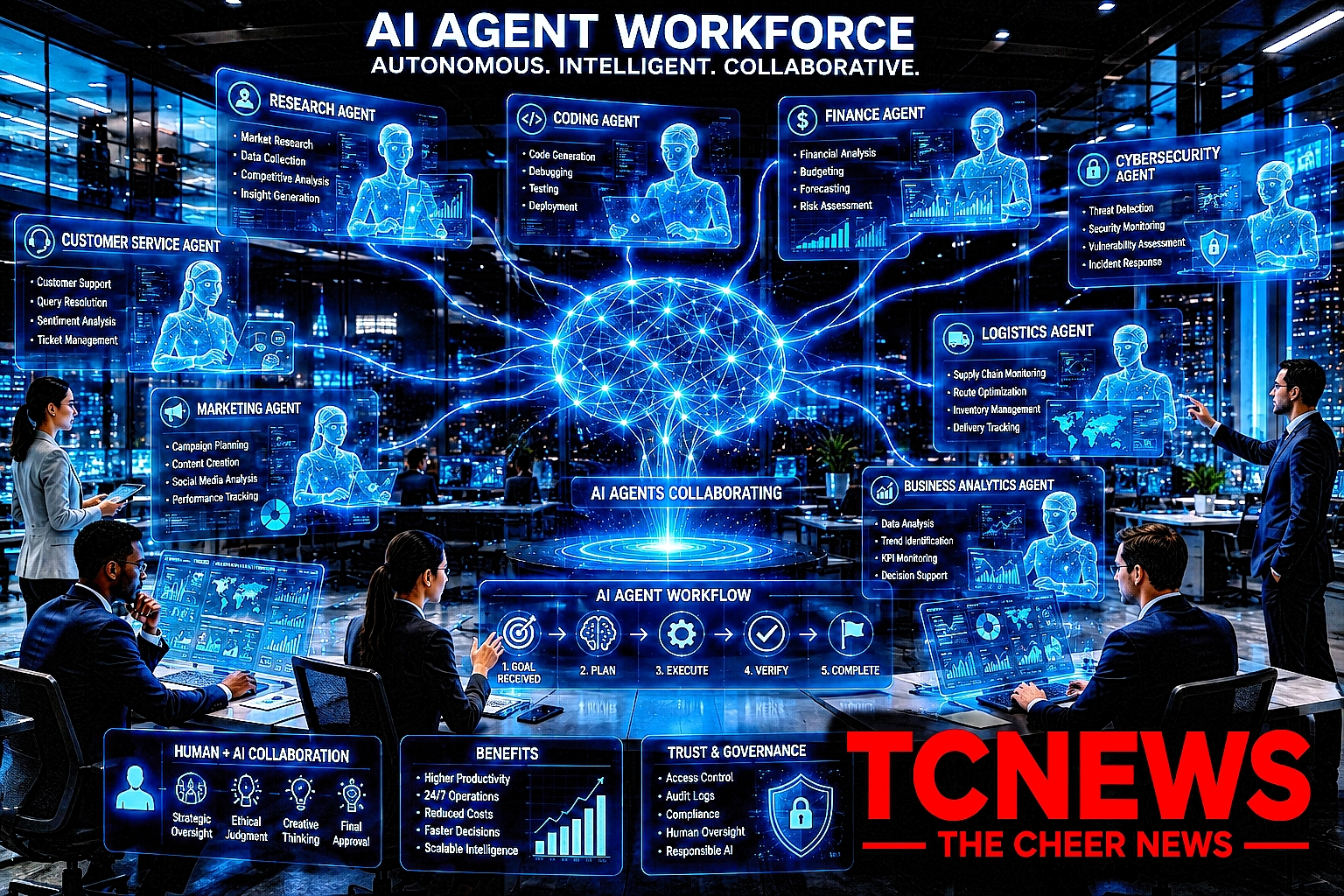
A company could potentially operate networks of specialized agents responsible for research, customer support, software development, finance, logistics and internal operations.
https://www.thecheernews.com/artificial-intelligence-does-work-of-250-people-at-my-company-ceo/
Why AI Agents Are Different
The major technological shift is the move from generation to execution.
Generative AI can create text, images, audio, video and computer code.
AI agents add an action layer.
An agent may be able to:
- Understand an objective.
- Break it into smaller tasks.
- Decide which tools are needed.
- Execute those tasks.
- Check the results.
- Correct mistakes.
- Continue until the objective is completed.
This creates the possibility of AI systems handling workflows that previously required several human actions.
The result could be a major change in how organizations measure productivity.
The Rise of the Autonomous Workforce
The phrase “AI workforce” does not necessarily mean millions of humanoid robots replacing employees.
In the near term, it is more likely to mean digital workers operating inside software environments.
An organization could have AI agents handling specific responsibilities.
AI Research Agent
Searches approved information sources and prepares research summaries.
Coding Agent
Writes, tests and improves software under defined development rules.
Customer-Service Agent
Handles routine customer requests and escalates complex cases.
Finance Agent
Analyzes financial records and prepares reports for human approval.
Marketing Agent
Studies campaign performance and proposes content strategies.
Operations Agent
Monitors workflows and identifies delays or inefficiencies.
The human workforce would increasingly become responsible for setting objectives, reviewing results and making decisions that require judgment.
AI Agents Are Already Entering Enterprise Workflows
The transition is not merely theoretical.
OpenAI launched Frontier in February 2026 as an enterprise platform designed to help organizations build and manage AI coworkers. OpenAI said organizations were already using agents for activities ranging from production optimization to sales workflows.
McKinsey’s 2026 research similarly describes enterprises moving into an “agentic phase,” where autonomous systems begin performing complex tasks across infrastructure, identity, engineering and security environments.
The important development is that businesses are moving beyond isolated AI experiments.
The next challenge is scaling agents safely across entire organizations.
The Agent Sprawl Problem
One of the emerging enterprise challenges is something researchers and technology analysts call agent sprawl.
As employees discover useful AI tools, organizations can end up with hundreds or thousands of agents operating across different departments.
Gartner predicts that by 2028, an average Fortune 500 enterprise could have more than 150,000 AI agents, compared with fewer than 15 in 2025. Gartner also reports that only 13% of organizations believe they currently have appropriate AI-agent governance.
That raises an important question:
Who knows what all these agents are doing?
If an organization cannot identify its AI agents, understand their permissions or monitor their actions, managing them becomes extremely difficult.
AI Agents Need Digital Identities
Traditional software applications normally operate under defined permissions.
AI agents introduce a more complicated problem.
An agent may need access to:
- Company documents
- Databases
- Software systems
- Financial information
- Customer records
- Internal communications
If the agent has too much access, a mistake or security breach could have serious consequences.
If it has too little access, it may not be useful.
That makes identity and access management central to the agentic AI era.
Organizations will increasingly need to know:
Which agent is acting?
Who authorized it?
What can it access?
What actions can it perform?
Who is responsible for its decisions?
The New Cybersecurity Challenge
AI agents create a new cybersecurity environment because the systems are not merely reading information.
They can potentially act on it.
McKinsey warns that agentic AI expands the attack surface because autonomous systems may interact with enterprise infrastructure, identities and sensitive data.
Imagine an AI agent responsible for processing financial information.
If an attacker manipulates information the agent receives, the agent could potentially make an incorrect decision or expose sensitive information.
This is why cybersecurity for AI agents must include more than protecting the underlying model.
Organizations also need to secure:
- Agent identities
- Tool permissions
- Data sources
- APIs
- Memory
- Communication between agents
- Human approval systems
- Activity logs
Why Human Oversight Still Matters
The emergence of autonomous AI does not eliminate the need for humans.
In fact, the more powerful agents become, the more important appropriate oversight may become.
Gartner argues that enterprises should not apply identical governance rules to every agent. Instead, controls should correspond to the agent’s autonomy level and the scope of its access.
A simple information-retrieval agent may require relatively limited permissions.
An agent capable of changing financial records or deploying software requires much stronger controls.
This suggests a future in which AI agents receive graduated levels of authority.
The Economic Opportunity
The potential economic impact is enormous.
AI agents could help organizations reduce repetitive work, accelerate research and allow employees to focus on higher-value activities.
OpenAI’s research on Codex usage found that agentic AI adoption grew rapidly during the first half of 2026, while users increasingly assigned the system more complex tasks.
Another 2026 study using production data from Perplexity’s Search and Computer products found that autonomous computer-use sessions could substantially reduce the time required to complete certain matched tasks compared with conventional search-based workflows.
However, productivity gains should not automatically be interpreted as job elimination.
Technology often changes jobs before it eliminates them.
Will AI Agents Replace Human Workers?
This is one of the biggest questions surrounding agentic AI.
The answer is likely to be more complicated than a simple “yes” or “no.”
AI agents are particularly suited to work involving:
- Repetitive digital processes
- Information retrieval
- Data analysis
- Software tasks
- Routine documentation
- Workflow coordination
- Pattern recognition
Humans remain essential for activities involving:
- Leadership
- Accountability
- Complex judgment
- Empathy
- Negotiation
- Physical-world interaction
- Creativity
- Ethical decision-making
- Relationship building
Therefore, many jobs may change rather than disappear.
The employee of the future may increasingly manage a collection of AI systems rather than perform every task personally.
The Rise of the AI Manager
One of the most interesting possibilities is the emergence of a new workplace role: the AI manager.
Instead of managing only human employees, some professionals may coordinate teams of AI agents.
Their responsibilities could include:
- Assigning objectives
- Monitoring performance
- Checking outputs
- Managing permissions
- Correcting errors
- Evaluating productivity
- Escalating complex decisions
This could create entirely new career opportunities around AI orchestration.
The valuable skill may no longer be simply knowing how to use an AI chatbot.
It may be knowing how to manage intelligent systems.
Multi-Agent Systems
A single AI agent may eventually be less important than a team of specialized agents.
Consider a hypothetical business workflow.
A research agent gathers information.
A financial agent analyzes the economics.
A marketing agent develops a campaign.
A legal-review agent checks compliance.
A project-management agent coordinates the workflow.
A human executive reviews the final recommendation.
This resembles an organization more than a chatbot.
However, multi-agent systems introduce additional complexity.
Agents must communicate accurately, resolve conflicting recommendations and operate within clearly defined boundaries.
The Importance of Memory
Memory could become one of the most important features of future AI agents.
A conventional chatbot may understand the current conversation.
An enterprise agent may need to remember:
- Previous projects
- Company policies
- Customer preferences
- Past decisions
- Workflow history
- Approved procedures
Persistent memory can make agents more useful.
But it also creates privacy and security concerns.
The more an agent remembers, the more sensitive information could potentially be exposed if its memory is poorly protected.
AI Agents and the Future of Software
AI agents could also change how software itself is built.
Instead of employees navigating dozens of applications manually, agents may increasingly act as an interface between people and software.
A user could describe an objective in natural language while the agent coordinates multiple systems behind the scenes.
This could make software easier to use.
However, it could also make traditional interfaces less important.
The future workplace might therefore involve fewer clicks and more delegation.
The Risks of Autonomous AI
The promise of AI agents must be balanced against serious risks.
Incorrect Actions
An AI can misunderstand a goal and execute the wrong plan.
Security Breaches
Agents with broad permissions could become attractive targets for attackers.
Data Leakage
Agents may accidentally expose sensitive information.
Excessive Autonomy
Giving systems too much authority can make mistakes harder to contain.
Accountability
Organizations must determine who is responsible when an agent makes a consequential decision.
Agent Sprawl
Thousands of poorly managed agents could create an enormous governance challenge.
Gartner predicts that 40% of enterprises could demote or decommission autonomous AI agents by 2027 because of governance failures identified after production incidents.
That prediction highlights a crucial lesson: deploying an agent is easier than governing one.
The New Question: Who Is Accountable?
Traditional software generally follows explicit instructions.
Autonomous agents can interpret objectives and decide how to achieve them.
That changes the accountability equation.
McKinsey describes this as a shift from asking whether a model is accurate to asking who is accountable when an autonomous system acts.
This question will become increasingly important in finance, healthcare, education, government and other high-stakes sectors.
Organizations will need clear policies defining:
- What agents may do independently.
- When human approval is required.
- What actions must be logged.
- How mistakes are investigated.
- Who carries responsibility.
Recent Developments in 2026
The agentic AI market has accelerated considerably this year.
OpenAI’s Frontier is designed around enterprise AI coworkers and organizational deployment.
OpenAI’s June research describes agents as systems capable of undertaking longer-horizon tasks and orchestrating multiple tools.
Gartner has warned about agent sprawl and the need for differentiated governance.
Meanwhile, McKinsey reports that enterprises are increasingly moving agentic AI from pilot projects into infrastructure, engineering, security and other operational environments.
The direction is clear: AI agents are moving from experimental demonstrations toward real organizational infrastructure.
Nigeria and Africa’s Opportunity
The agentic AI revolution could create significant opportunities for Nigeria and other African economies.
Many businesses across the continent face challenges involving limited personnel, administrative costs and access to specialized expertise.
AI agents could potentially help small and medium-sized businesses automate selected workflows without building large technology teams.
Potential applications include:
- Customer support
- Research
- Digital marketing
- Accounting assistance
- Inventory monitoring
- Agricultural information services
- Software development
- Education support
- Business administration
However, African businesses will need to pay close attention to data privacy, cybersecurity, infrastructure and workforce training.
The goal should not be to automate everything.
It should be to identify where AI can safely increase human productivity.
Benefits of AI Agents
Higher Productivity
Agents can handle repetitive multi-step digital workflows.
24/7 Operations
Digital agents can operate continuously.
Faster Research
Agents can gather and organize information rapidly.
Lower Administrative Burden
Routine tasks can be delegated to software.
Scalability
Businesses can deploy additional digital capacity without hiring for every repetitive task.
New Business Models
Companies may create entirely new services around autonomous AI systems.
Risks and Challenges
Security
More autonomy creates more opportunities for misuse or compromise.
Governance
Organizations need clear rules governing agent behavior.
Reliability
An agent can make mistakes even when its underlying model appears capable.
Privacy
Persistent memory and broad system access can expose sensitive information.
Workforce Disruption
Some roles will change significantly as automation expands.
Accountability
Organizations must determine responsibility when autonomous systems cause problems.
Agent Sprawl
Uncontrolled deployment can make AI environments difficult to monitor and secure.
Expert Perspective
The most important change brought by agentic AI is not simply that machines are becoming better at generating information.
It is that AI systems are increasingly being given authority to act.
That distinction matters.
A wrong answer from a chatbot may waste someone’s time.
A wrong action by an autonomous agent could potentially alter a database, send a confidential document, approve a transaction or disrupt a business process.
This is why governance must develop alongside capability.
The future of AI agents will depend not only on intelligence, but also on whether organizations can build systems that are observable, controllable, secure and accountable.
Future Outlook
The next generation of AI agents is likely to become more capable, specialized and interconnected.
We can expect progress in:
- Long-running autonomous tasks
- Multi-agent collaboration
- Computer-use capabilities
- Persistent memory
- Enterprise integration
- AI-powered software development
- Autonomous research
- Personalized digital assistants
- AI workforce management
- Agent-to-agent communication
The long-term vision is not simply one super-intelligent chatbot.
It is an ecosystem of specialized AI systems working together.
Human beings would establish goals, define boundaries and supervise outcomes, while AI systems handle increasingly complex execution.
That could fundamentally change how organizations operate.
Why This Matters
The arrival of AI agents could represent a bigger workplace transformation than the chatbot boom that preceded it.
Chatbots made AI accessible.
Agents could make AI operational.
Instead of asking AI to help with a task, people will increasingly ask AI to complete a workflow.
That shift has enormous implications for businesses, workers and governments.
For companies, the opportunity is higher productivity.
For workers, it means learning how to collaborate with intelligent systems.
For governments, it means developing rules for accountability, security and responsible deployment.
For Nigeria and Africa, it creates an opportunity to use AI agents to expand digital capacity and help businesses compete globally.
But the future should not be defined by how much autonomy organizations can give AI.
It should be defined by how wisely that autonomy is controlled.
Frequently Asked Questions (FAQs)
What is an AI agent?
An AI agent is an artificial intelligence system capable of pursuing a goal by planning tasks, using tools and taking actions with varying degrees of human supervision.
How are AI agents different from chatbots?
Chatbots primarily respond to prompts. AI agents can potentially plan and execute multi-step tasks using software tools and external systems.
Can AI agents replace employees?
They may automate some tasks and change certain jobs, but many roles will continue to require human judgment, creativity, communication, leadership and accountability.
What is agentic AI?
Agentic AI refers to AI systems designed to act toward goals with a degree of autonomy rather than simply generating responses.
Are AI agents safe?
AI agents can be useful, but their safety depends on appropriate permissions, monitoring, testing, cybersecurity and human oversight.
What is AI agent sprawl?
Agent sprawl occurs when organizations deploy large numbers of AI agents without sufficient visibility, governance or centralized management.
Will businesses need AI managers?
As organizations deploy larger numbers of agents, professionals who can coordinate, monitor and govern AI systems could become increasingly valuable.
What is the biggest challenge facing AI agents?
One of the biggest challenges is balancing autonomy with control. More autonomy can increase productivity, but it can also increase the consequences of mistakes.
Conclusion
The AI revolution is entering a new chapter.
The first generation of generative AI taught machines to produce information. The emerging generation of AI agents is teaching machines to act on information.
That distinction could reshape the global workplace.
AI agents may research, write code, analyze data, coordinate workflows and perform many other digital tasks. Businesses could gain enormous productivity advantages, while workers may increasingly become managers and collaborators of intelligent systems.
But capability must be matched with responsibility.
Organizations need strong security, clear permissions, reliable monitoring and human accountability before giving AI systems significant authority.
The future workplace may contain fewer repetitive tasks and far more collaboration between humans and digital workers.
The biggest question is not whether AI agents will become part of the workforce.
It is whether humans will build a workforce in which AI remains powerful, useful and under responsible control.
#AIAgents #AgenticAI #ArtificialIntelligence #AIWorkforce #AutonomousAI #FutureOfWork #AIAutomation #EnterpriseAI #AIInnovation #AIProductivity #AIGovernance #AI2026 #Technology #Nigeria #Africa #TheCheerNews