By DAYO ADESULU
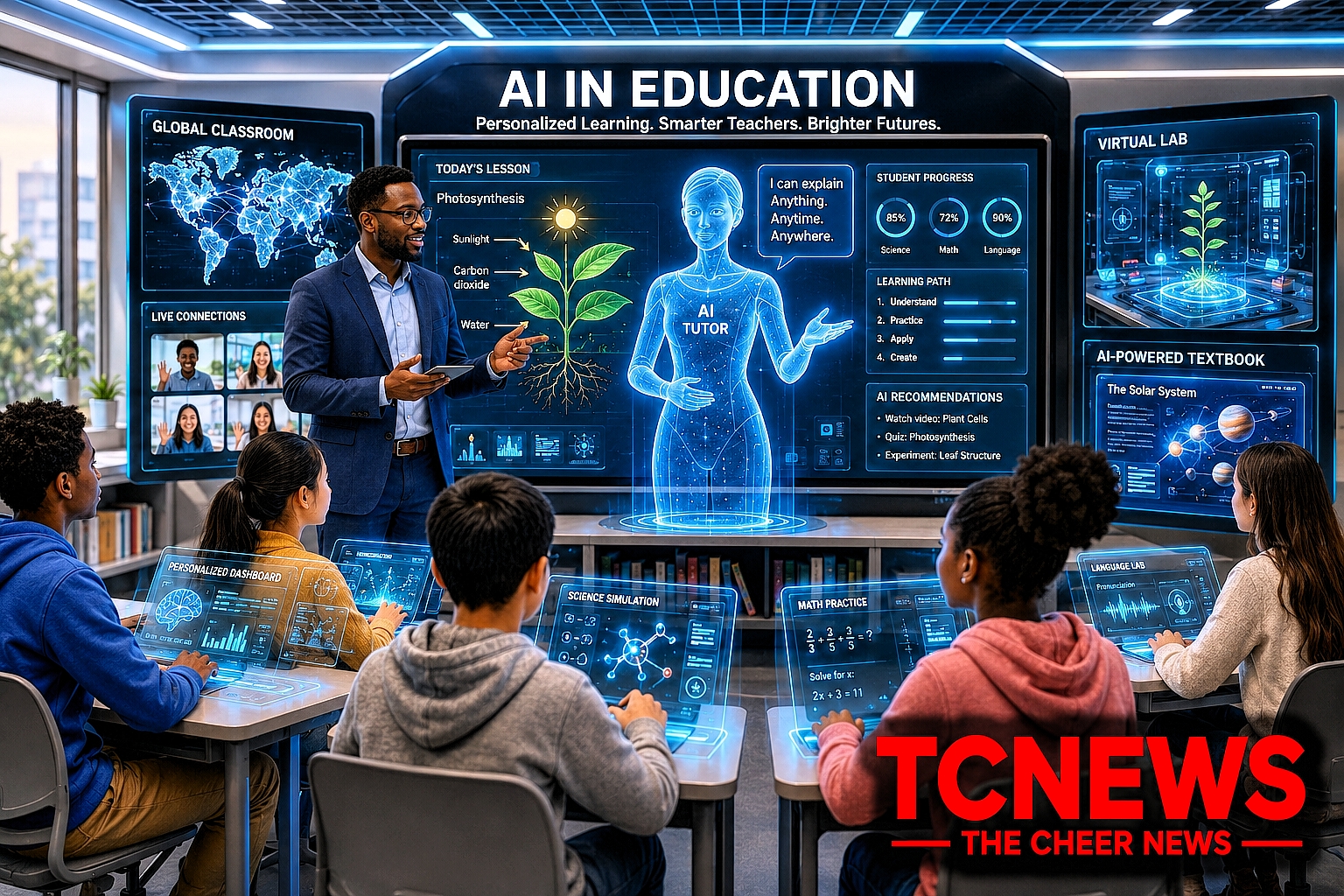
AI in education is moving from the technology lab into the classroom, changing how students learn, how teachers prepare lessons and how schools think about assessment.
From AI tutors that provide personalized explanations to systems that help teachers create learning materials, artificial intelligence is increasingly becoming part of the global education ecosystem. Yet the transformation is not simply about putting chatbots in classrooms. It is raising deeper questions about what students should learn, how knowledge should be assessed and what role teachers will play in an age when machines can generate answers in seconds.
The stakes are particularly high because education shapes the workforce of tomorrow. As AI changes professional skills across medicine, finance, engineering, journalism, manufacturing, and virtually every other sector, schools and universities must prepare learners for an economy in which working alongside intelligent systems may become normal.
Recent developments show that this transition is accelerating. The OECD’s Digital Education Outlook 2026 says generative AI can support learning when its use is guided by clear teaching principles. Meanwhile, the OECD and European Commission published a new AI literacy framework in June 2026 designed to help primary and secondary students understand AI, critically evaluate its outputs and use it responsibly.
The question is therefore no longer whether AI will influence education. It is how schools, teachers, governments, and students can use it without sacrificing critical thinking, creativity, human connection, and educational equity. https://crediblenews.com.ng/edge-ai-on-device-intelligence-future/
What Is AI in Education?
AI in education refers to the use of artificial intelligence technologies to support teaching, learning, assessment, research and school administration.
These technologies include:
- Generative AI
- AI tutors
- Machine learning
- Natural language processing
- Speech recognition
- Computer vision
- Predictive analytics
- Adaptive learning systems
- AI-powered educational assistants
Unlike traditional educational software, AI in education can interact with learners using natural language and adapt explanations to different questions and levels of understanding.
A student struggling with mathematics, for example, could receive an alternative explanation, additional examples, or a step-by-step discussion of a concept.
However, the quality of the learning experience depends heavily on how the technology is designed and used.
AI in Education Tutors Could Personalize Learning
One of the most promising applications of AI in education is personalized tutoring.
Traditional classrooms often require one teacher to support many students simultaneously. That makes individualized instruction difficult, particularly in overcrowded classrooms.
AI tutors can potentially provide additional support by adapting explanations to individual learners.
They may:
- Explain difficult concepts differently.
- Generate practice questions.
- Provide immediate feedback.
- Help students identify knowledge gaps.
- Adjust difficulty levels.
- Support language learning.
- Provide additional examples.
UNESCO identifies AI-powered personalized tutoring as one of the opportunities emerging in education, while also warning that over-reliance on AI can create educational and ethical problems.
The important distinction is that an AI tutor should ideally function as a learning companion—not as a replacement for teachers.
How AI Is Changing the Teacher’s Role
The arrival of AI in education does not necessarily make teachers less important.
Instead, it could change what teachers spend their time doing.
AI can assist with routine activities such as:
- Drafting lesson plans.
- Creating quizzes.
- Generating classroom exercises.
- Summarizing educational materials.
- Organizing information.
- Providing administrative assistance.
That could allow teachers to dedicate more time to activities requiring human judgment, including mentoring, classroom discussion, emotional support, and individualized guidance.
The OECD’s 2026 work on teaching emphasizes the need to rethink the teaching profession as technology changes the educational environment. https://www.thecheernews.com/nigerias-cybersecurity-ecosystem-under-scrutiny-experts-demand-collaborative-action-to-combat-rising-global-threats/
In this model, teachers become less like information providers and more like learning designers, mentors, and critical-thinking coaches.
AI In Education Changes How Students Learn
Students can already use generative AI to explore subjects, brainstorm ideas, practice languages and receive explanations.
But easy access to answers creates a major challenge.
If a student asks AI to complete an assignment and simply submits the response, the technology may have completed the learning task instead of supporting it.
That is why educators increasingly distinguish between using AI to learn and using AI to avoid learning.
A responsible approach encourages students to question AI-generated answers, verify information, compare explanations, and develop their own conclusions.
UNESCO has emphasized that creativity, critical thinking and human agency should remain central to education in the age of AI.
The Assessment Crisis
Perhaps no part of education is being challenged more directly by generative AI than assessment.
Traditional assignments often assume that a student’s written submission represents their own work.
Generative AI complicates that assumption.
Schools and universities are therefore reconsidering:
- Take-home essays.
- Homework.
- Online examinations.
- Research assignments.
- Oral assessments.
- Project-based learning.
Instead of relying exclusively on written answers, educators may increasingly assess students through presentations, discussions, practical projects, demonstrations, and supervised work.
The goal is not simply to determine whether AI was used. It is to determine whether the student actually understands the subject.
The OECD’s 2026 policy work on higher education identifies academic integrity, reliability, equity, data protection, and the development of students’ knowledge and skills as major issues surrounding generative AI adoption.
AI in Education: Literacy Is Becoming a Core Skill
Knowing how to use AI may soon become as important as knowing how to use a computer or search engine.
However, AI literacy involves much more than knowing how to write prompts.
Students need to understand:
How AI Works
They should have a basic understanding of models, data, algorithms, and machine learning.
How AI In Education Can Fail
AI systems can produce inaccurate, incomplete or misleading information.
How to Verify Information
Students must learn to check important claims against reliable sources.
How to Use AI In Education Ethically
They need to understand privacy, academic integrity, intellectual property and responsible technology use.
How to Think Independently
Perhaps most importantly, students must retain the ability to reason without depending entirely on AI.
The OECD and European Commission’s 2026 AI literacy framework specifically focuses on helping primary and secondary learners understand AI systems, critically evaluate their outputs and use them ethically and creatively.
UNESCO Calls for Human-Centred AI Education
UNESCO has consistently advocated a human-centered approach to AI in education.
Its guidance emphasizes privacy, inclusion, equity, safety, and appropriate governance. UNESCO also warns that technology should not deepen existing inequalities between students, schools, or countries.
This is particularly important because access to technology remains uneven.
UNESCO reports that although around 74% of the world’s population used the internet in 2025, only about 40% of primary schools and 50% of lower-secondary schools were connected to the internet.
That creates a major challenge.
If wealthy schools receive advanced AI tutors while disadvantaged schools lack reliable internet, AI could widen educational inequality instead of reducing it.
Nigeria and the African AI in Education Opportunity
Africa has a particularly important role to play in the future of AI education.
Nigeria, with its large young population and growing technology ecosystem, is already exploring ways to integrate AI into teacher development and education.
A UNESCO-documented Nigerian initiative known as Naija Teacher AI is designed to equip 1.5 million licensed Nigerian teachers with AI-powered tools and digital training. The initiative is being implemented by the Teachers Registration Council of Nigeria with partners including GMind AI, the Federal Ministry of Education and the National Teachers’ Institute.
The initiative also supports Nigeria’s revised K–12 curriculum, including AI, robotics, and digital literacy.
This illustrates an important principle: AI education cannot succeed simply by giving students access to technology. Teachers themselves must understand the technology and know how to integrate it into meaningful learning.
UNESCO also published a practical guide in July 2026 for integrating AI into technical and vocational education and training. The guide covers governance, curriculum development, teaching, assessment, skills development, safety-critical occupations, innovation, and entrepreneurship.
For Nigeria and other African countries, that approach could be particularly valuable because education systems must prepare young people for rapidly changing labour markets while addressing existing infrastructure and skills gaps.
Benefits of AI in Education
Personalized Learning
AI can adapt explanations and practice materials to individual learners.
Teacher Productivity
Automating some routine preparation and administrative activities can give teachers more time for students.
Accessibility
AI-powered tools can support translation, speech-to-text, text-to-speech and other accessibility needs.
Learning Support
Students can receive additional explanations outside normal classroom hours.
AI in Education Skills Development
Students can develop practical skills needed for an increasingly AI-driven economy.
Research Acceleration
Universities and researchers can use AI to analyze information, organize literature and support scientific workflows.
Risks and Challenges
Over-Reliance on AI in Education
Students may become dependent on AI instead of developing independent reasoning skills.
Incorrect Information
AI-generated answers can contain errors, requiring verification.
Academic Integrity
Schools must reconsider how assignments and examinations demonstrate genuine student understanding.
Privacy
Educational AI systems may process sensitive information about students and teachers.
Digital Inequality
Students without reliable internet, devices or digital skills could be left behind.
Bias
AI systems can reproduce biases present in their training data or design.
Teacher Preparedness
Technology cannot deliver meaningful educational transformation if teachers lack adequate training and support.
Recent Developments in 2026
The education sector is moving toward more structured AI in education adoption rather than simply experimenting with individual tools.
The OECD’s Digital Education Outlook 2026, released in January, examines effective uses of generative AI in education and emphasizes that educational value depends on how AI is integrated into teaching and learning.
In June, the OECD and European Commission released their AI literacy framework for primary and secondary education.
UNESCO is also preparing for its Digital Learning Week 2026, scheduled for September 8–11, under the theme “Education in the age of AI: Facts, Frictions and Frontiers.” The event is set to examine AI tutors, autonomous or agentic AI, synthetic content and the changing nature of knowledge.
These developments demonstrate that AI education is moving from experimentation toward policy, curriculum, and institutional planning.
What Will the Classroom of the Future Look Like?
The future classroom is unlikely to be completely automated.
Instead, it may combine human teachers with intelligent digital systems.
A student could have access to an AI learning assistant that remembers areas of difficulty, while the teacher uses analytics to identify where additional classroom support is needed.
Students might also work with AI simulations, virtual laboratories and interactive learning environments.
However, physical classrooms, teachers and peer interaction are unlikely to disappear.
Education is not simply the transfer of information. It also involves communication, collaboration, social development, mentorship and the formation of judgment.
Those human dimensions remain difficult to automate.
Expert Perspective
The emerging consensus among major education organizations is that the central question should not be whether AI belongs in education but how it can be used effectively and responsibly.
UNESCO promotes human agency, critical thinking and ethics. The OECD similarly emphasizes guided use, AI literacy and policies that protect learning outcomes and academic integrity.
This points toward a balanced model: AI should expand educational possibilities while teachers and institutions remain responsible for the learning environment.
Future Outlook
AI is likely to become increasingly embedded in education over the next decade.
Future systems could offer:
- Highly personalized AI tutors.
- Intelligent educational agents.
- AI-assisted lesson planning.
- Adaptive examinations.
- Virtual laboratories.
- AI-powered language learning.
- Personalized career guidance.
- Automated administrative support.
- Advanced learning analytics.
However, the most successful education systems will not necessarily be those with the most AI.
They will be those that use AI with clear educational objectives.
The technology must serve learning—not the other way around.
Why This Matters
Education determines how societies prepare for the future.
As artificial intelligence transforms the global economy, schools and universities face a historic responsibility: teach students not only how to use AI in education but also how to question it, verify it and understand its consequences.
For developing countries such as Nigeria, the opportunity is particularly significant. AI could help extend access to learning, strengthen teacher capacity and prepare young people for emerging careers.
But access alone is not enough.
The future of education will depend on combining artificial intelligence with excellent teachers, strong infrastructure, critical thinking, and responsible policy.
The goal should not be to build classrooms where machines replace teachers.
It should be to build classrooms where teachers and intelligent technologies work together to help students become more capable, curious and independent thinkers.
Frequently Asked Questions (FAQs)
What is AI in education?
AI in education refers to the use of artificial intelligence to support teaching, learning, assessment, research and educational administration.
Can AI replace teachers?
AI in education can automate certain tasks, but teachers provide mentorship, judgment, social interaction and emotional support that technology cannot fully replace.
Can AI in Education improve student learning?
Yes, AI can support personalized learning and provide additional explanations. However, research and policy guidance increasingly emphasize that its effectiveness depends on how it is integrated into teaching.
What is AI literacy?
AI literacy is the ability to understand AI, evaluate its outputs critically and use it responsibly and effectively.
Will students still need traditional textbooks?
Yes. Digital AI tools are likely to complement rather than completely replace traditional educational resources. UNESCO has emphasized the continued importance of human-centred and equitable approaches to technology in education.
What is the biggest danger of AI in education?
One major concern is over-reliance. If students use AI to produce answers without understanding the underlying concepts, technology could undermine rather than strengthen learning.
Conclusion
Artificial intelligence is changing education at a remarkable pace.
AI in education tutors, generative systems, adaptive learning platforms and intelligent educational assistants are creating new possibilities for personalized instruction and teacher support. At the same time, they are forcing schools and universities to rethink assessment, academic integrity, privacy and the meaning of learning itself.
The emerging evidence suggests that AI is most valuable when it is guided by strong teaching principles rather than treated as a shortcut to answers.
For Nigeria, Africa and the wider world, the challenge is to build education systems that combine technological innovation with human judgment.
The classroom of tomorrow may contain more AI than today’s classroom—but the most important element will remain the same: people learning how to think.
Hashtags
#AIInEducation #ArtificialIntelligence #EducationTechnology #AITutors #FutureOfEducation #AI #EdTech #DigitalLearning #AIforEducation #PersonalizedLearning #EducationInnovation #Nigeria #Africa #TheCheerNews