By DAYO ADESULU
Artificial intelligence is moving from a tool people use occasionally into an infrastructure layer that could underpin much of the global economy.
By 2035, Artificial intelligence may look very different from today’s chatbots and image generators. Instead of waiting for users to type prompts, AI systems are likely to operate continuously across workplaces, devices, vehicles, factories, laboratories and public services.
However, predicting 2035 is not the same as predicting the next software release. Some developments are becoming increasingly plausible, while others remain highly uncertain.
The strongest evidence suggests that AI will become more autonomous, multimodal, physical, personalized and deeply integrated into everyday systems. At the same time, questions surrounding energy, governance, employment, safety and global power will become even more important.
A recent Council on Foreign Relations survey of 350 foreign-policy experts found broad agreement that Artificial intelligence will significantly affect the global order by 2035, while also highlighting substantial uncertainty over the capabilities of frontier AI and the ability of governments to keep pace. (Council on Foreign Relations)
So, what could AI actually look like by 2035? https://crediblenews.com.ng/ai-startups-2026-billion-dollar-companies-to/
The AI of 2035 May Be Less Visible—and More Powerful
Today’s AI is easy to identify.
You open a chatbot, type a question and receive an answer.
By 2035, that interaction model could become much less common.
AI may instead operate quietly in the background.
Your computer could organize files automatically. Your business software could identify problems before you notice them. A medical system could continuously analyze patient information. A factory could adjust production in real time. Vehicles could make increasingly complex decisions without direct human input.
In other words, AI could become less like an application and more like digital infrastructure.
Stanford’s 2026 Artificial intelligence Index already shows the direction of travel: AI capabilities are continuing to accelerate, with frontier models increasingly reaching or exceeding human baselines on difficult scientific, mathematical and multimodal benchmarks. (Stanford HAI)
The next decade may therefore be about turning increasingly capable models into reliable systems that can operate in the real world.
1. AI Agents Could Become the Default Interface
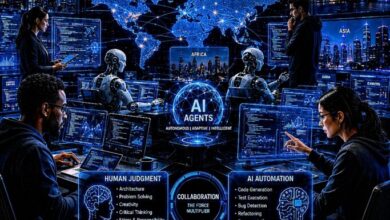
One of the biggest changes by 2035 could be the rise of AI agents.
Today’s chatbot generally waits for instructions.
An AI agent can potentially:
- Understand an objective.
- Break it into tasks.
- Use software tools.
- Search for information.
- Make decisions within defined boundaries.
- Complete multiple steps.
- Report the outcome.
That is a major shift.
Instead of asking AI, “How do I prepare this report?”, a user could eventually tell an AI system:
“Prepare the report, analyze the data, identify the major trends, create the presentation and send it for my approval.”
The human would establish the objective.
The AI would manage much of the execution.
This does not mean humans disappear from the process. For important decisions, human oversight is likely to remain essential.
But the workplace could increasingly move from prompting AI to delegating tasks to AI.
2. Multimodal AI Will Become Much More Natural
Current artificial intelligence systems can already process combinations of text, images, audio, and video.
By 2035, multimodal interaction could become the normal way people communicate with computers.
Imagine speaking naturally to an AI while simultaneously showing it:
- A document
- A photograph
- A video
- A spreadsheet
- A physical object
- A live environment
The system could combine all of those inputs.
A doctor might discuss medical images while reviewing a patient’s history.
An engineer could point a camera at a machine and ask AI to identify a problem.
A teacher could show an experiment and receive real-time assistance.
A journalist could provide documents, audio recordings, and datasets to an AI research assistant.
The interface may become much closer to human conversation.
3. AI Could Become a Personal Digital Assistant
The personal assistant of 2035 could be dramatically more capable than today’s voice assistants.
Instead of simply setting reminders or answering questions, an AI assistant could potentially coordinate a person’s digital life.
It might:
- Organize schedules
- Summarize communications
- Compare documents
- Prepare travel plans
- Manage routine administrative tasks
- Help with learning
- Monitor personal digital security
- Coordinate other AI agents
The important development would be continuity.
Rather than treating every conversation as a separate interaction, future systems may maintain useful context within appropriate privacy boundaries.
This could make artificial intelligence feel less like a search box and more like an always-available digital collaborator. https://www.thecheernews.com/ai-startups-in-nigeria-2025-how-artificial-intelligence-empowers-growth/
4. Robotics Could Bring AI Into the Physical World
Software AI is only part of the story.
The next decade could see much greater integration between AI and robotics.
AI-powered robots are already being developed for manufacturing, warehouses, agriculture, healthcare and other environments.
By 2035, more capable robots could potentially operate in environments that are difficult or dangerous for humans.
Factories could contain fleets of AI-controlled machines.
Warehouses could become increasingly autonomous.
Agricultural robots could monitor crops and perform selected field operations.
Healthcare facilities could use robotic systems for logistics and assistance.
Home robots remain much harder to predict because real-world homes are messy and unpredictable.
Still, progress in Physical AI could be one of the defining developments of the next decade.
5. AI May Learn to Reason Across Longer Tasks
Today’s artificial intelligence can perform impressive individual tasks.
The next challenge is maintaining reliability across long chains of activity.
For example, producing a complex scientific analysis may require dozens or hundreds of intermediate decisions.
An advanced AI system must remember objectives, detect errors, revise its approach and determine when it needs human assistance.
This is why agentic AI matters so much.
The future is not necessarily about a model that simply produces a better answer.
It is about systems capable of planning, acting, evaluating and correcting themselves over extended periods.
Stanford’s 2026 AI Index shows that AI performance on demanding benchmarks is improving rapidly, while benchmark saturation is also becoming a problem because some tests are being overtaken by frontier models much faster than expected. (Stanford HAI)
By 2035, measuring AI capability may itself be a major scientific challenge.
6. AI Could Become a Scientific Research Partner
Perhaps one of the most important applications of advanced AI will be science.
AI systems are increasingly being used in areas such as:
- Drug discovery
- Protein research
- Materials science
- Climate modelling
- Mathematics
- Astronomy
- Biology
- Engineering
By 2035, AI could potentially participate in much longer research cycles.
A scientist might provide a research objective.
AI systems could search literature, generate hypotheses, design simulations, analyze results and propose experiments.
Humans would still need to validate important discoveries.
But the speed of scientific exploration could increase significantly.
This could be particularly important for diseases, energy technologies, agriculture and climate adaptation.
7. AI Hardware Will Become More Specialized
The artificial intelligence revolution is also a hardware revolution.
Training and running advanced models requires enormous amounts of computing power.
That means the future of AI will depend on advances in:
- GPUs
- AI accelerators
- Neural processing units
- Memory
- Networking
- Data centres
- Edge computing
- Energy-efficient architectures
A 2026 research roadmap involving leading AI and computer-hardware researchers argues that AI and hardware must increasingly be co-designed, with a long-term objective of dramatically improving intelligence per unit of energy. The paper identifies a potential 1,000-fold improvement in AI training and inference efficiency over a decade as an ambitious target. (arXiv)
If computing becomes dramatically more efficient, advanced AI could become cheaper and more widely accessible.
That could be just as important as making models more intelligent.
8. AI Could Move From the Cloud to the Edge
Not every AI task will need a massive data centre.
By 2035, increasingly capable AI could run directly on:
- Smartphones
- Cars
- Cameras
- Laptops
- Wearables
- Industrial equipment
- Robots
- Medical devices
This is known as edge AI.
The advantage is speed and privacy.
A device does not always need to send information to a distant data center before processing it.
For example, an autonomous machine could make decisions locally.
A smartphone could perform advanced AI functions without constantly uploading personal information.
This could also reduce pressure on centralized computing infrastructure.
9. AI Will Become More Personalized
The artificial intelligence of 2035 could increasingly adapt to individual users.
Instead of one generic assistant serving millions of people in exactly the same way, systems may become highly personalized.
A student’s AI tutor could understand the student’s learning history.
A business AI could understand a company’s workflows.
A professional assistant could understand the user’s preferred working methods.
A healthcare AI could potentially help organize information relevant to a patient’s care.
However, personalization creates an important trade-off:
The more artificial intelligence knows about someone, the greater the responsibility to protect that information.
Privacy could therefore become one of the most important AI issues of the 2030s.
10. Artificial intelligence Could Transform Education
By 2035, education may become much more personalized.
Instead of every student receiving exactly the same explanation, AI could adapt lessons to individual needs.
An AI tutor could:
- Explain difficult concepts differently
- Identify knowledge gaps
- Generate practice exercises
- Provide immediate feedback
- Simulate laboratories
- Translate educational content
- Support different learning speeds
Teachers would remain important.
In fact, their role could become more focused on mentorship, critical thinking, classroom relationships and helping students use technology responsibly.
The teacher may increasingly become the orchestrator of human and AI learning systems.
11. Healthcare AI Could Become Continuous
Healthcare is another area where artificial intelligence could become deeply embedded.
By 2035, AI may increasingly assist with:
- Medical imaging
- Drug discovery
- Patient monitoring
- Clinical documentation
- Risk prediction
- Medical research
- Administrative work
Instead of artificial intelligence being used only when a doctor opens a particular application, systems could continuously process appropriate information and alert professionals when something requires attention.
However, medicine will remain a high-stakes field.
Accuracy, privacy, regulation and human oversight will remain essential.
AI should enhance medical professionals rather than encourage patients to rely blindly on automated systems.
12. AI Will Change Cybersecurity—and Cyberattacks
The cybersecurity environment of 2035 could be radically different.
AI will help defenders identify unusual behavior, analyze threats and respond to attacks faster.
But the same underlying technology could also make cyber threats more sophisticated.
This means the cybersecurity battle may increasingly become:
AI versus AI.
Organizations will need systems capable of detecting automated attacks at machine speed.
Security teams may increasingly supervise fleets of defensive artificial intelligence agents.
This could make AI security one of the most strategically important technology sectors of the next decade.
13. AI Could Reshape Global Economic Power
Artificial intelligence will not simply change companies.
It could change countries.
The nations that control advanced artificial intelligence models, semiconductor supply chains, energy infrastructure, data centres and technical talent may gain significant economic and geopolitical advantages.
The recent CFR survey of 350 experts highlights this uncertainty, with experts considering different possible configurations of global artificial intelligence power by 2035. (Council on Foreign Relations)
The emerging competition is therefore broader than an AI model race.
It includes:
Chips + Compute + Energy + Data + Talent + Models + Infrastructure.
Countries that build strong ecosystems across these areas could become major AI powers.
14. Africa Could Use AI to Leapfrog Development
The 2035 AI story should not be written only from Silicon Valley, Beijing or European technology centres.
Africa could become an important part of the next phase.
The World Bank said in August 2026 that artificial intelligence could offer emerging economies an opportunity to accelerate development but warned that electricity, internet access, digital skills, and device availability remain critical barriers. (Reuters)
For Africa, artificial intelligence could potentially expand access to:
- Education
- Healthcare
- Financial services
- Agricultural intelligence
- Legal information
- Public services
- Business automation
Nigeria, in particular, could benefit from AI-enabled services because of its large population, entrepreneurial ecosystem and English-speaking workforce.
But infrastructure will determine how much of that potential becomes reality.
15. AI May Become Much More Energy Efficient
The artificial intelligence boom is creating another major challenge: energy consumption.
Massive data centres require electricity, cooling systems and increasingly sophisticated infrastructure.
By 2035, AI development may therefore be judged not only by intelligence but also by intelligence per watt.
The AI+HW 2035 research roadmap specifically emphasizes energy efficiency and system-level optimization as central challenges for the coming decade. (arXiv)
This could accelerate investment in:
- Specialized processors
- Efficient models
- Advanced cooling
- Renewable energy
- Smarter data centres
- Localized computing
The future artificial intelligence race may increasingly be an energy-efficiency race.
16. Artificial General Intelligence Remains Uncertain
No serious forecast about 2035 should pretend that the arrival of AGI is guaranteed.
“Artificial general intelligence” generally refers to AI with broad capabilities comparable to or exceeding humans across a wide range of cognitive tasks.
Some experts believe systems approaching this level could emerge relatively soon.
Others remain skeptical.
A major 2024 survey of 2,778 AI researchers found substantial uncertainty about advanced AI timelines. The researchers’ aggregated forecasts placed a 50% probability of machines outperforming humans in every possible task at 2047, while estimates for full automation of human occupations were much later. (arXiv)
That disagreement matters.
By 2035, we could have systems that look extraordinarily capable without having reached a universally accepted definition of AGI.
So the responsible prediction is not:
“AGI will definitely arrive by 2035.”
It is:
“AI systems could become dramatically more general and autonomous by 2035, but the exact threshold for AGI remains uncertain.”
17. The AI Singularity Is an Even Bigger Unknown
The idea of a technological singularity involves artificial intelligence becoming capable of rapidly improving itself, potentially creating an accelerating cycle of intelligence growth.
Some AI leaders and researchers are increasingly discussing this possibility.
However, there is no consensus that recursive self-improvement has been achieved.
Recent debate among artificial intelligence experts illustrates the disagreement. Some argue that increasingly autonomous systems may be approaching a new phase of AI development, while others caution that impressive performance does not necessarily constitute genuine self-improvement or a singularity. (Axios)
Therefore, the singularity belongs in the category of possible but highly uncertain scenarios, not established predictions.
18. AI Regulation Will Become More Sophisticated
By 2035, Artificial Intelligence regulation is likely to be far more developed than it is today.
Governments will probably regulate areas such as:
- High-risk AI
- Autonomous systems
- AI-generated content
- Data protection
- AI safety
- Model transparency
- AI in healthcare
- AI in employment
- AI accountability
However, international differences will remain.
The challenge will be creating enough regulation to protect society without preventing beneficial innovation.
That tension will remain one of the defining policy questions of the AI era.
19. Human Skills Will Not Become Obsolete
One of the most misleading predictions about 2035 would be that humans will become irrelevant.
Even if Artificial intelligence becomes exceptionally capable, people will continue to provide:
- Goals
- Values
- Leadership
- Accountability
- Creativity
- Social relationships
- Cultural understanding
- Ethical judgment
The question may therefore shift from:
“What can humans do better than AI?”
to:
“What should humans remain responsible for even when artificial intelligence can do it?”
That distinction could become increasingly important.
What Will AI Look Like in 2035?
The most plausible picture is not one giant machine replacing humanity.
Instead, imagine a world where AI is distributed everywhere.
A person wakes up in a home with intelligent systems.
Their vehicle uses artificial intelligence to navigate.
Their workplace contains specialized artificial intelligence agents.
Their doctor uses AI-assisted diagnostics.
Their children learn with personalized AI tutors.
Factories use intelligent robots.
Farmers use AI-powered monitoring systems.
Scientists work with artificial intelligence research assistants.
Governments use AI to analyze infrastructure and public services.
Cybersecurity systems continuously monitor digital networks.
And most people may not even think of these systems as “AI” anymore.
They will simply be part of everyday life.
Why This Matters
The significance of 2035 is not the exact date.
The important question is the direction.
Artificial intelligence is moving from isolated software applications toward a broader technological ecosystem combining models, agents, robotics, chips, data centres, edge devices and physical infrastructure.
Stanford’s 2026 AI Index says AI capability is accelerating rather than plateauing, while evaluation and governance are struggling to keep pace. (Stanford HAI)
Meanwhile, experts remain deeply divided over how quickly advanced AI will develop and what its ultimate capabilities could be.
That uncertainty is itself important.
Governments, businesses, universities and individuals cannot afford to prepare for only one future.
They need to prepare for several.
The safest strategy is therefore not to bet everything on either an AI utopia or an AI catastrophe.
It is to build systems capable of capturing the benefits while managing the risks.
By 2035, artificial intelligence could be one of the most important infrastructures of modern civilization.
The winners will not necessarily be those who predict the future perfectly.
They may be those who prepare intelligently for several possible futures.
Frequently Asked Questions
Will AI reach AGI by 2035?
It is possible, but there is no reliable consensus that AGI will arrive by 2035. Expert forecasts vary substantially, and even researchers disagree about the definition and measurement of AGI.
Will AI replace humans by 2035?
There is no credible basis for saying that AI will replace humanity as a whole by 2035. A more realistic expectation is that AI will automate and transform many tasks while creating new forms of human-AI collaboration.
Will robots become common by 2035?
Robotics is likely to become significantly more capable, particularly in factories, warehouses, logistics, agriculture and other structured environments. The widespread use of general-purpose household robots is much harder to predict.
What will AI agents do by 2035?
Advanced AI agents could potentially perform multi-step digital tasks, coordinate software tools, conduct research, manage workflows and collaborate with other specialized agents under human-defined objectives.
Will AI make healthcare better?
AI could improve medical imaging, research, documentation, diagnostics and patient monitoring. However, healthcare remains high-stakes, so validation, regulation and professional oversight will remain critical.
Will AI make people more productive?
Potentially. AI can automate routine tasks and assist with research, analysis and creation. However, productivity gains depend heavily on how organizations redesign workflows and train workers.
What will happen to AI jobs?
Demand for AI engineers, researchers, cybersecurity specialists, AI governance professionals, robotics experts and AI implementation specialists is likely to remain strong. At the same time, many traditional jobs will change as AI takes over selected tasks.
What will AI mean for Africa by 2035?
AI could help African countries expand access to education, healthcare, financial services and agricultural intelligence. However, reliable electricity, connectivity, devices, skills and local AI infrastructure will be essential.
Conclusion
Trying to predict exactly what artificial intelligence will look like in 2035 is almost impossible.
The technology is moving too quickly.
But the major direction of travel is becoming clearer.
AI is becoming more capable.
AI agents are becoming more autonomous.
Robotics is connecting intelligence to the physical world.
Specialized AI hardware is becoming increasingly important.
Scientific AI is accelerating research.
Edge computing is moving intelligence closer to users.
And governments are increasingly treating AI as an economic and geopolitical priority.
The biggest change may be that AI will no longer feel like a separate technology.
It will become part of the infrastructure through which people work, learn, communicate, travel, conduct business and solve problems.
Yet uncertainty will remain.
AGI may arrive earlier than many expect—or much later.
Robotics could advance rapidly—or encounter persistent physical-world limitations.
AI productivity could transform economies—or be slowed by energy, infrastructure and organizational challenges.
That is why the future should not be treated as a fixed prediction.
It should be treated as a range of possibilities.
One thing, however, appears increasingly certain:
By 2035, the world will probably not be asking whether AI is important. It will be asking how deeply humanity should allow artificial intelligence to shape civilization.
SEO Title
AI in 2035: Expert Predictions and Emerging Artificial Intelligence Trends
Focus Keyphrase
AI in 2035
Meta Description
What will AI look like by 2035? Explore expert predictions on AI agents, robotics, AGI, AI hardware, healthcare, jobs, regulation and global AI trends.
URL Slug
ai-in-2035-expert-predictions-emerging-trends
Relevant Keywords
- AI in 2035
- artificial intelligence 2035
- future of AI
- AI predictions
- AI trends 2035
- future artificial intelligence
- AGI 2035
- AI agents
- AI robotics
- future of AI technology
- AI hardware
- AI healthcare
- AI jobs
- AI economy
- AI Africa
- AI Nigeria
- future of work
- AI singularity
- artificial general intelligence
- emerging AI trends
Suggested Feature Image
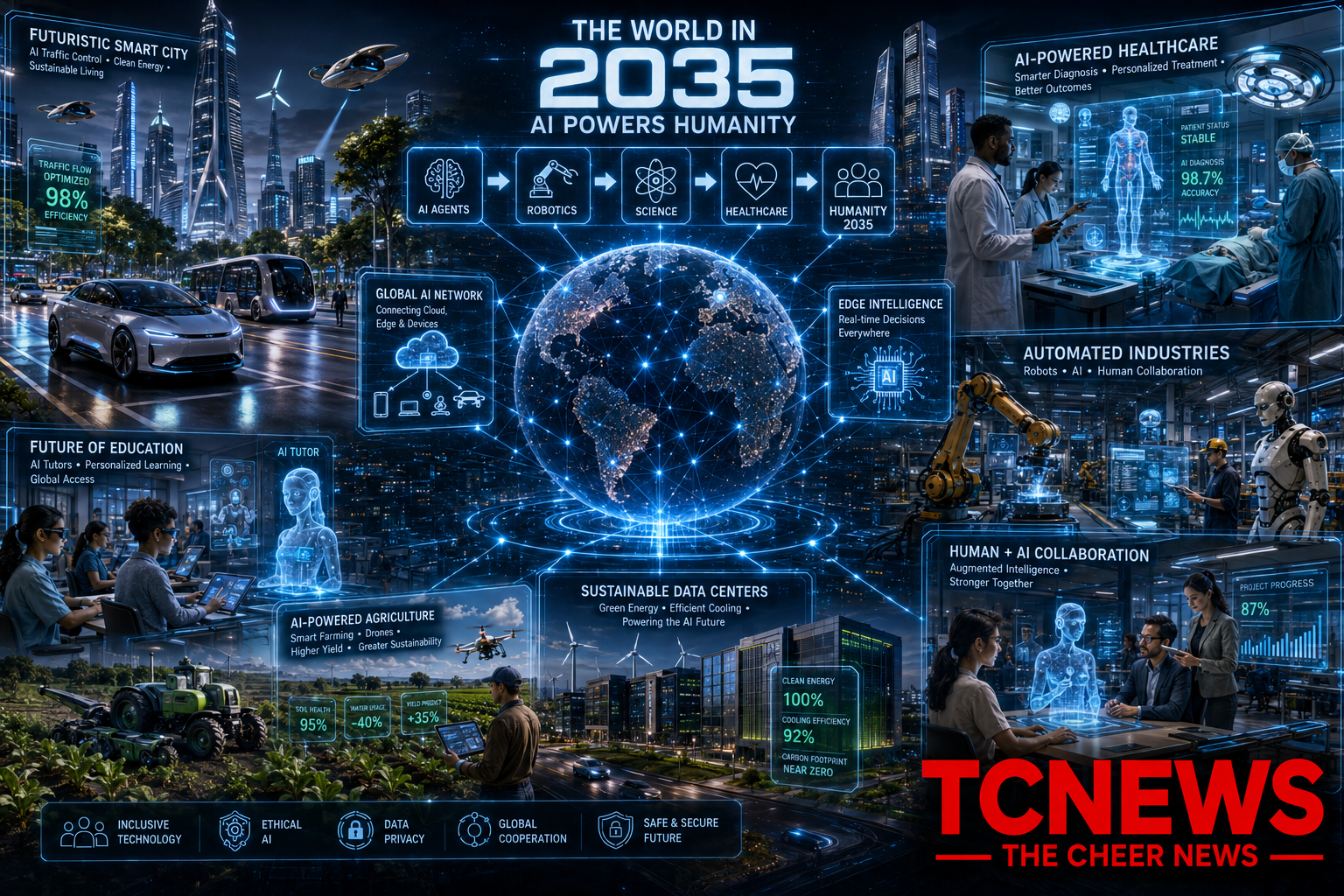
A breathtaking futuristic global city in the year 2035 where humans and advanced artificial intelligence coexist across everyday life. Show autonomous vehicles moving through a smart city, humanoid robots working alongside humans, AI holographic assistants, intelligent hospitals, automated factories, futuristic classrooms, AI-powered agriculture and massive but sustainable data centres. Connect everything through a glowing global neural network representing AI intelligence flowing between cloud systems, edge devices and physical machines. Add subtle holographic indicators reading “AI AGENTS → ROBOTICS → SCIENCE → HEALTHCARE → HUMANITY 2035.” Use a sophisticated cinematic blue-and-black technology-news aesthetic with glowing digital data streams, realistic human professionals and advanced futuristic infrastructure. Include the TCNEWS logo in bold red at the bottom-right corner.
Suggested Infographic
Create a professional infographic titled “AI IN 2035: THE NEXT DECADE OF ARTIFICIAL INTELLIGENCE.” Place 2035 at the centre and create eight connected pathways: AI AGENTS, ROBOTICS, AGI, AI HARDWARE, HEALTHCARE, SCIENCE, FUTURE OF WORK and AI GOVERNANCE. Show a timeline from 2026 → 2030 → 2035 illustrating increasing AI autonomy, multimodal intelligence, physical AI, edge computing and human-AI collaboration. Add a separate section titled “WHAT EXPERTS AGREE ON — AND WHAT REMAINS UNCERTAIN,” distinguishing high-confidence trends from uncertain possibilities such as AGI and the AI singularity. Include global regions representing the United States, China, Europe, India and Africa. Use a sophisticated blue-and-black technology-news design with subtle red accents and include the TCNEWS logo in bold red at the bottom-right corner.
Social Media Captions
🚨🤖 WHAT WILL AI LOOK LIKE IN 2035?
Imagine waking up in 2035.
Your AI assistant has already organized your day.
Your vehicle drives itself.
Your workplace has AI agents handling research, analysis and routine decisions.
Robots work alongside humans in factories and hospitals.
AI tutors personalize education.
Scientists use artificial intelligence to accelerate discoveries.
And intelligent systems are quietly operating across the infrastructure around you.
But here’s the big question:
Will AGI arrive by 2035?
Nobody knows.
Expert forecasts remain deeply divided.
What is becoming clearer is that AI is moving toward greater autonomy, multimodal intelligence, robotics, scientific discovery and deeper integration into everyday life. (Stanford HAI)
Day 22 of our Global AI Series explores what the next decade could bring.
👇 What do YOU think AI will be capable of by 2035?
X
What will AI look like in 2035?
🤖 AI agents
🦾 Advanced robotics
🧠 More capable reasoning
🔬 AI-powered science
🏥 Intelligent healthcare
⚡ Specialized AI hardware
🌍 New global AI powers
But AGI and the AI singularity remain uncertain.
The next decade could change everything.
#AI #AI2035 #FutureOfAI #ArtificialIntelligence
The most important AI question may not be:
“Will AGI arrive by 2035?”
It may be:
“How deeply will AI become embedded into civilization by 2035?”
AI agents, robotics, specialized hardware, scientific AI, healthcare systems and edge computing are already developing rapidly.
The next decade could transform how businesses operate and how people work, learn and solve problems.
🤖 WELCOME TO 2035?
AI agents.
Humanoid robots.
Autonomous vehicles.
AI-powered hospitals.
Personal digital assistants.
AI scientists.
Smart factories.
But one question remains:
🧠 Will AGI arrive by 2035?
Experts disagree.
One thing is becoming increasingly clear: the next decade of AI could be unlike anything we’ve experienced before.
Day 22: What Artificial Intelligence Will Look Like by 2035.
Hashtags
#AI2035 #FutureOfAI #ArtificialIntelligence #AITrends #AIAgents #AGI #Robotics #FutureTechnology #AIInnovation #AIHealthcare #AIJobs #AIHardware #AIScience #FutureOfWork #Nigeria #Africa #GlobalTechnology #TheCheerNews