By DAYO ADESULU
AI talent may be powered by chips, data and massive computing infrastructure, but behind every major breakthrough are people.
Researchers develop new algorithms. Engineers build AI systems. Entrepreneurs turn research into products. Universities train the next generation. Governments create policies designed to attract the specialists capable of determining technological leadership.
That is why a new global competition is intensifying around AI talent.
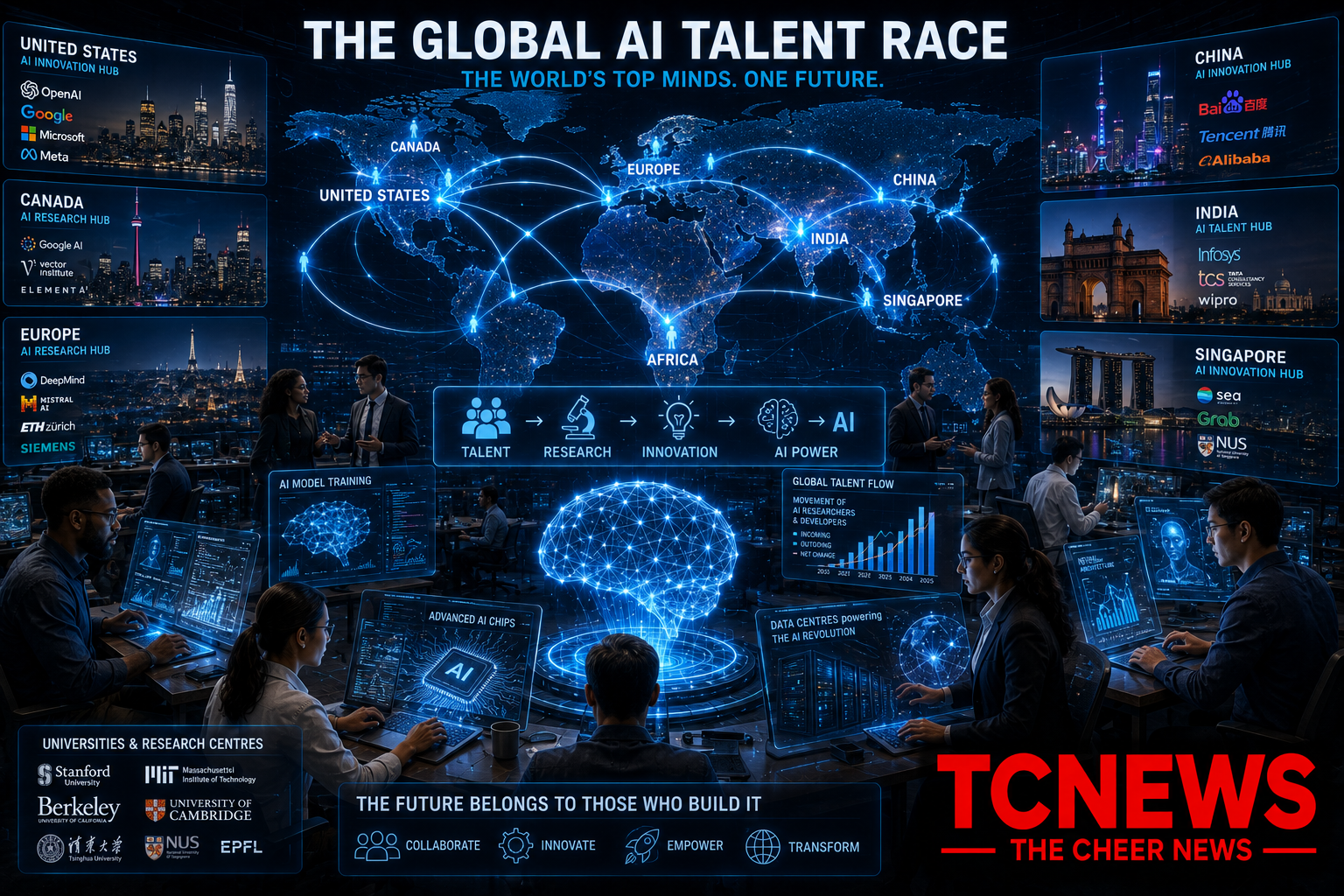
The United States remains the world’s strongest AI ecosystem by several measures, particularly in private investment, startups and frontier model development. China leads in AI research publication volume, citations and patent grants. India has emerged as one of the world’s largest pools of AI specialists, while countries including Singapore, Switzerland, Canada, the United Kingdom and several European economies are competing aggressively for highly skilled researchers and engineers.
Yet the global AI talent map is changing.
The 2026 Stanford AI Index reports that the United States still has more AI talent than any other country, but the number of AI researchers and developers moving to the U.S. has fallen sharply—down 89% since 2017 and 80% in the latest year measured.
That creates an important question:
If AI talent determines technological power, which countries are actually winning the race to attract, educate, and retain it?
https://crediblenews.com.ng/ai-for-small-businesses-productivity-profits/
Why AI Talent Has Become a Strategic Resource
The AI industry is entering a period in which technological competition increasingly depends on access to highly specialized people.
A country can purchase computing hardware.
It can build data centres.
It can invest billions of dollars in startups.
But developing the people capable of advancing frontier AI can take years.
AI researchers require strong foundations in mathematics, computer science, statistics, engineering and increasingly specialized areas such as robotics, machine learning and semiconductor technology.
This creates a strategic advantage for countries with strong universities, research institutions and technology companies.
The competition is therefore no longer simply about who has the most computers.
It is also about who has the people capable of making those computers intelligent.
The United States Still Leads the AI Talent Ecosystem
The United States remains the world’s most powerful AI ecosystem.
Stanford’s 2026 AI Index reports that U.S. private AI investment reached $285.9 billion in 2025, more than 23 times China’s reported private investment of $12.4 billion. The U.S. also produced 1,953 newly funded AI companies in 2025.
The country also maintains an enormous concentration of major AI laboratories, technology companies, universities, venture capital firms and computing infrastructure.
That combination creates a powerful feedback loop:
Talent attracts investment → investment attracts companies → companies attract more talent → research produces new technologies → new technologies attract more investment.
This ecosystem has helped the United States maintain an important advantage in frontier AI development.
Stanford reports that U.S. organizations produced 59 notable AI models in 2025, compared with 35 from China.
However, America’s position comes with a warning.
Its ability to attract new international AI talent is weakening.
The U.S. Has a Talent Attraction Problem
For decades, the United States benefited from attracting talented researchers and engineers from around the world.
Universities provided advanced training.
Technology companies offered high-paying jobs.
Venture capital provided funding for ambitious startups.
The country’s technology ecosystem became a magnet for international talent.
But Stanford’s latest data indicates that this advantage is under pressure.
The number of AI researchers and developers moving to the United States has declined dramatically since 2017.
That does not mean the U.S. has suddenly lost its AI leadership.
It means the competition is becoming harder.
Other countries are improving their universities, funding research, developing startup ecosystems and changing immigration policies to attract specialists. https://www.thecheernews.com/%f0%9f%87%b3%f0%9f%87%ac-nigerias-5g-revolution-how-faster-internet-is-powering-everyday-life-and-businesses-in-2025/
For Washington, the challenge is therefore twofold:
Keep existing talent—and continue attracting new talent.
China Is Building a Different Kind of AI Advantage
China presents perhaps the most important challenge to U.S. AI dominance.
According to Stanford’s 2026 AI Index, China leads the world in AI publication volume, citations and patent grants. The country has also increased its share of highly cited AI research.
China’s advantage extends beyond research.
It possesses a huge domestic market, a large engineering workforce, substantial manufacturing capacity and strong government support for strategic technologies.
Chinese universities are producing large numbers of technically trained graduates, while technology companies are investing heavily in artificial intelligence.
The country’s AI ecosystem has therefore developed around a combination of:
- University research
- Government investment
- Industrial capacity
- Startup development
- Engineering talent
- Large-scale AI deployment
This creates a formidable competitor.
China Is Also Retaining More of Its Talent
One of the most important developments in the global AI talent race is the changing direction of talent mobility.
For many years, highly skilled Chinese researchers frequently pursued education and careers abroad, particularly in the United States.
That flow helped strengthen American AI research.
But China’s growing technology ecosystem is creating more opportunities for researchers to remain or return.
Stanford’s 2026 AI Index shows that while the U.S. still hosts more AI talent overall, its ability to attract additional international researchers is declining.
The strategic implication is significant.
Countries do not necessarily need to import every researcher.
They can also build domestic ecosystems capable of retaining the talent they produce.
India Has Become a Major AI Talent Powerhouse
India is another critical player.
The country has a huge technology workforce and a large population of engineering and computer science graduates.
A 2026 analysis cited by Euronews found that the United States and India each have nearly one million AI specialists, although their strengths differ. The United States has a strong concentration of AI engineering talent, while India has particularly strong representation in software development and related profiles.
India’s importance extends beyond numbers.
The country’s technology workforce supports global companies across software development, cloud computing, cybersecurity, data science and now artificial intelligence.
India therefore has the potential to become both:
A major supplier of AI talent
and
A major AI market.
The next challenge will be increasing the country’s ability to retain more advanced AI researchers and build globally dominant AI companies.
Europe Wants to Become the Third AI Talent Superpower
Europe has historically possessed strong universities and research institutions, but it has struggled to convert scientific excellence into technology companies operating at the scale of U.S. giants.
That is beginning to change.
Countries such as Germany, France, the Netherlands, Ireland, Switzerland and the United Kingdom are developing stronger AI ecosystems.
Euronews reported in April 2026 that Ireland, Germany and the Netherlands were increasingly attracting AI professionals, positioning Europe as a growing third destination for global AI talent.
The United Kingdom has also been expanding pathways designed to attract highly skilled researchers.
A recent expansion of its Global Talent visa scheme widened eligibility to more research-intensive businesses, creating additional opportunities for international researchers.
Europe’s challenge is therefore not simply producing researchers.
It must create enough attractive opportunities for those researchers to stay.
Singapore and Switzerland Show Why Population Size Isn’t Everything
The global AI talent race is not determined entirely by population.
Small countries can become disproportionately influential by concentrating high-skilled talent.
Stanford’s 2026 AI Index identifies Switzerland and Singapore as leaders in AI researchers and developers per capita.
That is important because it demonstrates another model of AI development.
A country does not necessarily need hundreds of millions of people to become competitive in AI.
It needs:
- Excellent universities
- Research funding
- International connectivity
- Strong infrastructure
- Attractive working conditions
- Supportive technology policies
- Access to global markets
Singapore has particularly emphasized its role as a technology and research hub connecting Asia with global businesses.
Switzerland combines world-class universities, research institutions and a strong technology ecosystem.
Canada Remains an Important AI Research Hub
Canada has played an important role in the development of modern machine learning.
The country has benefited from major academic institutions, AI research centres and immigration policies designed to attract highly skilled professionals.
Its ecosystem has also been connected to leading global AI research networks.
Canada’s challenge, like Europe’s, is converting research strength into enough commercial scale.
Producing world-class researchers is one thing.
Keeping them in domestic companies is another.
The Talent Race Is No Longer About Salary Alone
The AI industry has reached a point where compensation can be extraordinary.
However, money is no longer the only factor influencing where elite researchers choose to work.
A recent Axios report on the AI talent wars noted that leading AI laboratories are competing not only through compensation but also through status, mission, culture and the opportunity to work on ambitious projects.
This matters because the best researchers often have multiple opportunities.
A scientist may choose between:
- A major technology company
- A frontier AI laboratory
- A university
- A startup
- A government research programme
- An international opportunity
The winning country or company must therefore offer more than a salary.
It must offer an environment where exceptional people believe they can accomplish exceptional things.
Universities Are Becoming Strategic AI Assets
The global AI competition begins long before someone joins a technology company.
It begins in classrooms and laboratories.
Universities train the researchers and engineers who will eventually build the next generation of AI.
Research by the National Bureau of Economic Research found that immigrants play a central role in the U.S. frontier AI workforce and that universities act as important institutional pathways connecting international students to top AI companies.
This makes university policy a strategic component of AI policy.
Countries seeking AI leadership need to ask:
Are our universities producing enough advanced technical talent?
And:
Are those graduates finding reasons to remain in the country?
The Immigration Question
AI talent is unusually mobile.
A researcher can potentially move from one country to another without moving an entire factory.
That makes immigration policy strategically important.
Countries that make it easier for highly skilled researchers to study, work, launch companies and obtain long-term residency may gain an advantage.
Countries that create unnecessary barriers could lose talent to competitors.
The issue has become particularly sensitive in the United States.
The country remains enormously attractive to AI professionals, but changing immigration conditions and uncertainty can influence where researchers choose to build their careers.
The global race is therefore partly a race between immigration systems.
The New AI Talent War Is Also a Geopolitical Contest
Artificial intelligence is increasingly connected to national security, economic competitiveness and technological sovereignty.
That makes AI researchers strategically valuable.
Governments want to encourage innovation while also protecting sensitive technologies.
The result is a difficult balance.
Countries want international collaboration because science benefits from global cooperation.
At the same time, national-security concerns have encouraged restrictions around advanced chips, AI technologies and strategic research.
This tension could reshape the global movement of AI talent.
The old model was:
Researchers move freely → knowledge spreads → innovation accelerates.
The emerging model may be:
Researchers remain internationally connected—but strategic technologies face increasing restrictions.
That could make the global AI ecosystem more fragmented.
The Hidden Power of the AI Diaspora
AI talent does not always stop contributing to its country of origin after moving abroad.
Researchers can maintain:
- Academic collaborations
- Business relationships
- Startup connections
- Investment networks
- Family links
- Research partnerships
Research examining AI scientists found significant cross-border movement between the United States and China, with researchers often continuing international collaboration after relocating.
That creates an important concept:
AI talent networks may be more important than national borders.
A researcher trained in one country, educated in another and employed by a company headquartered somewhere else can contribute to multiple ecosystems.
Africa’s Missing Opportunity
Africa has a large and growing population, including millions of young people entering education and the workforce.
That creates enormous potential.
But the continent faces a major challenge:
How can it turn demographic potential into AI talent?
The answer requires more than coding boot camps.
Africa needs stronger:
- Universities
- Research laboratories
- Mathematics education
- Computer science programmes
- AI scholarships
- Computing infrastructure
- Startup funding
- Industry partnerships
- Research collaboration
The continent also needs to retain more of its highly skilled professionals.
If talented African engineers and researchers must leave the continent to find advanced opportunities, African economies risk losing a significant portion of the value created by their education systems.
Nigeria Has a Huge Talent Opportunity
Nigeria has one of Africa’s largest technology ecosystems and a large population of young people.
The country has already developed significant strengths in software development, fintech and digital entrepreneurship.
AI creates an opportunity to move further up the technology value chain.
Nigeria could develop stronger capabilities in:
AI Research
Universities and research centres can support advanced machine learning research.
AI Engineering
Developers can build applications for African and global markets.
AI Entrepreneurship
Startups can address problems in healthcare, agriculture, education, finance and logistics.
AI Data Services
Specialized data work can support global AI development.
AI Education
Training programmes can expand the country’s technical workforce.
The challenge is creating an ecosystem where talented Nigerians can build globally competitive careers without being forced to look elsewhere for opportunity.
Why AI Talent Is Becoming More Valuable
AI systems are improving rapidly.
Yet frontier research remains difficult.
Companies need people who can:
- Build new architectures
- Optimize models
- Develop AI agents
- Improve reasoning systems
- Create efficient AI hardware
- Develop robotics
- Solve data problems
- Improve AI safety
- Deploy AI at scale
These skills are scarce.
That scarcity increases their economic value.
The result is an AI labour market in which exceptional specialists can command enormous compensation and influence.
The Risk of a Global AI Talent Divide
One danger is that AI talent could become concentrated in a small number of countries and companies.
If that happens, technological benefits may become unevenly distributed.
A small group of countries could dominate:
- Frontier AI research
- Advanced models
- AI infrastructure
- AI patents
- AI startups
- AI investment
Developing economies could become primarily consumers rather than creators.
That would widen the technological divide.
For this reason, expanding AI education and research capacity in emerging economies is not merely a development issue.
It is becoming an issue of global technological balance.
The Future of the AI Talent Race
The next decade could produce a very different global AI map.
The United States is likely to remain a major centre because of its investment, companies, universities and computing infrastructure.
China is likely to continue strengthening its research and engineering base.
India could become increasingly important as both a talent and innovation centre.
Europe will continue trying to convert research excellence into commercial scale.
Singapore, Switzerland, Canada, the UK, South Korea, the United Arab Emirates, Saudi Arabia and other countries are also seeking positions in the emerging AI economy.
The biggest winners may ultimately be countries that combine five things:
Talent + Capital + Compute + Research + Opportunity.
Having only one or two will not be enough.
What Countries Must Do to Win
A successful national AI talent strategy should include several components.
1. Strengthen Mathematics and Science Education
AI talent begins with strong foundations.
2. Build World-Class Universities
Research institutions remain critical.
3. Attract International Researchers
Global talent can accelerate domestic ecosystems.
4. Retain Homegrown Talent
Education without opportunity can produce brain drain.
5. Fund Research
Frontier AI requires significant resources.
6. Support Startups
Researchers need pathways from laboratories into companies.
7. Build Computing Infrastructure
Talent cannot work at the frontier without access to sufficient compute.
8. Encourage International Collaboration
AI research benefits from knowledge exchange.
Why This Matters
The global AI race is often described as a competition between countries.
But countries do not build AI systems.
People do.
The decisive resource may therefore be the researchers, engineers, entrepreneurs and technical specialists capable of pushing AI forward.
The United States still has the strongest overall position, but its declining ability to attract new international AI talent is an important warning. China is strengthening its research base and retaining more talent. India possesses an enormous technical workforce, while Europe and smaller technology hubs are becoming more aggressive in attracting global specialists.
For Africa, the message is particularly important.
The continent cannot afford to view AI simply as a technology it will import.
It needs to develop people who can build, research, deploy and govern AI.
The countries that invest in talent today could determine who captures the greatest economic value from AI tomorrow.
And the most important AI infrastructure of all may not be a data centre.
It may be a human mind.
Frequently Asked Questions
Which country currently leads in AI talent?
The United States remains the largest overall concentration of AI talent and has major advantages in frontier AI companies, investment and model development. However, China leads in several research measures, while India has a very large AI specialist workforce.
Is China overtaking the United States in AI?
China has become a major competitor and leads the U.S. in several research indicators. However, the United States continues to lead in private AI investment, newly funded AI companies and notable model development according to Stanford’s 2026 AI Index.
Why is India important to the AI talent race?
India has a huge technology workforce and a large pool of AI and software specialists. Its long-term opportunity is to expand advanced research and retain more high-level AI talent domestically.
Why is AI talent important to national economies?
Highly skilled AI researchers and engineers can create new technologies, companies, intellectual property and productivity gains. Their work can influence economic competitiveness and national technological capabilities.
What countries are attracting AI talent in Europe?
Germany, Ireland and the Netherlands have been identified as increasingly attractive European destinations, while the UK, Switzerland and France also maintain important AI ecosystems.
Can Africa compete for AI talent?
Yes. Africa has a large young population and growing technology sectors. However, countries need stronger education, research, infrastructure, funding and career opportunities to retain and attract high-level talent.
Why are AI researchers moving between countries?
Career opportunities, research resources, compensation, immigration policies, quality of life, professional networks and the opportunity to work on ambitious projects can all influence decisions.
Will AI talent become more important than AI hardware?
Neither can be separated. Advanced AI requires both computing infrastructure and highly skilled people. However, talent is especially important because researchers and engineers create the algorithms, systems and innovations that determine how effectively hardware is used.
Conclusion
The next phase of artificial intelligence will be shaped not only by who builds the largest data centres or the most powerful AI models.
It will be shaped by who has the people capable of building what comes next.
The United States still possesses enormous advantages. China is rapidly strengthening its position. India is emerging as a global talent powerhouse. Europe is attempting to become a stronger destination for researchers, while smaller countries are demonstrating that concentrated expertise can produce disproportionate influence.
For developing economies, the race presents both a warning and an opportunity.
A country that trains talented people but cannot provide opportunities may lose them.
A country that attracts talent but lacks infrastructure may fail to capitalize on it.
But a country that combines education, research, capital, computing infrastructure and opportunity can create a powerful AI ecosystem.
That is why the global AI competition is ultimately a competition for human capability.
The countries that educate, attract and retain the world’s best AI minds may have the strongest influence over the future of artificial intelligence.
Hashtags
#AITalent #ArtificialIntelligence #AI2026 #GlobalAITalent #AIResearch #AIEngineers #AIWorkforce #FutureOfAI #AIInnovation #Technology #AIJobs #AIEducation #Nigeria #Africa #GlobalTechnology #TheCheerNews