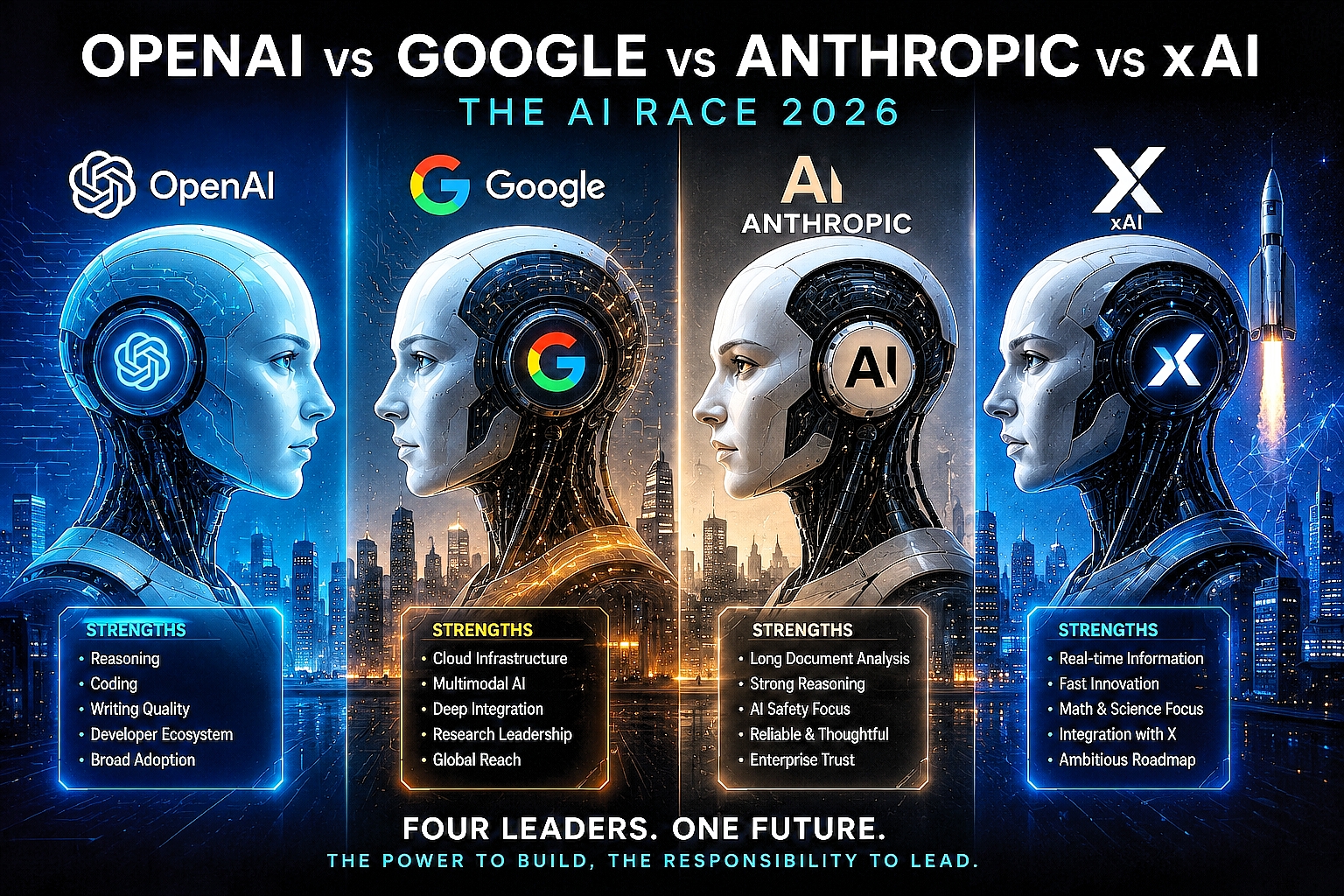
OpenAI has evolved into one of the world’s most competitive technology sectors. What began as a race to build powerful chatbots has transformed into a global contest to develop AI systems capable of reasoning, coding, researching, creating multimedia content, and acting as intelligent digital assistant
At the center of this competition are four major players—OpenAI, Google, Anthropic, and xAI. Each company has introduced increasingly sophisticated AI models that serve businesses, developers, governments, educators, researchers, and millions of everyday users.
The Rise of AI Agents: How Autonomous AI Is Changing Work and Business – Credible News
But one question continues to dominate conversations across the technology industry:
Which AI model performs best in 2026?
The answer is more nuanced than simply declaring a single winner. Each platform excels in different areas, from reasoning and coding to enterprise deployment and scientific research. This analysis examines how the leading AI developers compare, where they lead, where they lag, and what the competition means for the future of artificial intelligence.
The AI Race Enters a New Phase
Over the past few years, AI has shifted from generating text to performing increasingly complex tasks.
Today’s leading AI systems can:
- Write and debug software
- Analyze large documents
- Generate images and videos
- Conduct research
- Interpret charts
- Solve mathematical problems
- Build presentations
- Assist doctors
- Help lawyers review contracts
- Support customer service
- Automate business workflows
Rather than competing solely on chatbot capabilities, companies now focus on building AI ecosystems that integrate into daily work and enterprise operations.
Meet the Four AI Giants
OpenAI
OpenAI remains one of the most recognizable names in artificial intelligence.
Its ChatGPT platform has become widely adopted by consumers, businesses, developers, educators, and enterprises. The company’s AI models are known for strong reasoning, coding assistance, writing quality, and multimodal capabilities.
OpenAI has also expanded into AI agents, allowing users to automate increasingly complex workflows.
Strengths
- Excellent reasoning
- Strong coding performance
- High-quality writing
- Extensive developer ecosystem
- Broad enterprise adoption
Challenges
- Premium features require subscriptions.
- Enterprise governance remains an evolving area.
Google has leveraged decades of expertise in search, cloud computing, and machine learning to develop a comprehensive AI ecosystem.
Its AI strategy extends beyond conversational assistants into Workspace, Android, Chrome, YouTube, and Cloud services.
Google’s greatest advantage lies in integrating AI into products that billions of people already use.
Strengths
- Massive cloud infrastructure
- Strong multimodal AI
- Integration across Google services
- Advanced scientific research
Challenges
- Product branding and feature rollout have sometimes confused users.
- Enterprise customers often compare multiple Google AI offerings before deciding.
Anthropic
Founded by former OpenAI researchers, Anthropic has positioned itself as a leader in responsible AI development.
Its Claude family of models is widely praised for handling lengthy documents, careful reasoning, and reducing harmful outputs.
Businesses dealing with legal, financial, and policy documents often appreciate Claude’s ability to analyze extensive text while maintaining clarity.
Strengths
- Exceptional long-document analysis
- Strong reasoning
- Emphasis on AI safety
- High-quality writing
Challenges
- Smaller ecosystem than OpenAI or Google.
- Fewer consumer-facing products.
xAI
Founded by Elon Musk, xAI has quickly emerged as an ambitious competitor.
Its flagship models emphasize real-time information, scientific reasoning, and integration with the X platform.
Although younger than its rivals, xAI continues to expand rapidly through significant infrastructure investments.
Strengths
- Fast development pace
- Real-time information capabilities
- Strong mathematics and scientific reasoning
- Deep integration with the X ecosystem
Challenges
- Smaller enterprise footprint.
- Ecosystem continues to mature.
Comparing the Major AI Models
Reasoning
Complex reasoning has become one of the most important benchmarks.
OpenAI consistently performs strongly across logic-intensive tasks.
Anthropic is highly regarded for deliberate, structured reasoning.
Google continues improving advanced reasoning while leveraging extensive research capabilities.
xAI has made notable progress in mathematical and scientific reasoning.
Coding
Software developers increasingly rely on AI.
OpenAI remains a preferred choice for many programmers due to its debugging, code generation, and explanation capabilities.
Google performs well across programming languages while integrating closely with developer tools.
Anthropic earns praise for explaining code clearly.
xAI continues strengthening its coding performance through frequent updates.
Writing Quality
Content creators, journalists, marketers, and students require AI that produces natural language.
OpenAI offers polished writing across diverse formats.
Anthropic is known for thoughtful, well-structured responses.
Google provides increasingly fluent writing with strong multilingual support.
xAI has improved significantly while emphasizing direct responses.
Research
Research now extends beyond summarizing web pages.
Leading AI systems analyze documents, compare evidence, and synthesize information.
OpenAI excels in structured research assistance.
Google benefits from decades of search expertise.
Anthropic performs particularly well with long reports and policy documents.
xAI focuses on timely information and analytical reasoning.
Enterprise Adoption
Large organizations increasingly deploy AI throughout their operations.
OpenAI has secured extensive enterprise partnerships.
Google benefits from its existing cloud infrastructure and Workspace ecosystem.
Anthropic continues gaining enterprise customers prioritizing safety and document analysis.
xAI is expanding but remains earlier in enterprise adoption.
What Experts Say
Technology analysts increasingly believe the AI competition will not produce a single permanent winner.
Instead, organizations will select models based on their priorities.
A law firm may favor document analysis.
A software company may prioritize coding.
A hospital may require strong safety controls.
A media organization may value research and writing capabilities.
The future appears increasingly multi-model rather than dominated by a single platform.
Recent Developments
Competition among AI developers has accelerated dramatically in 2026.
Major companies continue releasing improved reasoning models, expanding multimodal capabilities, investing in AI infrastructure, and introducing autonomous AI agents for enterprise workflows. Partnerships with cloud providers, software vendors, and hardware manufacturers have also intensified as organizations race to deploy AI across industries.
At the same time, governments worldwide are advancing AI governance frameworks focused on transparency, privacy, accountability, and safety, reflecting the technology’s growing influence on economies and public services.
Benefits of Competition
Healthy competition benefits consumers and businesses alike.
It drives:
- Faster innovation
- Better performance
- Lower costs
- Improved safety
- More developer tools
- Greater enterprise choice
- Increased investment in research
Without competition, AI progress would likely slow considerably.
Risks Facing the Industry
Despite remarkable progress, challenges remain.
Hallucinations
AI systems can still generate inaccurate or fabricated information.
Copyright
Questions continue over the use of copyrighted material in AI training.
Privacy
Organizations must carefully protect confidential information.
Security
Advanced AI can also be exploited by cybercriminals if safeguards are inadequate.
Regulation
Governments continue balancing innovation with public protection.
Future Outlook
The next stage of AI competition will likely focus less on who has the “smartest chatbot” and more on who builds the most useful, trustworthy, and integrated AI ecosystem.
Future AI systems are expected to become more autonomous, multimodal, and collaborative, helping users complete complex tasks rather than simply responding to prompts.
As adoption expands across healthcare, education, finance, manufacturing, journalism, and government, responsible development and human oversight will remain essential.
Why This Matters
Artificial intelligence is rapidly becoming a foundational technology, much like the internet and smartphones before it. The outcome of the competition between OpenAI, Google, Anthropic, and xAI will influence how businesses operate, how students learn, how researchers make discoveries, and how governments deliver public services.
For organizations, selecting the right AI model is increasingly a strategic decision. The best choice depends on specific needs:
- Businesses seeking a versatile AI assistant may prioritize broad capabilities and integrations.
- Software companies may focus on coding performance and developer tools.
- Financial institutions and legal firms may value long-context analysis and reliability.
- Media organizations may emphasize research quality, writing, and fact-checking support.
- Educational institutions may prioritize accessibility, multilingual support, and safety.
Rather than asking, “Which AI is best?” organizations should ask, “Which AI is best for our use case?”
AI Model Comparison at a Glance
| Feature | OpenAI | Anthropic | xAI | |
|---|---|---|---|---|
| General Reasoning | ★★★★★ | ★★★★☆ | ★★★★★ | ★★★★☆ |
| Coding | ★★★★★ | ★★★★☆ | ★★★★☆ | ★★★★☆ |
| Long Document Analysis | ★★★★☆ | ★★★★☆ | ★★★★★ | ★★★★☆ |
| Enterprise Integration | ★★★★★ | ★★★★★ | ★★★★☆ | ★★★☆☆ |
| Scientific Research | ★★★★☆ | ★★★★★ | ★★★★☆ | ★★★★★ |
| Writing Quality | ★★★★★ | ★★★★☆ | ★★★★★ | ★★★★☆ |
| Ecosystem | ★★★★★ | ★★★★★ | ★★★☆☆ | ★★★☆☆ |
| AI Safety Focus | ★★★★☆ | ★★★★☆ | ★★★★★ | ★★★★☆ |
Key takeaway: There is no single universal winner. Each platform has distinct strengths that make it well-suited to different users and industries.
Frequently Asked Questions (FAQs)
1. Which AI model is best overall in 2026?
There is no universal winner. OpenAI, Google, Anthropic, and xAI each perform exceptionally well in different areas such as reasoning, coding, research, enterprise integration, or long-document analysis.
2. Which AI is best for software developers?
Many developers prefer OpenAI for its coding assistance and debugging capabilities. Google, Anthropic, and xAI also offer strong programming support, making the choice dependent on workflow and preferred tools.
3. Which AI is best for business?
Businesses should evaluate AI based on security, compliance, integration with existing software, pricing, and the specific tasks they want to automate.
4. Can AI replace human professionals?
AI is more likely to augment human work than replace it entirely. Professionals who learn to work effectively with AI are expected to gain productivity and competitive advantages.
5. What is the biggest challenge facing AI today?
Major challenges include accuracy, privacy, cybersecurity, copyright issues, ethical governance, and ensuring that AI systems remain transparent and accountable.
Conclusion
The competition between OpenAI, Google, Anthropic, and xAI is accelerating innovation across the technology industry. Each company is investing heavily in more capable AI models, enterprise solutions, and intelligent agents that can automate increasingly complex tasks.
Instead of producing a single dominant platform, the AI landscape is evolving into a diverse ecosystem where organizations can choose the tools that best align with their goals. Success will depend not only on raw performance but also on trust, security, integration, and responsible development.
For businesses, governments, educators, and individuals, staying informed about these developments is essential. As AI continues to mature, the organizations that adopt it thoughtfully and ethically will be better positioned to thrive in an increasingly digital world.
#ArtificialIntelligence #OpenAI #GoogleAI #Anthropic #xAI #GenerativeAI #EnterpriseAI #MachineLearning #TechNews #Innovation #FutureOfWork #DigitalTransformation #TheCheerNews