By DAYO ADESULU
Artificial intelligence has spent much of the past decade living inside computers.
It writes, searches, analyzes, translates, generates images and helps people make decisions. However, a new phase of the AI revolution is emerging—one in which intelligent systems are no longer limited to digital environments.
They are beginning to move.
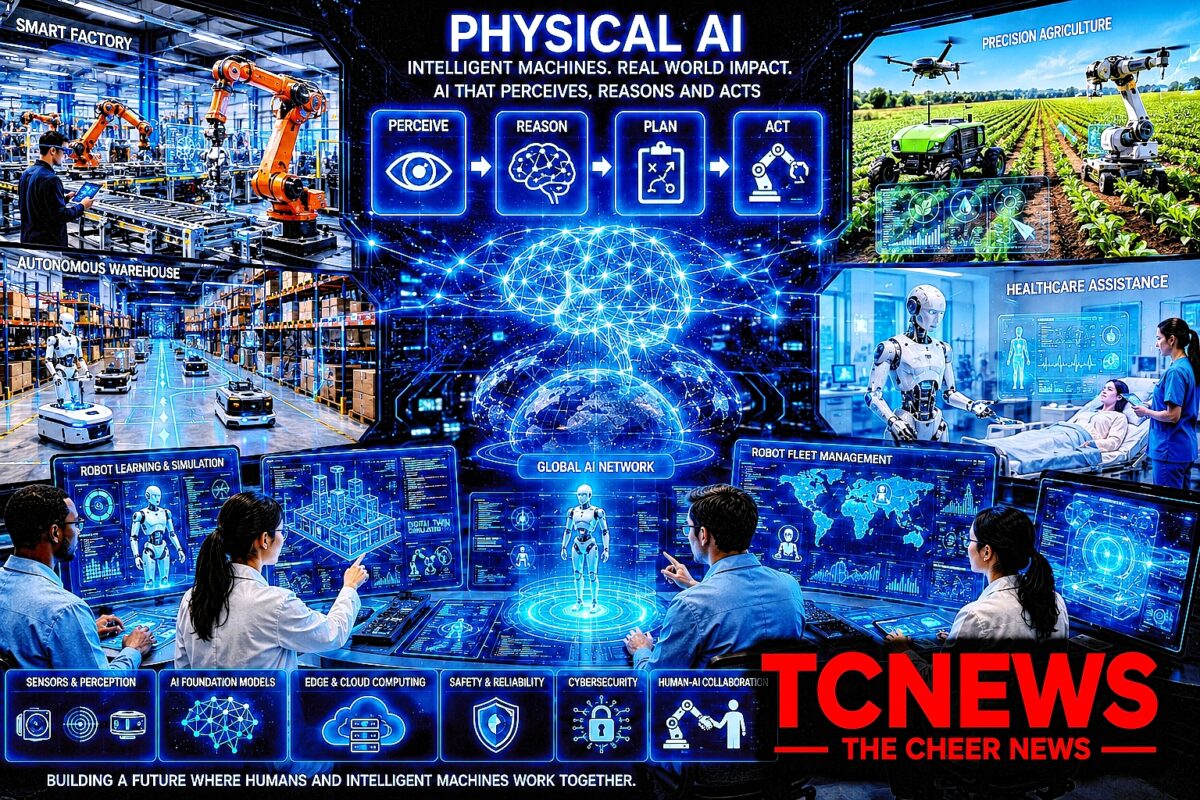
Physical AI refers to artificial intelligence systems that can perceive and interact with the physical world. These systems combine AI models with sensors, cameras, robotics, simulation, advanced computing and mechanical systems to allow machines to understand their surroundings and perform physical tasks.
The implications are enormous.
A robot equipped with physical AI could potentially identify an object, understand an instruction, plan a sequence of movements and manipulate the object. In a factory, an autonomous machine could inspect products and respond to changing conditions. In agriculture, robots could monitor crops. In logistics, autonomous systems could move goods through warehouses.
The technology is developing rapidly.
In March 2026, NVIDIA announced partnerships with robotics companies including ABB Robotics, Agility, Figure, KUKA, Medtronic, Universal Robots and others as part of an effort to bring physical AI into industrial, surgical and humanoid robotics. The company also unveiled new simulation and robot-learning technologies designed to accelerate development.
Meanwhile, China has introduced a national standards framework covering the industrial chain and lifecycle of humanoid robots and embodied AI, illustrating how seriously governments are beginning to treat physical AI as a strategic technology.
The race has therefore moved beyond teaching machines to think and generate.
The next challenge is teaching them to perceive, move and act safely in the real world.
https://crediblenews.com.ng/edge-ai-on-device-intelligence-future/
What Is Physical AI?
Physical AI is AI designed to operate in environments where physical actions matter.
Traditional generative AI works mainly with digital information.
Physical AI adds another dimension: the physical environment.
A physical AI system may combine:
- Cameras
- Microphones
- Radar or other sensors
- AI models
- Robotics software
- Motion controllers
- Simulation environments
- Specialized processors
- Motors and actuators
- Real-time decision-making
Together, these technologies allow a machine to perceive its surroundings, interpret information and take physical action.
This is sometimes described as embodied AI.
The basic concept is simple:
Traditional AI operates on information. Physical AI operates on information and the physical world.
From AI Agents to Physical Agents
Day 15 examined AI agents capable of performing digital tasks.
Physical AI takes that concept one step further.
An AI agent might book a meeting, analyze a document or write software.
A physical AI agent could potentially move an object, inspect a machine, navigate a warehouse or assist with manufacturing.
This creates a new category of intelligent systems.
Instead of simply asking:
“What should the AI say?”
Engineers increasingly need to ask:
“What should the AI do—and how can it do it safely?”
That is a much harder problem.
Why the Physical World Is Difficult for AI
The digital environment is relatively predictable.
The physical world is not.
Objects can move unexpectedly.
Lighting can change.
Surfaces can be slippery.
People can behave unpredictably.
Sensors can produce incomplete information.
A robot operating in the real world therefore needs to continuously interpret changing conditions.
A physical AI system must solve several problems simultaneously:
Perception
What is around the robot?
Reasoning
What does the environment mean?
Planning
What should the robot do next?
Control
How should it physically move?
Feedback
Did the action produce the expected result?
This creates a continuous loop:
Sense → Understand → Plan → Act → Observe → Adapt.
The Rise of Humanoid Robots
Humanoid robots have become one of the most visible areas of physical AI.
Their human-like shape is not simply about appearance.
A humanoid form can potentially allow robots to operate in environments designed for humans.
Factories, offices, homes and warehouses already contain:
- Doors
- Stairs
- Shelves
- Tools
- Workstations
- Vehicles
- Human-sized equipment
A robot capable of walking and manipulating objects like a person could potentially work within these existing environments without requiring every location to be redesigned.
However, humanoid robots remain technically challenging.
Walking, balancing, manipulating objects and understanding complex environments require sophisticated coordination between hardware and AI.
2026: The Robotics Race Accelerates
The global physical AI race has intensified in 2026.
NVIDIA announced in May a humanoid robotics reference design combining a Unitree H2 Plus robot, dexterous five-fingered hands, Jetson Thor computing and its Isaac GR00T robotics platform. Research institutions including Stanford, ETH Zurich and UC San Diego are involved in research using the reference platform.
In January, NVIDIA also announced new physical AI models, simulation tools and robotics infrastructure involving companies such as Boston Dynamics, Caterpillar, Franka Robotics, LG Electronics and NEURA Robotics.
The significance is broader than any individual robot.
The industry is building an AI robotics ecosystem involving hardware, software, simulation, training data and computing infrastructure.
Robots Need AI Foundation Models
One of the most important developments is the attempt to create general-purpose AI models for robots.
Traditional robots are often programmed for specific tasks.
A manufacturing robot might repeatedly perform the same operation.
Physical AI aims to create robots capable of handling a wider range of situations.
Instead of programming every movement individually, developers can train models to understand relationships between:
- Language
- Images
- Objects
- Actions
- Environments
- Physical movement
This could allow a person to give a robot a natural-language instruction and have the robot determine how to accomplish it.
That is one of the central ambitions behind modern embodied AI.
Simulation Is Becoming a Critical Technology
Training robots in the real world can be expensive and slow.
A robot learning a new task may make thousands of mistakes.
Those mistakes can damage equipment or create safety risks.
Simulation offers an alternative.
Engineers can create virtual environments where robots practice tasks repeatedly.
NVIDIA’s physical AI ecosystem includes simulation and robot-learning technologies designed to accelerate this process. Its Isaac and Cosmos platforms are intended to help developers generate environments, data and training experiences before deploying systems in the real world.
The process can therefore become:
Simulate → Train → Test → Evaluate → Deploy → Learn.
This could dramatically accelerate robotics development.
Synthetic Data and Robot Learning
Another major challenge is data.
Large language models can learn from enormous quantities of digital text.
Robots need different types of information.
They need examples of:
- Movement
- Object manipulation
- Spatial relationships
- Human interaction
- Physical environments
- Failures
- Recovery strategies
Synthetic data can help generate some of these experiences in simulation.
The advantage is scale.
Instead of waiting for a physical robot to experience every possible situation, engineers can generate thousands or millions of simulated scenarios.
However, simulation must accurately represent reality.
A robot trained in a perfect virtual environment may struggle when faced with unpredictable real-world conditions.
This is known as the sim-to-real challenge.
AI Robots in Manufacturing
Manufacturing is likely to remain one of the earliest major markets for physical AI.
Factories already use industrial robots extensively.
The next generation could be more flexible.
Instead of performing one highly specialized movement, intelligent robots could potentially switch between tasks.
Applications could include:
- Assembly
- Quality inspection
- Packaging
- Material handling
- Machine maintenance
- Inventory management
- Workplace safety monitoring
A 2026 research roadmap on AI and smart manufacturing highlights autonomous systems, robotics, digital twins, supply-chain optimization and foundation models as important areas shaping future industrial production.
The result could be factories that are not merely automated, but increasingly adaptive.
Physical AI in Logistics
Warehouses are another natural environment for intelligent machines.
Robots can potentially:
- Move packages
- Sort inventory
- Navigate warehouses
- Load and unload materials
- Monitor stock
- Optimize routes
Unlike traditional automated machinery, physical AI systems could potentially adapt to changing layouts and unexpected obstacles.
This could make logistics networks more flexible.
AI Robotics in Agriculture
Agriculture presents an especially interesting opportunity.
Farms are complex environments where weather, terrain, crops and biological conditions change constantly.
Physical AI could support:
- Crop monitoring
- Weed detection
- Harvesting
- Soil analysis
- Autonomous farm vehicles
- Precision spraying
- Irrigation management
Robots could eventually perform highly targeted physical tasks rather than treating an entire field uniformly.
That could potentially improve efficiency while reducing waste.
Healthcare and Medical Robotics
Physical AI could also transform healthcare.
Robotic systems already assist with certain medical procedures and rehabilitation.
Future AI-powered systems could potentially provide more adaptive assistance.
Possible applications include:
- Surgical assistance
- Rehabilitation
- Patient mobility support
- Hospital logistics
- Laboratory automation
- Medical equipment handling
However, healthcare requires an exceptionally high level of safety and accountability.
A physical AI system operating around patients cannot be treated like an ordinary consumer device.
The Safety Problem
Physical AI creates a new category of AI risk.
A chatbot producing an incorrect answer can cause confusion.
A physical robot making an incorrect movement could potentially cause physical harm.
This makes safety engineering essential.
In June 2026, NVIDIA announced Halos for Robotics, a safety architecture designed specifically for physical AI and robotics. The system is intended to integrate safety across computing, sensors, software and inspection processes.
Academic experts have similarly emphasized that embodied AI requires strong systems engineering, lifecycle governance, human-centered design and evolving safety standards.
This suggests an important principle:
Robot intelligence cannot be separated from robot safety.
China’s Growing Role
China has emerged as a major force in humanoid robotics.
In February 2026, China introduced its first national standard system covering the full industrial chain and lifecycle of humanoid robots and embodied AI. The framework includes intelligent computing, robot components, complete systems, applications, safety and ethics.
The move reflects an effort to standardize a rapidly expanding sector.
More recently, Chinese humanoid robot manufacturer Unitree priced its Shanghai IPO in August 2026 at a valuation of approximately $9 billion, according to Reuters. The company reported that humanoid robots generated 867.8 million yuan in revenue in 2025.
That development illustrates how quickly robotics is moving from laboratory research toward commercial markets.
The Global Competition
The physical AI race involves more than the United States and China.
Companies and research organizations across Europe, Asia and other regions are developing robotics platforms, sensors, AI models and industrial systems.
The competition is occurring across several layers:
- AI models
- Robot hardware
- Sensors
- Actuators
- AI processors
- Simulation
- Training data
- Manufacturing
- Safety standards
- Commercial deployment
The winners may not necessarily be the companies that build the most impressive-looking robot.
They may be the companies that create the most reliable combination of intelligence, affordability, safety and scalability.
Will Humanoid Robots Replace Workers?
This is one of the most debated questions surrounding physical AI.
The answer will depend heavily on what robots can actually do reliably.
Some tasks are repetitive and predictable.
Others require human judgment, communication and adaptability.
Robots may therefore first complement workers in areas such as:
- Heavy lifting
- Repetitive assembly
- Dangerous environments
- Warehouse operations
- Inspection
- Routine material handling
Rather than replacing entire occupations immediately, physical AI is more likely to automate selected tasks and change how workers perform their jobs.
That distinction matters.
The future workplace could involve humans managing intelligent machines rather than competing directly against them.
Benefits of Physical AI
Higher Productivity
Robots can operate continuously in suitable environments.
Safer Workplaces
Machines can potentially perform dangerous or physically demanding tasks.
Greater Manufacturing Flexibility
AI-powered robots may adapt to different tasks more easily than traditional automation.
Labour Support
Robots could help address labour shortages in certain industries.
Precision
AI-controlled machines can perform highly consistent operations.
New Services
Physical AI could create new markets in healthcare, agriculture, logistics and home services.
Risks and Challenges
Safety
Physical machines can cause harm if they malfunction or misinterpret their environment.
High Costs
Advanced robots require sophisticated hardware, sensors and computing systems.
Reliability
A robot that succeeds in demonstrations may still struggle in unpredictable environments.
Cybersecurity
Connected robots can become targets for digital attacks.
Workforce Disruption
Some tasks may become automated, requiring workers to develop new skills.
Privacy
Robots equipped with cameras and sensors can collect large amounts of environmental information.
Energy Consumption
Large fleets of intelligent machines require electricity and computing resources.
Nigeria and Africa: A New Opportunity
Physical AI could offer Africa opportunities that extend beyond traditional industrial automation.
Agriculture is one particularly important area.
African economies could benefit from robots capable of operating in environments where labour shortages, difficult terrain or repetitive manual tasks create challenges.
Other potential applications include:
- Warehouse automation
- Mining support
- Infrastructure inspection
- Agricultural robotics
- Healthcare logistics
- Construction
- Renewable-energy maintenance
- Manufacturing
However, African countries should avoid simply importing technology without developing local expertise.
Universities, engineering institutions, technology companies and vocational programmes can help build skills in:
- Robotics
- AI
- Electronics
- Mechanical engineering
- Computer vision
- Embedded systems
- Automation
This could create a new generation of African engineers capable of building and maintaining physical AI systems.
Expert Perspective
The transition from digital AI to physical AI represents a fundamental technological shift.
AI systems must now deal with uncertainty, physics, movement and human interaction.
Researchers have identified challenges including data collection, generalization across environments, lifelong learning, explainability, safety and sustainable computing as major barriers to widespread robotic intelligence.
The lesson is clear.
A robot that can perform one task perfectly is useful.
A robot that can safely understand many tasks and environments would be transformative.
The industry is still working toward the second goal.
Future Outlook
The next decade could see physical AI expand across factories, warehouses, farms, hospitals and infrastructure.
Robots will likely become:
- More intelligent
- More dexterous
- More energy efficient
- More affordable
- Easier to program
- Better at understanding natural language
- Better at learning from experience
Humanoid robots will receive considerable attention, but they will not necessarily dominate every application.
Specialized robots may remain more efficient for particular tasks.
The larger trend is therefore not simply humanoid robotics.
It is the emergence of machines that can intelligently perceive and act in the physical world.
Why This Matters
Artificial intelligence is no longer confined to screens.
The next stage of the AI revolution is physical.
When intelligent software connects with robots, machines can potentially move through warehouses, operate factories, assist agriculture, inspect infrastructure and support healthcare.
That creates extraordinary opportunities.
But physical AI also introduces a responsibility that does not exist to the same degree in conventional software.
Machines must be safe.
They must be predictable.
They must be secure.
And humans must remain able to understand and control important decisions.
For Nigeria and Africa, the physical AI revolution could create opportunities in manufacturing, agriculture, logistics and engineering—provided the continent invests in the skills and infrastructure required to participate.
The future of AI will therefore not simply be about machines that can think.
It will increasingly be about machines that can think, move and act.
Frequently Asked Questions (FAQs)
What is Physical AI?
Physical AI refers to artificial intelligence systems that perceive, reason about and interact with the physical world through robots, autonomous machines and other devices.
What is embodied AI?
Embodied AI is closely related to physical AI and generally refers to AI systems that learn and act through interaction with a physical or simulated environment.
Are humanoid robots already being used?
Yes. Humanoid robots and other advanced robotic systems are moving into research, industrial pilots and commercial development, although widespread general-purpose deployment remains an evolving process.
Why are robots difficult to train?
Robots must deal with real-world physics, unpredictable environments, sensor uncertainty and complex movements. These challenges are considerably different from processing digital information.
Can physical AI replace human workers?
It can automate certain physical tasks, particularly repetitive or hazardous activities. However, many jobs require human judgment, communication and adaptability.
Is Physical AI safe?
Safety depends on hardware, software, sensors, testing, monitoring and human oversight. Because physical systems can directly affect the real world, safety engineering is particularly important.
What industries could benefit most from Physical AI?
Manufacturing, logistics, agriculture, healthcare, construction, energy and infrastructure inspection are among the sectors with significant potential.
What is the future of humanoid robots?
Humanoid robots may become increasingly capable and commercially useful, but specialized robots will likely remain important because they can be better suited to specific tasks.
Conclusion
The AI revolution is entering the physical world.
For years, artificial intelligence transformed how humans interact with information. Now, robotics and embodied AI are attempting to transform how intelligent machines interact with the physical environment.
The technology combines AI models, robotics, sensors, simulation, advanced chips and mechanical systems.
Its potential is enormous.
Factories could become more adaptive. Farms could become more automated. Warehouses could become more intelligent. Healthcare systems could gain new robotic capabilities.
But the biggest challenge is not simply building robots that can move.
It is building machines that can understand, adapt and act safely.
#PhysicalAI #EmbodiedAI #ArtificialIntelligence #Robotics #HumanoidRobots #AIRobotics #FutureOfAI #FutureOfRobotics #Automation #SmartFactory #AIInnovation #Technology #AI2026 #Nigeria #Africa #TheCheerNews