Artificial intelligence is moving beyond screens, smartphones, and data centers. The next major frontier is physical AI—intelligent systems that can perceive the real world, make decisions, and act through robots, machines, and autonomous devices.
For decades, robots were largely programmed to repeat specific movements in controlled environments. Today, advances in generative AI, computer vision, sensors, and robotics are giving machines a greater ability to understand changing environments and respond to them.
That shift is driving renewed interest in humanoid robots, autonomous mobile machines, and intelligent industrial systems. Technology companies, manufacturers, and investors increasingly see physical AI as a potential bridge between digital intelligence and the physical economy.
The implications are enormous. Robots could eventually assist in factories, warehouses, hospitals, laboratories, agriculture, logistics, and other environments where repetitive or physically demanding work is required.
However, the transition from impressive demonstrations to reliable commercial deployment remains challenging. Robots must operate safely around people, manipulate unpredictable objects, navigate changing environments, and perform tasks consistently.
As a result, physical AI is emerging as one of the most important technology trends to watch in 2026. https://crediblenews.com.ng/ai-chips-semiconductor-race-future/
What Is Physical AI?
Physical AI refers to artificial intelligence systems that can perceive and interact with the physical world.
Traditional AI operates primarily in digital environments. It can analyze documents, generate text, recognize images or write software.
Physical AI adds a body or physical interface.
These systems can combine:
- Computer vision
- Machine learning
- Generative AI
- Robotics
- Sensors
- Motion control
- Spatial reasoning
- Real-time decision-making
The result is an AI system capable of translating perception and reasoning into physical action.
For example, a warehouse robot could identify a package, determine where it belongs, navigate around obstacles and place it on the appropriate conveyor system.
Why Physical AI Is Different From Traditional Robotics
Traditional industrial robots are extremely capable when their environment is predictable.
A robotic arm on an assembly line may perform the same movement thousands of times with remarkable precision.
However, conventional robots often struggle when:
- Objects change position.
- Lighting changes.
- Humans enter the workspace.
- An unexpected obstacle appears.
- The task changes.
- Objects have different shapes or textures.
Physical AI attempts to make robots more adaptable.
Instead of simply following predetermined instructions, AI-powered machines can increasingly interpret their surroundings and determine appropriate actions.
That capability is particularly important for environments designed for humans.
The Rise of Humanoid Robots
Humanoid robots have become one of the most visible applications of physical AI.
Their human-like form is not simply about appearance. A humanoid design can potentially allow robots to operate in environments already built around human bodies, including stairs, doors, tools, shelves and workstations.
Research and commercial development are accelerating.
A 2026 review published in ACM Computing Surveys noted that advances in generative AI and multimodal large language models have intensified interest in humanoid systems capable of more interactive and general-purpose applications.
At the same time, financial institutions and technology researchers are closely watching the sector as companies move from laboratory demonstrations toward commercial pilots.
https://www.thecheernews.com/watch-out-for-false-information-about-5g-networks-police-warns/
How AI Gives Robots Greater Intelligence
Computer Vision
Robots need to understand what is around them.
Computer vision enables machines to identify objects, people, surfaces and obstacles using cameras and other sensors.
Multimodal AI
Modern AI systems increasingly process multiple forms of information simultaneously.
A physical AI system could combine:
- Images
- Video
- Audio
- Text instructions
- Sensor measurements
- Spatial information
This allows the robot to develop a richer understanding of its environment.
Reasoning and Planning
Large AI models can help robots interpret instructions and break complex objectives into smaller actions.
For example, rather than programming every movement individually, an operator could provide a high-level objective and allow the system to determine an appropriate sequence of actions.
Learning From Experience
Physical AI systems can improve through simulation, demonstrations and real-world feedback.
This is important because the physical world contains countless variables that are difficult to anticipate through traditional programming alone.
Where Physical AI Is Being Used
Manufacturing
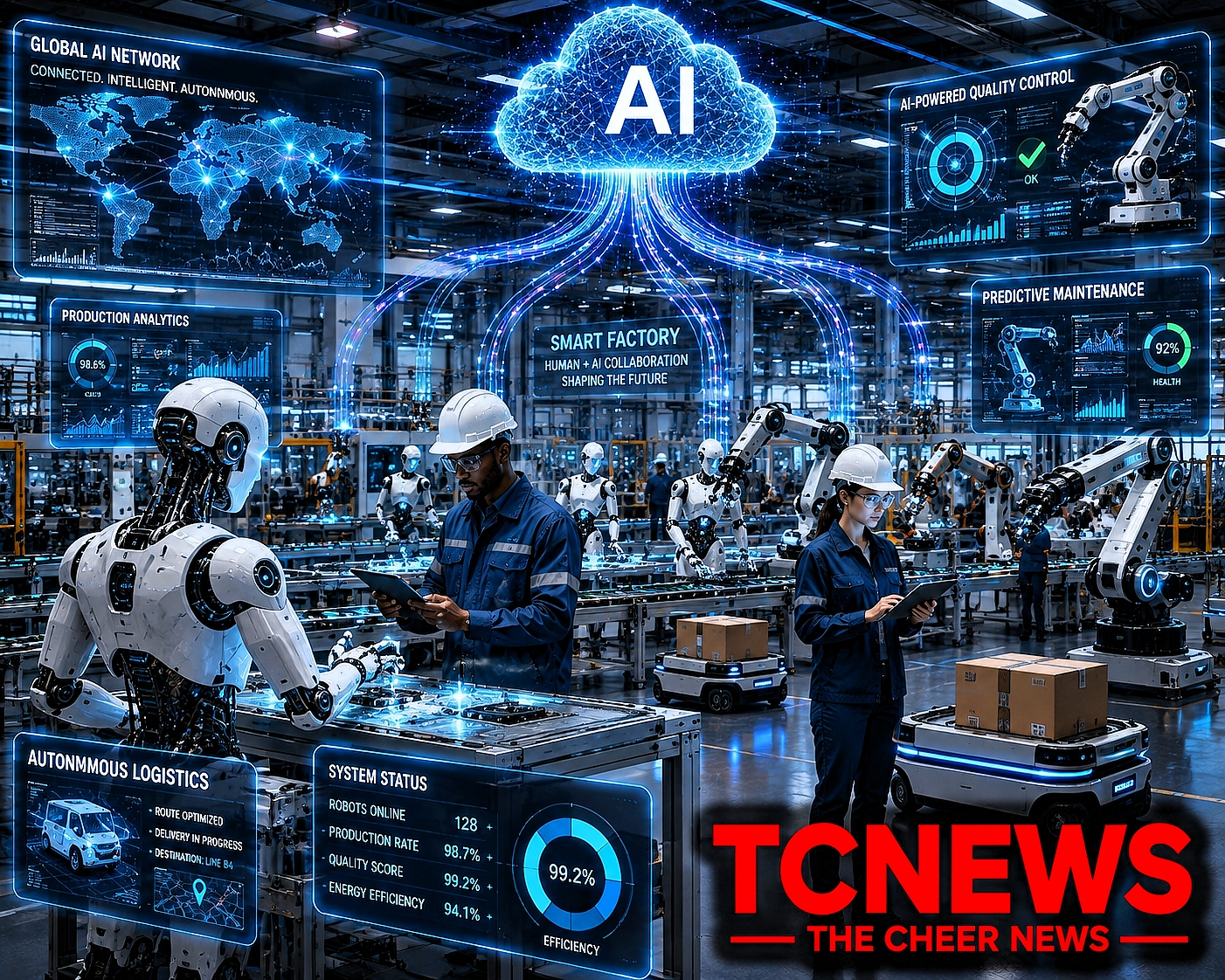
Factories are among the earliest environments for advanced robotics.
AI-powered robots can assist with:
- Assembly
- Inspection
- Material handling
- Packaging
- Quality control
- Machine tending
Industrial environments are particularly attractive because workflows can be structured and safety conditions can be carefully controlled.
Warehouses and Logistics
Warehouses contain repetitive tasks that can potentially be automated.
Physical AI could help robots identify packages, move inventory, organize shelves and support order fulfillment.
The technology could become particularly valuable as e-commerce and logistics operations demand faster processing.
Healthcare
Robotics already plays an important role in healthcare, particularly in surgery and rehabilitation.
Future physical AI systems could assist with:
- Hospital logistics
- Medication transportation
- Laboratory operations
- Patient-support tasks
- Rehabilitation
- Elder-care assistance
Because healthcare involves vulnerable people, however, safety, reliability and human supervision will be especially important.
Agriculture
Agricultural environments are highly unpredictable.
AI-powered robots could potentially identify crops, monitor plant health, detect weeds and assist with harvesting.
Physical AI could therefore contribute to more efficient and data-driven agriculture.
Construction
Construction sites contain hazardous and physically demanding activities.
Robotic systems could eventually assist with material movement, inspection, repetitive installation tasks and other operations while allowing human workers to focus on more complex activities.
The Global Race for Humanoid Robotics
The physical AI race is becoming increasingly competitive.
China is emerging as a major force in humanoid robotics. In August 2026, Chinese humanoid robot maker Unitree priced its Shanghai IPO at a valuation of approximately $9 billion, according to Reuters. The company reported that its 2025 revenue more than quadrupled to 1.7 billion yuan, although growth and profitability pressures emerged in early 2026.
The development also highlights the strategic importance of robotics hardware, manufacturing capacity and AI software.
Meanwhile, Meta acquired humanoid robotics startup Assured Robot Intelligence in May 2026. The startup had been developing foundation models designed to help humanoid robots understand, predict and adapt to human behavior in complex environments.
Germany’s Agile Robots is another example of the industry’s movement toward practical deployment. The company expects to double revenue in 2026 from €300 million in 2025 and is integrating Google’s Gemini Robotics technology into its products.
These developments demonstrate that the physical AI competition is no longer limited to robotics specialists. Major AI companies, manufacturers and investors are increasingly entering the field.
Why Embodied Intelligence Matters
A major concept behind physical AI is embodied intelligence.
The idea is simple: intelligence is not only about processing information. A machine also needs to understand the physical consequences of its actions.
For a robot, that means learning how:
- Objects move.
- Surfaces affect balance.
- Weight affects lifting.
- Humans move.
- Tools behave.
- Environments change.
Researchers are developing systems that combine physical design, AI models and interaction with people.
A 2026 research paper on the ergoCub humanoid, for example, explored ways of combining embodied cognition with shared intelligence so robots can collaborate more effectively with humans.
The Economic Opportunity
Physical AI could create a major new technology market.
Potential areas include:
- Robot manufacturing
- AI chips
- Sensors
- Actuators
- Robot operating systems
- Simulation software
- AI foundation models
- Industrial automation
- Robot-as-a-service
- Maintenance and support
The economic impact could extend far beyond companies that manufacture robots.
Manufacturers, logistics companies, healthcare providers, construction firms and agricultural businesses could all become customers.
Benefits of Physical AI
Higher Productivity
Robots can perform repetitive tasks consistently and continuously.
Improved Workplace Safety
Machines could take on certain hazardous or physically demanding activities.
Greater Manufacturing Flexibility
AI-powered robots could potentially adapt to different products without extensive reprogramming.
Addressing Labor Gaps
Automation may help industries facing shortages of workers for repetitive or physically demanding roles.
New Business Models
Robot-as-a-service and AI-powered automation could create new opportunities for startups and established businesses.
Risks and Challenges
Physical AI is not without significant challenges.
Safety
A software error can produce incorrect information. A physical robot can potentially cause real-world harm if it behaves unexpectedly.
Safety engineering must therefore remain central to development.
Reliability
A robot that works 95% of the time may still be unsuitable for some critical applications.
Commercial systems need extremely high levels of reliability.
Cost
Advanced robots require expensive hardware, sensors, computing systems and maintenance.
Reducing these costs will be essential for mass adoption.
Workforce Disruption
Automation could change the nature of many jobs.
The transition will require workforce training and new approaches to human-machine collaboration.
Security
Connected robots could become targets for cyberattacks. Protecting their software, communications and control systems will therefore be essential.
Expert Perspectives
The direction of the industry suggests that the biggest breakthrough may not come from making robots look more human. Instead, the competitive advantage could come from making machines more capable of understanding environments and performing useful tasks reliably.
Researchers are increasingly emphasizing human-centered design, safety and trust alongside technical performance. A 2026 research framework on “humanoid factors” argues that robots designed to share environments with humans must account for physical, cognitive, social and ethical considerations.
This reflects a broader shift in robotics: the question is moving from “Can a robot perform this task?” to “Can it perform the task safely, reliably and economically alongside humans?”
Future Outlook
Physical AI is likely to become one of the defining technology categories of the next decade.
The first major wave of adoption is likely to focus on structured environments such as factories, warehouses and logistics centers. As robots become more capable and affordable, their use could expand into healthcare, agriculture, construction and eventually consumer environments.
The technology is still developing, however. Humanoid robots must overcome challenges involving dexterity, battery life, navigation, safety, reliability and cost before widespread deployment becomes realistic.
The long-term vision is not simply a world filled with humanoid machines. It is a world where AI can understand both digital information and physical environments—and where intelligent machines can work alongside humans.
Why This Matters
Artificial intelligence has spent much of the past decade transforming the digital world. Physical AI could be the next major step: bringing that intelligence into factories, hospitals, warehouses, farms and other real-world environments.
For businesses, this could mean greater productivity and new automation opportunities. For workers, it could change how tasks are performed and create demand for new technical and supervisory skills.
For countries such as Nigeria and other emerging economies, physical AI also presents an opportunity to modernize manufacturing, agriculture, logistics and healthcare—provided investment in infrastructure, education and responsible technology adoption keeps pace.
The race for physical AI has already begun. The winners may not simply be those who build the smartest robots, but those who make intelligent machines useful, affordable, safe and trustworthy.
Frequently Asked Questions (FAQs)
What is Physical AI?
Physical AI refers to artificial intelligence systems that can perceive, reason about and interact with the physical world through robots or other machines.
What is an AI-powered humanoid robot?
It is a robot with a human-like physical form that uses AI to perceive its environment, understand instructions and perform physical tasks.
Is Physical AI available today?
Yes. AI-powered robots are already being used in manufacturing, logistics, research and other specialized environments, although general-purpose humanoid robots remain an emerging technology.
Will humanoid robots replace human workers?
Some tasks may become automated, particularly repetitive or hazardous ones. However, widespread adoption will also create demand for people who design, operate, maintain, supervise and manage robotic systems.
What is embodied intelligence?
Embodied intelligence describes AI systems whose capabilities develop through interaction between computation, physical bodies and the real-world environment.
Conclusion
Physical AI is transforming the relationship between artificial intelligence and robotics. Instead of limiting AI to computers and digital services, researchers and companies are building machines capable of seeing, reasoning and acting in the physical world.
The technology remains in an early stage, but investment and research are accelerating rapidly. Recent developments involving humanoid robot manufacturers, major AI companies and industrial automation firms show that the industry is moving toward practical deployment.
The next phase of AI may therefore not happen entirely on a screen. It may walk into a factory, move through a warehouse, assist a healthcare worker or operate beside a human employee.
Hashtags
#PhysicalAI #ArtificialIntelligence #Robotics #HumanoidRobots #EmbodiedAI #FutureOfRobotics #AIInnovation #Automation #FutureOfWork #SmartFactories #Technology