By DAYO ADESULU
Artificial intelligence has already changed how people search for information, write documents, create software, and analyze data. But a new generation of AI is emerging—one that goes beyond answering questions to completing entire tasks with minimal human supervision.
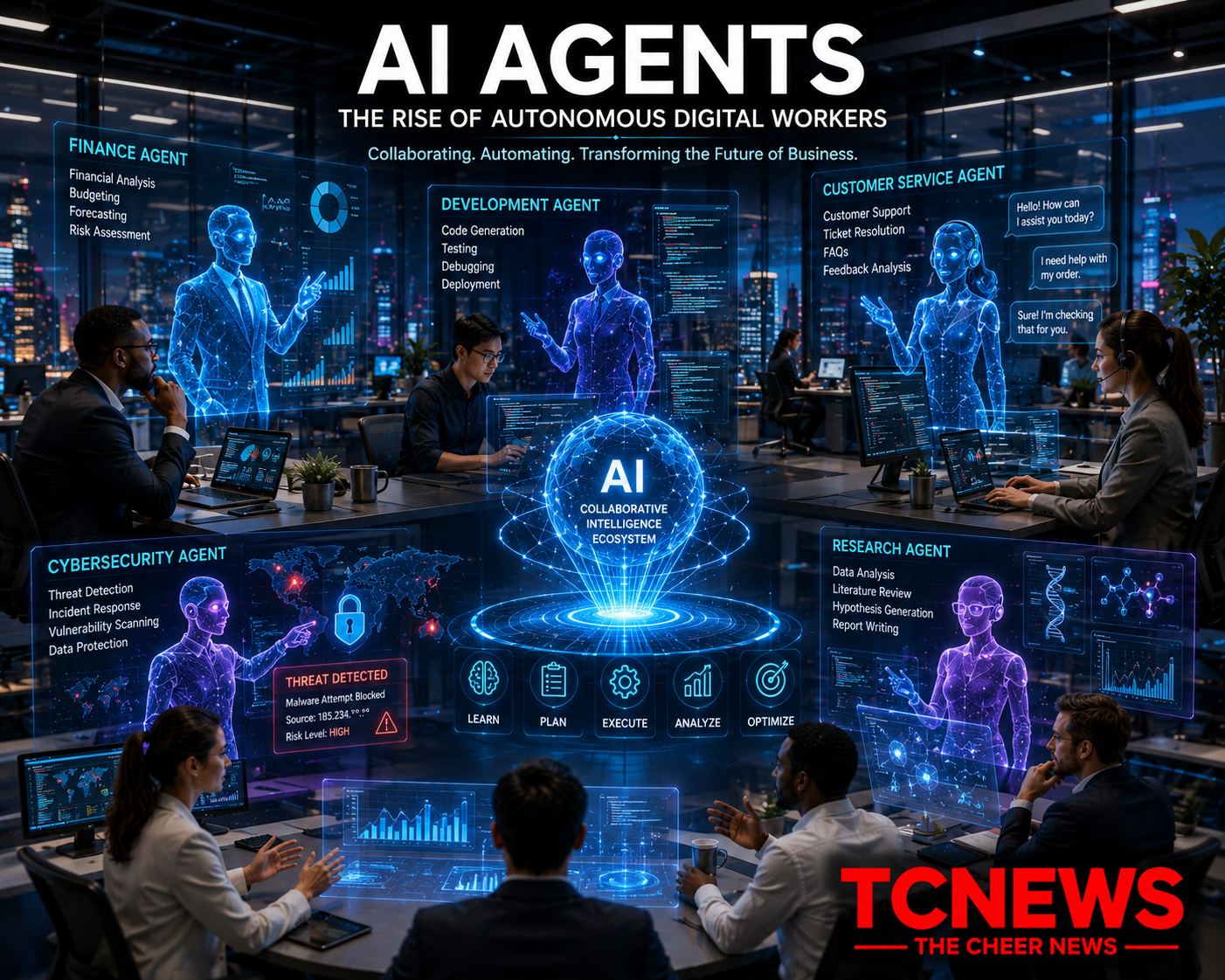
These systems, known as AI agents, are rapidly becoming one of the most significant developments in artificial intelligence. Unlike traditional chatbots that wait for prompts, artificial intelligence agents can plan, reason, make decisions, use software tools, collaborate with other AI systems, and complete complex workflows autonomously.
Technology companies around the world are investing billions of dollars in artificial intelligence agents because many experts believe they represent the next major leap after generative AI. Businesses are already deploying artificial intelligence agents to handle customer service, software development, cybersecurity, marketing, finance, logistics, and research.
As organizations race to improve productivity and reduce operational costs, artificial intelligence agents could redefine how work is performed across virtually every industry.
What Are AI Agents?
AI agents are software systems powered by advanced artificial intelligence that can perform tasks with varying degrees of autonomy.
Unlike traditional AI assistants that primarily respond to user questions, AI agents can:
- Understand goals.
- Develop action plans.
- Use external software tools.
- Access databases.
- Analyze information.
- Make decisions within defined limits.
- Complete multi-step tasks.
- Learn from feedback.
Rather than asking users what to do next after every step, artificial intelligence agents can independently determine the sequence of actions needed to achieve a goal.
How AI Agents Work
Artificial intelligence agents combine several technologies, including:
Large Language Models
Advanced language models provide reasoning, planning, and communication capabilities.
Memory
Agents remember previous interactions, allowing them to maintain context across long projects.
Tool Integration
Modern Artificial Intelligence agents can interact with:
- Calendars
- Databases
- Business software
- Cloud storage
- Customer relationship management (CRM) platforms
- Coding environments
Decision-Making
Instead of simply generating text, artificial intelligence agents evaluate options and select appropriate actions based on objectives and available information.
AI Agents vs Traditional Chatbots
Although both use artificial intelligence, important differences exist.
Traditional Chatbots
- Answer questions
- Generate text
- Require continuous user prompts
- Limited autonomy
AI Agents
- Complete complex workflows
- Make intermediate decisions
- Coordinate multiple tools
- Operate with greater independence
- Execute long-running tasks
This shift transforms AI from an information provider into a digital coworker.
Business Applications
Customer Service
AI agents can:
- Answer customer inquiries.
- Resolve routine issues.
- Escalate complex cases.
- Process refunds.
- Schedule appointments.
This improves response times while allowing human representatives to focus on more complex interactions.
Software Development
Development teams increasingly use artificial intelligence agents to:
- Write code.
- Test software.
- Identify bugs.
- Generate documentation.
- Review pull requests.
Rather than assisting with isolated coding tasks, artificial intelligence agents can contribute throughout the software development lifecycle.
Marketing
Marketing departments use AI agents to:
- Plan campaigns.
- Analyze customer behavior.
- Generate content.
- Optimize advertising.
- Monitor performance.
This enables faster execution and data-driven decision-making.
Finance
Financial institutions deploy artificial intelligence agents for:
- Fraud monitoring.
- Risk assessment.
- Regulatory compliance.
- Financial reporting.
- Customer support.
Healthcare
Healthcare organizations are exploring AI agents to:
- Assist with administrative workflows.
- Schedule patients.
- Summarize clinical notes.
- Support medical research.
- Coordinate care management.
Human healthcare professionals remain responsible for diagnosis and treatment decisions.
AI Agents in Scientific Research
Researchers increasingly use Artificial Intelligence agents to:
- Review scientific literature.
- Organize research findings.
- Generate hypotheses.
- Analyze experimental data.
- Assist with documentation.
These capabilities help scientists focus more on innovation and critical analysis.
Recent Developments
Technology companies are rapidly introducing AI agents capable of completing increasingly sophisticated tasks across enterprise environments. Organizations are integrating these systems into customer service, software engineering, cybersecurity, finance, and research workflows.
The focus has shifted from simple conversational AI toward autonomous systems that can reason, plan, and coordinate multiple digital tools while operating under human oversight.
https://crediblenews.com.ng/ai-powered-search-is-google-losing-its-domina/
Benefits of AI Agents
Increased Productivity
Routine tasks can be completed faster.
Lower Operational Costs
Automation reduces repetitive manual work.
Faster Decision Support
AI agents analyze large datasets quickly.
Continuous Operation
Unlike humans, AI agents can operate around the clock.
Improved Customer Experience
Businesses can provide faster and more consistent support.
Risks and Challenges
Human Oversight
Autonomous systems still require supervision, especially in high-stakes industries.
Data Privacy
AI agents often access sensitive business information, making strong security controls essential.
Accuracy
Errors can occur if agents receive incomplete or inaccurate information.
Ethical Governance
Organizations must define clear rules governing how AI agents make decisions.
Workforce Transformation
AI agents are expected to automate some routine tasks while creating demand for new skills in AI management, oversight, and digital strategy.
Expert Perspectives
Industry experts increasingly view AI agents as the next major evolution in artificial intelligence. Rather than replacing entire professions, these systems are expected to automate repetitive processes, augment human capabilities, and enable employees to focus on higher-value work requiring creativity, judgment, and interpersonal skills.
https://crediblenews.com.ng/top-20-ai-tools-every-professional-should-use-in-2026/
Experts also emphasize that successful adoption depends on transparency, accountability, security, and maintaining meaningful human oversight.
Future Outlook
Over the coming years, AI agents are expected to become more capable, collaborative, and specialized. Businesses may deploy teams of Artificial Intelligence agents working together across departments, handling everything from customer support and procurement to financial analysis and software development.
As regulations and governance frameworks mature, artificial intelligence agents could become standard digital coworkers, fundamentally changing how organizations operate.
Why This Matters
AI agents represent a shift from AI that simply answers questions to AI that actively performs work. This evolution has the potential to increase productivity, accelerate innovation, and transform industries worldwide. Organizations that understand how to deploy AI agents responsibly may gain significant competitive advantages while ensuring that human expertise remains central to decision-making.
Frequently Asked Questions (FAQs)
What is an AI agent?
An AI agent is an autonomous software system that can plan, reason, use digital tools, and complete tasks with limited human intervention.
How are AI agents different from chatbots?
Chatbots primarily respond to prompts, while Artificial Intelligence agents can execute multi-step workflows, make decisions within defined limits, and use external software tools.
Will AI agents replace human workers?
AI agents are expected to automate many repetitive tasks, but human oversight, creativity, ethics, and strategic decision-making will remain essential.
Which industries will benefit most?
Customer service, finance, healthcare, manufacturing, software development, logistics, education, and scientific research are among the sectors likely to see significant benefits.
Are AI agents safe?
When implemented with proper governance, security, and human supervision, Artificial Intelligence agents can improve efficiency. However, organizations must address privacy, cybersecurity, and ethical considerations. Artificial Intelligence
Conclusion
AI agents are rapidly emerging as one of the most transformative developments in artificial intelligence. By combining reasoning, planning, memory, and tool integration, these autonomous systems are moving beyond simple conversations to complete meaningful work across industries.
While challenges surrounding governance, security, and workforce transformation remain, artificial intelligence agents have the potential to redefine productivity and collaboration. Businesses that embrace this technology responsibly will be better positioned to innovate, compete, and thrive in an increasingly AI-driven economy.
Hashtags
#AIAgents #ArtificialIntelligence #Automation #DigitalWorkers #FutureOfWork #EnterpriseAI #BusinessTechnology #Innovation #Productivity #Technology #TheCheerNews