By DAYO ADESULU
How AI in Cybersecurity Is Reshaping and Fighting Digital Crime
Cybercrime has become one of the fastest-growing threats to governments, businesses, and individuals worldwide. From ransomware attacks and data breaches to phishing scams and identity theft, digital criminals are becoming more sophisticated—and more relentless.
Fortunately, cybersecurity is also evolving. Artificial intelligence (AI) has emerged as one of the most powerful weapons in the fight against cybercrime, enabling organizations to detect threats faster, respond more effectively, and strengthen digital defenses.
Unlike traditional cybersecurity tools that rely heavily on predefined rules, AI systems can analyze enormous volumes of data in real time, recognize unusual patterns, and identify previously unknown threats. This capability is transforming how organizations protect their networks, financial systems, healthcare records, and critical infrastructure.
However, AI is also being used by cybercriminals to launch more convincing and automated attacks. As a result, cybersecurity has entered a new era—one in which both defenders and attackers are harnessing artificial intelligence.
Why Cybersecurity Needs Artificial Intelligence
Every day, organizations generate massive amounts of digital data, including emails, financial transactions, login attempts, cloud activity, and network traffic.
Human analysts cannot manually review all this information fast enough.
AI addresses this challenge by:
- Monitoring millions of events simultaneously.
- Detecting suspicious behavior.
- Identifying hidden attack patterns.
- Predicting potential threats.
- Automating security responses.
This allows security teams to focus on the most critical incidents rather than routine monitoring. https://crediblenews.com.ng/quantum-computing-and-artificial-intelligence-the-next-technology-revolution/
How AI Detects Cyber Threats
Behavioral Analysis
Instead of relying only on known attack signatures, AI studies normal user and system behavior.
When unusual activity occurs—such as an employee logging in from an unfamiliar location or downloading unusually large amounts of data—AI can immediately flag the behavior for investigation.
Machine Learning
Machine learning enables cybersecurity systems to improve continuously by learning from new attacks.
As cybercriminals develop new tactics, AI models adapt and recognize emerging threats more quickly than traditional rule-based systems.
Real-Time Threat Detection
Speed is essential during cyberattacks.
AI in cybersecurity can analyze network activity within seconds and detect threats before significant damage occurs.
AI Against Phishing Attacks
Phishing remains one of the most common forms of cybercrime.
Modern AI systems can:
- Detect fraudulent emails.
- Identify suspicious websites.
- Analyze unusual communication patterns.
- Warn users before they click malicious links.
As attackers use AI to generate increasingly convincing phishing messages, defensive AI is becoming even more important.
Fighting Ransomware
Ransomware attacks can cripple hospitals, schools, businesses, and government agencies.
AI in cybersecurity helps organizations by:
- Detecting unusual file encryption.
- Monitoring abnormal system behavior.
- Isolating infected devices.
- Automatically initiating incident response procedures.
Early detection can significantly reduce financial losses.
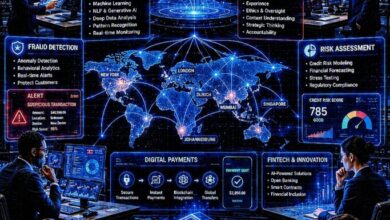
AI in Cybersecurity and Fraud Detection
Financial institutions process millions of transactions every day.
AI analyzes transaction patterns to identify:
- Credit card fraud.
- Money laundering.
- Identity theft.
- Account takeovers.
- Suspicious financial activity.
This enables banks to stop fraudulent transactions before they are completed.
Securing Cloud Computing
As organizations move more data to the cloud, AI has become essential for cloud security.
AI in cybersecurity systems monitor:
- User access.
- Configuration changes.
- Data transfers.
- Application activity.
- Authentication attempts.
This continuous monitoring helps reduce security risks in increasingly complex cloud environments.
AI in National Cyber Defense
Governments are investing heavily in AI-powered cybersecurity to protect:
- Military systems.
- Critical infrastructure.
- Energy grids.
- Transportation networks.
- Financial institutions.
- Public services.
AI enables faster threat intelligence analysis and coordinated responses to sophisticated cyber threats.
Recent Developments
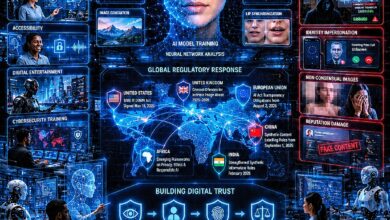
Organizations worldwide are increasingly deploying AI-powered security platforms capable of detecting advanced threats, automating incident response, and improving vulnerability management. At the same time, cybercriminals are using generative AI to craft more convincing phishing campaigns, automate malware development, and identify potential vulnerabilities.
These developments have intensified the global focus on responsible AI deployment, cybersecurity resilience, and international cooperation to combat digital crime.
Benefits of AI in Cybersecurity
Faster Threat Detection
AI identifies attacks within seconds rather than hours.
Reduced Human Workload
Automation allows cybersecurity professionals to focus on complex investigations.
Continuous Monitoring
AI protects systems around the clock without interruption.
Better Accuracy
Machine learning improves threat detection by identifying subtle attack patterns.
Improved Incident Response
Automated responses reduce the impact of cyberattacks.
Risks and Challenges
AI-Powered Cybercrime
Criminals are increasingly using AI to automate attacks and create convincing phishing content.
Privacy Concerns
Security systems must protect sensitive user information while monitoring digital activity.
False Positives
AI in cybersecurity can occasionally flag legitimate behavior as suspicious, requiring human verification.
Skills Shortage
Demand for cybersecurity and AI professionals continues to outpace supply.
Ethical Considerations
Organizations must ensure AI security tools operate transparently and fairly.
Expert Perspectives
Cybersecurity experts widely agree that AI is becoming an essential component of modern digital defense. Rather than replacing human analysts, AI enhances their capabilities by processing vast amounts of data, identifying threats more quickly, and automating repetitive tasks. Experts also stress that human oversight remains critical for investigating complex incidents and making strategic security decisions.
Future Outlook
The future of cybersecurity will likely involve even greater integration of AI into security operations. Emerging systems are expected to predict attacks before they occur, automate complex investigations, and coordinate responses across cloud environments, connected devices, and critical infrastructure.
As cyber threats continue to evolve, organizations that combine AI with skilled cybersecurity professionals and robust governance will be better positioned to protect their digital assets.
Why This Matters
AI in cybersecurity affects everyone—from individuals using smartphones to multinational corporations managing global operations. Artificial intelligence offers powerful new defenses against digital crime, but it also introduces new challenges as attackers adopt the same technology. Understanding both sides of this AI arms race is essential for building a safer digital future.
Frequently Asked Questions (FAQs)
What is AI in cybersecurity?
AI in cybersecurity refers to the use of artificial intelligence to detect, analyze, prevent, and respond to cyber threats.
Can AI stop cyberattacks completely?
No. AI significantly improves cybersecurity but cannot eliminate all threats. Human expertise and strong security practices remain essential.
How does AI in cybersecurity detect hackers?
AI analyzes user behavior, network traffic, and system activity to identify unusual patterns that may indicate malicious activity.
Do hackers use AI too?
Yes. Cybercriminals increasingly use AI to automate attacks, create phishing campaigns, and identify vulnerabilities, making defensive AI even more important.
Which industries benefit most?
Financial services, healthcare, government, manufacturing, telecommunications, retail, and cloud service providers all benefit from AI-powered cybersecurity.
Conclusion
Artificial intelligence is transforming cybersecurity by enabling faster threat detection, stronger fraud prevention, smarter cloud protection, and more efficient incident response. As cybercriminals continue to adopt AI, organizations must invest in equally advanced defensive technologies and skilled professionals.
The future of AI in cybersecurity will not depend on AI alone. Success will come from combining intelligent automation with human expertise, ethical governance, and continuous innovation to stay ahead of an ever-changing threat landscape.
Hashtags
#Cybersecurity #ArtificialIntelligence #AI #DigitalSecurity #CyberDefense #MachineLearning #Ransomware #CloudSecurity #Technology #Innovation #TheCheerNews