Artificial intelligence has already transformed industries by enabling machines to analyze data, automate tasks, and assist in complex decision-making. Yet many experts believe AI’s true potential will only be unlocked when it joins forces with another groundbreaking technology—quantum computing.
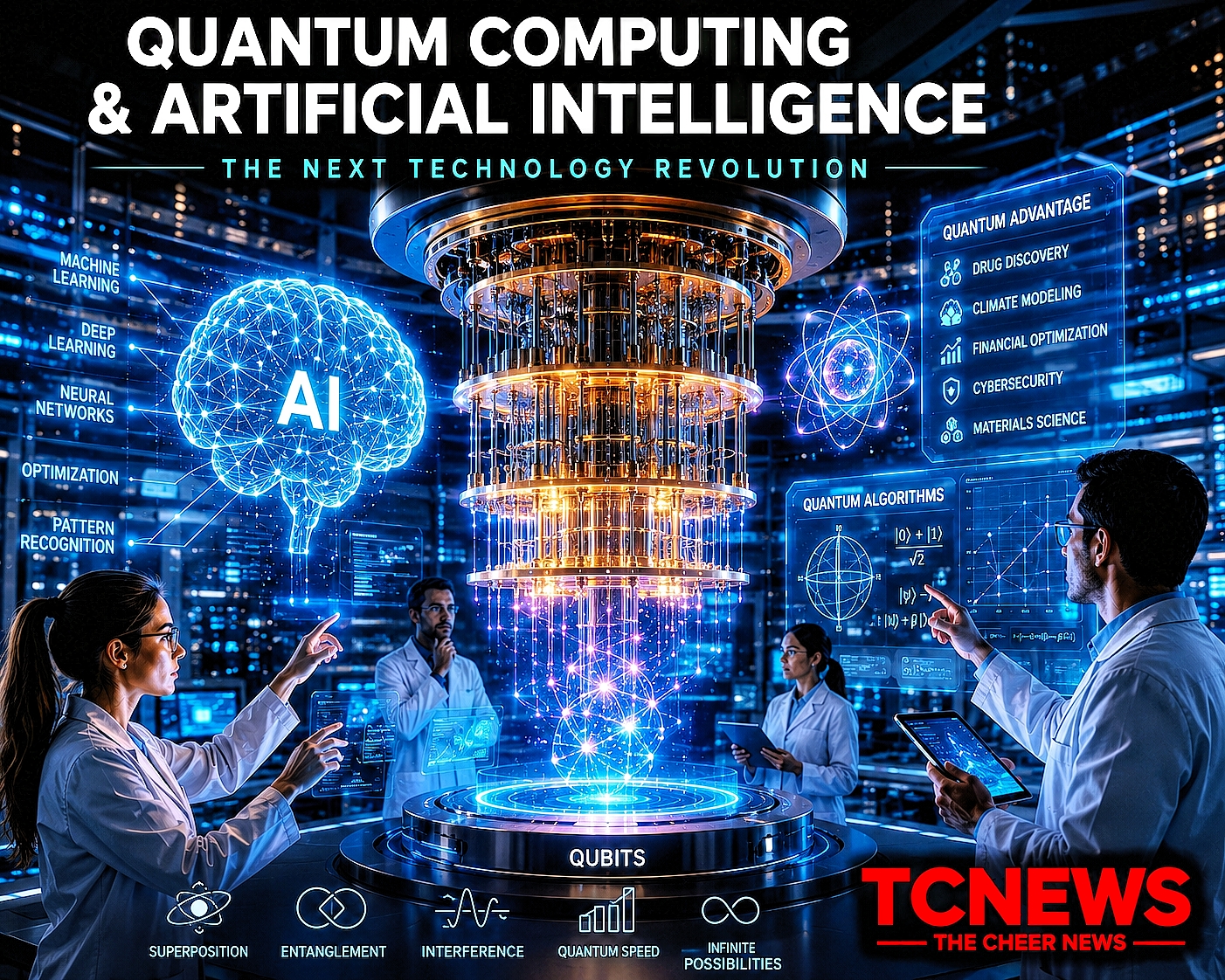
While today’s most advanced supercomputers process information using classical bits that represent either a 0 or a 1, quantum computers use quantum bits (qubits) that can exist in multiple states simultaneously. This unique capability enables quantum computers to solve certain complex problems exponentially faster than traditional machines.
When combined with artificial intelligence, quantum computing could revolutionize drug discovery, climate modeling, cybersecurity, finance, manufacturing, and scientific research. Governments and technology companies worldwide are investing billions of dollars in quantum technologies, viewing them as the next frontier in global innovation.
Although practical quantum AI is still in its early stages, its long-term potential is so significant that researchers are calling it the next technological revolution.
What Is Quantum Computing?
Quantum computing is a new approach to computation based on the principles of quantum mechanics—the branch of physics that studies matter and energy at the smallest scales.
Unlike traditional computers that process one calculation at a time using binary bits, quantum computers use qubits, allowing them to evaluate many possibilities simultaneously.
Two key concepts define quantum computing:
Superposition
A qubit can represent multiple values at once rather than being limited to either 0 or 1.
Entanglement
Qubits can become interconnected in ways that allow them to work together efficiently, even across complex calculations.
These properties make quantum computers particularly powerful for solving optimization and simulation problems.
https://crediblenews.com.ng/top-20-ai-tools-every-professional-should-use-in-2026/
Why AI Needs Quantum Computing
Modern AI systems require enormous computational resources.
Training advanced AI models often involves processing trillions of calculations using vast amounts of data. As AI models become larger and more sophisticated, computing demands continue to grow.
Quantum computing could help AI by:
- Accelerating machine learning.
- Solving optimization problems.
- Improving pattern recognition.
- Speeding up scientific simulations.
- Reducing training time for complex models.
Rather than replacing today’s AI infrastructure, quantum computers are expected to complement classical computing systems.
Industries That Could Benefit
Healthcare
Quantum AI may dramatically accelerate drug discovery by simulating molecular interactions with unprecedented precision.
Researchers believe this could shorten the development timeline for new medicines and personalized treatments.
Potential Applications
- Cancer research
- Vaccine development
- Protein modeling
- Precision medicine
- Genetic analysis
Financial Services
Banks and investment firms constantly solve complex optimization problems.
Quantum-enhanced AI could improve:
- Portfolio optimization
- Fraud detection
- Risk analysis
- Market forecasting
- Financial modeling
Climate Science
Climate models require processing enormous datasets.
Quantum AI could improve:
- Weather forecasting
- Carbon emission modeling
- Renewable energy optimization
- Disaster prediction
Manufacturing
Manufacturers could use quantum AI to optimize:
- Supply chains
- Production scheduling
- Factory automation
- Material discovery
- Logistics
Cybersecurity
Quantum computing presents both opportunities and challenges.
It may strengthen cybersecurity through advanced encryption while also posing risks to some current cryptographic systems. Researchers worldwide are developing quantum-resistant encryption to prepare for this future.
Global Investment in Quantum AI
Governments and private companies are investing heavily in quantum technologies.
Major investments are coming from:
- United States
- China
- European Union
- United Kingdom
- Canada
- Japan
- South Korea
Leading technology companies are also expanding quantum research, recognizing its long-term strategic importance.
Recent Developments
The global race to develop practical quantum computers has intensified. Researchers continue to improve qubit stability, error correction, and quantum hardware performance while exploring ways to integrate quantum computing with AI-driven scientific research and industrial applications.
Cloud-based quantum platforms are also making experimental quantum computing more accessible to universities, startups, and businesses, allowing developers to begin exploring quantum algorithms without owning specialized hardware.
Benefits of Quantum AI
Faster Scientific Discovery
Researchers could solve complex scientific problems far more quickly.
Better Healthcare
Drug discovery and disease research may accelerate significantly.
Smarter AI
AI systems could become more efficient and capable of tackling problems beyond the reach of classical computing.
Economic Growth
Quantum technologies could create new industries, jobs, and business opportunities.
Environmental Solutions
Quantum AI may help optimize energy systems and improve climate research.
Challenges and Risks
Despite its promise, quantum AI faces significant hurdles.
Technical Complexity
Building stable, large-scale quantum computers remains extremely difficult.
High Costs
Quantum research requires substantial investment in specialized infrastructure and expertise.
Cybersecurity Concerns
Powerful quantum computers could eventually challenge existing encryption methods, making the transition to quantum-resistant security essential.
Skills Gap
The demand for experts in quantum computing, AI, and quantum algorithms currently exceeds supply.
Expert Perspectives
Scientists generally agree that quantum computing will complement rather than replace classical computing. Experts believe the greatest breakthroughs will come from hybrid systems that combine traditional computing, artificial intelligence, and quantum processing to solve problems that are currently beyond reach.
Many researchers also emphasize that meaningful commercial applications will require continued advances in hardware, software, and error correction.
Future Outlook
Over the next decade, quantum computing is expected to move from research laboratories into more real-world applications. As hardware improves and quantum algorithms mature, AI could benefit from faster optimization, more accurate simulations, and breakthroughs in fields ranging from medicine to materials science.
While widespread adoption may still take years, the convergence of AI and quantum computing is widely regarded as one of the most promising frontiers in technology.
Why This Matters
Quantum computing and artificial intelligence together have the potential to redefine scientific discovery, healthcare, finance, cybersecurity, and environmental research. Although the technology is still emerging, organizations that invest in understanding quantum AI today may be better positioned to lead tomorrow’s innovation economy.
Frequently Asked Questions (FAQs)
What is quantum computing?
Quantum computing is a form of computing that uses qubits and the principles of quantum mechanics to solve certain complex problems more efficiently than traditional computers.
How does quantum computing improve AI?
Quantum computing could accelerate AI training, improve optimization, and enable more advanced simulations for scientific and industrial applications.
Will quantum computers replace today’s computers?
No. Quantum computers are expected to complement classical computers, with each being suited to different types of tasks.
Is quantum AI available today?
Research and limited commercial applications are underway, but large-scale practical quantum AI remains in development.
Which industries will benefit most?
Healthcare, finance, cybersecurity, manufacturing, logistics, energy, and scientific research are among the sectors expected to benefit significantly.
Conclusion
The convergence of quantum computing and artificial intelligence represents one of the most exciting technological developments of the 21st century. While practical quantum AI is still evolving, its potential to accelerate scientific discovery, transform industries, and solve previously intractable problems is attracting unprecedented global investment.
The journey toward quantum-powered AI will require patience, innovation, and collaboration. However, as research continues to advance, this powerful combination could become the foundation of the next great technological revolution.
Hashtags
#QuantumComputing #ArtificialIntelligence #QuantumAI #Technology #Innovation #MachineLearning #FutureTech #Cybersecurity #ScientificResearch #DigitalTransformation #TheCheerNews